
As spring bird migration comes to an end, I feel a hint of melancholy. The season’s excitement, anticipation and daily discoveries give way to quieter days. Still, this year’s migration left me with a set of experiences and memories that will linger long after the last migrants have passed through to their northern breeding grounds.
Many of my migration adventures come through field trips organized by the Natural Resources Foundation of Wisconsin. This year, they offered 280 educational excursions across the state, all aimed at supporting conservation, connecting people with nature, and promoting stewardship.
My migration season began at Wyalusing State Park in Wisconsin’s southwest corner. I had never visited before and was hoping to see a Kentucky warbler, one of the state’s most sought-after “forest phantom” warblers known to breed there.
Like most birding trips, the day began early, when birds are most active. The forest was filled with song as males sang vigorously to establish territories and attract mates. There was more going on than just singing.
Throughout the morning, males of various species pursued females through the trees in aerial chases resembling fighter jets weaving and diving through the canopy. Females darted and maneuvered to evade their suitors while determined males followed closely behind. Watching this seasonal drama unfold was every bit as fascinating as spotting the birds themselves.
As our group explored the park, we walked along Sentinel Ridge overlooking the confluence of the Wisconsin and Mississippi rivers. There we learned about the Native American mounds that overlook the valley and the area’s connection to one of North America’s greatest conservation tragedies: the extinction of the passenger pigeon.
The ridge once lay along a migration corridor traveled by immense flocks of passenger pigeons. Once numbering in the billions, the species vanished in the early 20th century, the last dying in captivity in 1914. A monument overlooking the river honors the species and serves as a reminder of what can happen when wildlife is taken for granted.
Although the Kentucky warbler never appeared, the trip still delivered highlights. A striking cerulean warbler descended from the tree tops for close views, and a black-billed cuckoo posed with a worm dangling from its beak. Baltimore orioles seemed to be flitting everywhere. It was as if a clown hidden in the canopy was juggling oranges between the branches.
The next NRF trip took me to Door County, where favorable winds had concentrated migrating warblers. Our group recorded 19 species including a Canada warbler hopping between shrubs so fast I couldn’t keep up, a Nashville warbler foraging among catkins, and a black-throated green warbler whose buzzy song helped us track him down.
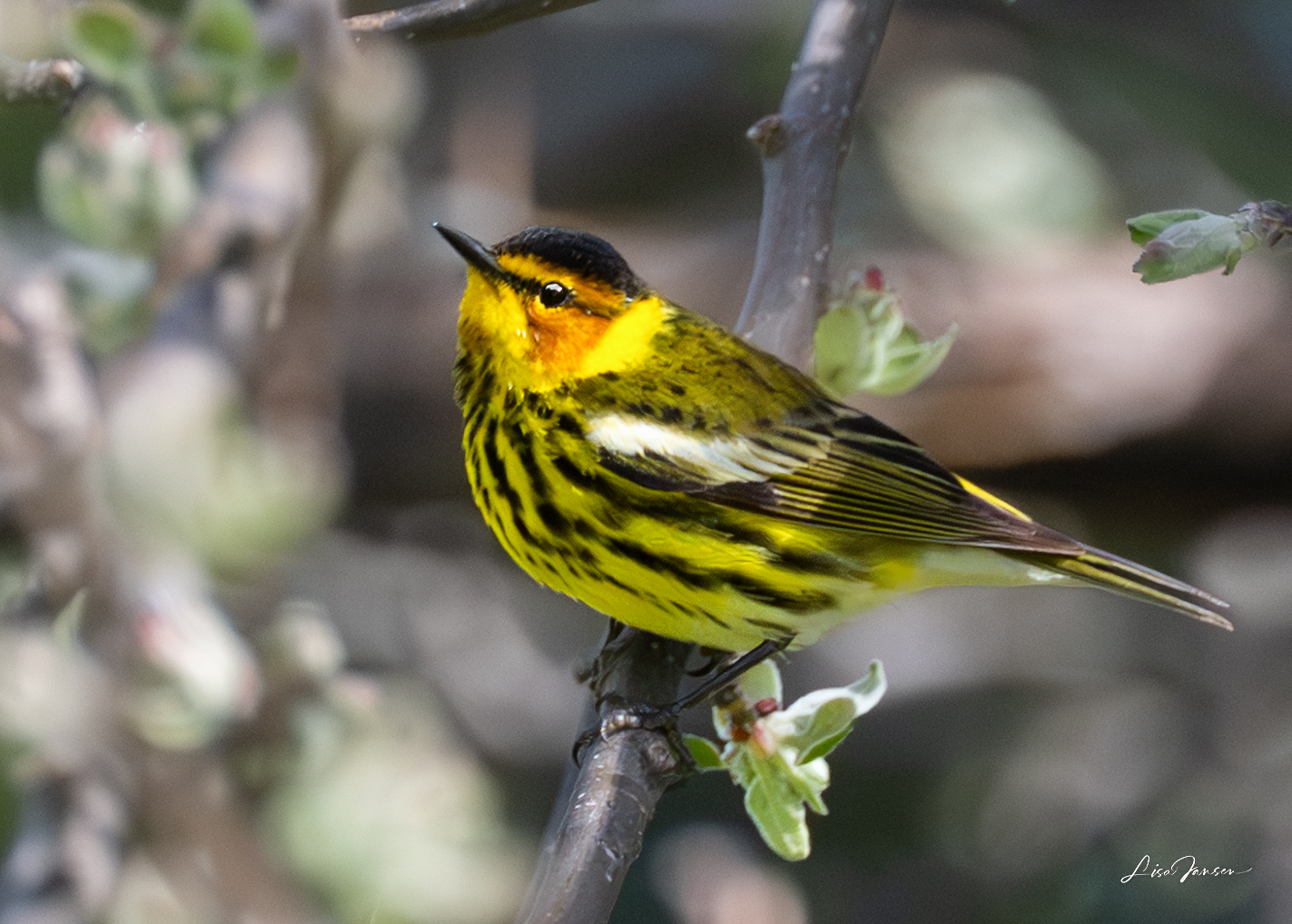
The only warbler with a tubular tongue, a striking Cape May warbler was sipping nectar from flowering buds. Alexander Wilson first observed the species in Cape May, New Jersey, giving it its name, though it was not seen there again for more than 100 years.
American redstarts appeared to be singing everywhere, fitting for a species whose males may hold multiple territories. We also were ecstatic to see a Blackburnian warbler unusually low in the canopy, its flame-orange throat flashing in the spring light. Did you know they are the only warbler in North America with an orange throat?
On the drive home, I stopped at Ken Euer’s Nature Area in Green Bay, where birds were fully engaged in the business of spring — establishing territories, attracting mates, building nests, and a couple of tree swallows in the process of, well, filling those nests.
Wilson’s phalaropes swam in tight circles while northern waterthrush patrolled the shoreline. Nearby, short-billed dowitchers rapidly probed the shallows for food, sometimes plunging their entire heads underwater. The entire landscape buzzed with activity.
My final NRF trip took me to Wisconsin Point, the narrow sandspit between Superior and Duluth. There, birders can scan Lake Superior for waterbirds, search mudflats for shorebirds and explore nearby woods for songbirds, all within a relatively small area.
While seeing a great crested flycatcher up close and an American bittern in the open were memorable, the true highlight was learning from our guide. His unique and creative lessons on bird identification while they are flying, swimming, and at rest, were both entertaining and unforgettable, leaving me a better birder and deeply appreciative of the experience.
As spring migration winds down, I feel both gratitude and a touch of wistfulness. The season offers a chance to witness nature’s most remarkable spectacles and, briefly, to feel part of them.
The passenger pigeon remains a sobering reminder of how quickly abundance can vanish when stewardship is neglected. By learning from the past and supporting conservation efforts today, we can help ensure future generations continue to experience the wonder of spring migration for years to come.
Lisa Jansen is a Wisconsin master naturalist, nature writer, and award-winning photographer. She specializes in raising awareness of birds and butterflies of the Midwest.


