
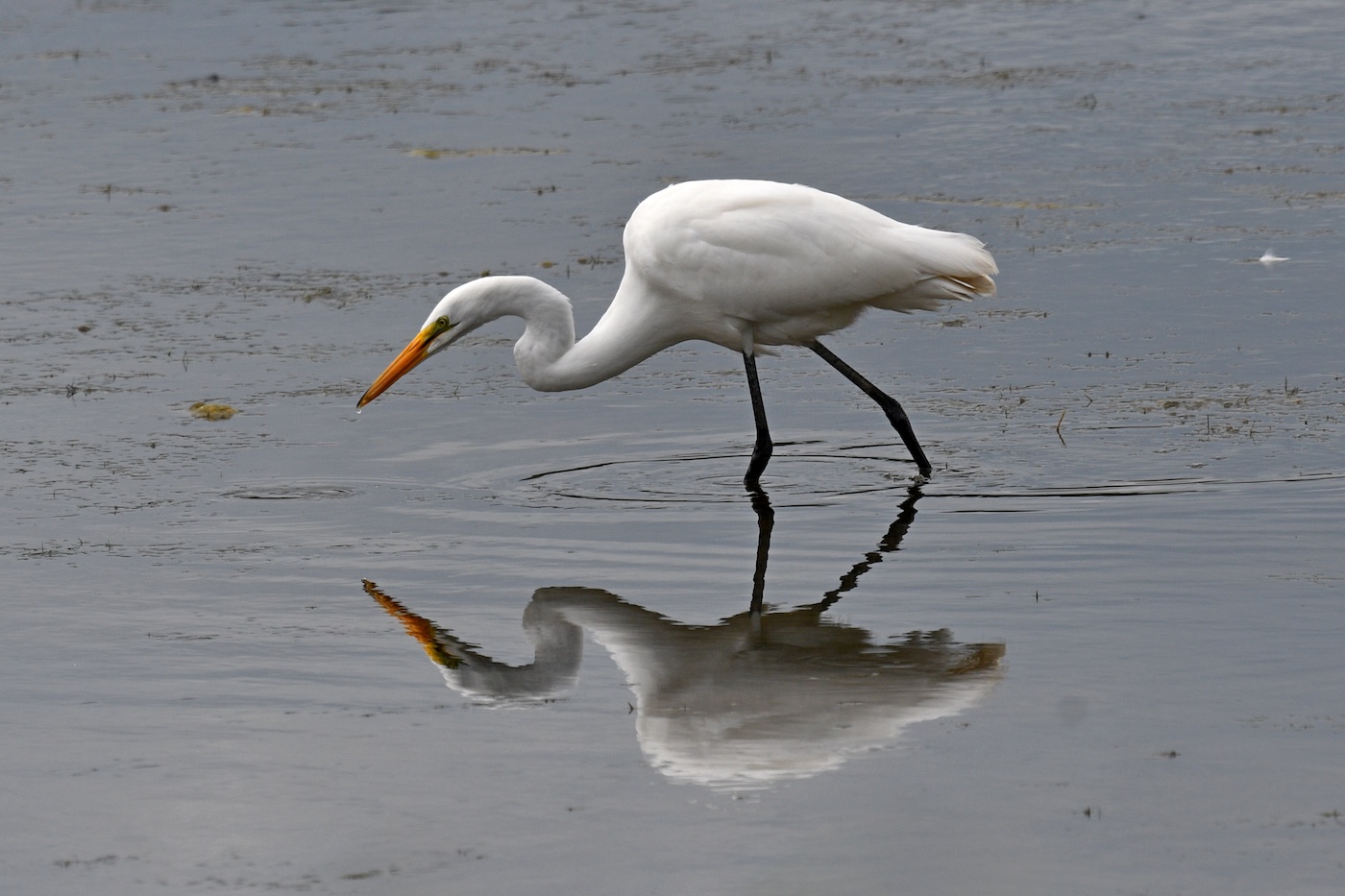
We recently enjoyed a birding trip to the southeast United States that rewarded us with sightings of many bird species not seen in Wisconsin. These included the wood stork, roseate spoonbill, yellow-crowned night heron and brown pelican among others. It also allowed us to see many more egrets than we’d see here in northeast Wisconsin.
It was the great egret that caught most of our attention. The great egret is the largest and most common of the three egret species that occur in Wisconsin. They stand a little over 3 feet tall on lengthy black stilt-like legs, their height enhanced by a long, graceful neck. A heavy yellow bill and piercing eyes completes their profile.
Great egrets speak to me of the beauty of flight. With up to a 5 1/2-foot wingspan and bright white plumage, neck tucked back and long trailing legs, they seem to soar effortlessly through the air. According to the Cornell Lab All About Birds (AAB) website, great egrets fly slowly but powerfully. With just two wingbeats per second, they cruise at about 25 mph.
Egrets are wading birds often seen standing very still along the edges of waterways such as lakes, marshes and impoundments. Patience and stealth are their hallmark traits when hunting for prey. Their long dagger-like bills bring home small fish, amphibians, reptiles, birds, small mammals and invertebrates such as crayfish and dragonflies.
Breeding birds of both sexes are especially beautiful. They grow long delicate white plumes (known as aigrettes) on their backs early in the breeding season, which they raise during courtship displays giving them a regal look. They also sport a vivid green patch of skin on the face just above the bill.
Great egrets are colonial nesting birds, nesting together in trees and shrubs alongside waterways. The nesting site we saw in the south was a busy and noisy place. These large white birds, scattered throughout the trees were preening, roosting or in courtship display. Their dazzling white forms, many with feathery plumes elegantly raised, decorated the foliage like bright ornaments on Christmas trees. The air was alive with their croaking calls.
Like the bird, the great egret’s nest is large. According to AAB, it can be up to 3 feet in diameter and a foot deep. The birds line it with pliable plant materials forming it into a cup shape. The female lays one to six eggs and can raise two broods of chicks a year.
Hatchlings come into the world well developed having long white down on their backs and eyes open, but not all of the nestlings survive. Large chicks may compete with their smaller siblings, frequently killing them. This behavior, known as siblicide, often occurs as a result of poor breeding conditions. Young that do survive fledge (leave the nest) in about four weeks.
Unfortunately, the beauty of egrets cost them their lives in the past. Great egrets were hunted for their long white plumes that were used to decorate hats. This almost decimated their population by 1900. According to AAB, plume hunting was mostly banned by 1910, and the population started to recover. According to the North American Breeding Bird Survey, from 1966 to 2019, the population has been increasing by about 1.5% a year across most of the species’ range and now appears stable.
The great egret is the symbol of the National Audubon Society. One of the oldest environmental organizations in North America, it was founded to protect birds from being killed for their feathers. We owe a great debt to organizations like Audubon that strive to save not only the egrets but so many of our bird species whose populations are spiraling downwards. Consider supporting Audubon or another conservation group to help save birds.
The two other species of egrets that are also seen in Wisconsin, but not as frequently as the great egret are the snowy and cattle egrets. They are mostly white and smaller than the great egret.
Distinguishing features of the snowy egret are its long black bill and legs, and very bright yellow feet. Always look at the feet to identify this species.
The cattle egret is the smallest of the three egrets and is more compact and chunkier in appearance. When perching it draws its neck in giving it a hunched look. In the breeding season, it shows patches of yellow orange feathers on the head, breast and back. This species is seen near waterways and also in open fields hunting for larger insects like grasshoppers.
Like the egrets, practice patience and stealth when searching for them. Look along the edges of waterways and marshes for these species, and in fields for the cattle egret. Hopefully you will have the pleasure of watching one as it expertly stalks its prey or takes beautifully to the air. Once seen, these elegant birds are not easily forgotten.
Cathy Carnes is a retired biologist in Oconto who worked with the U.S. Fish and Wildlife Service Green Bay Field Office and prior to that with the U.S. Army Corps of Engineers Regulatory Branch in Buffalo, New York. As endangered species coordinator for the USFWS, she helped conserve and recover federally listed threatened and endangered species in Wisconsin.


