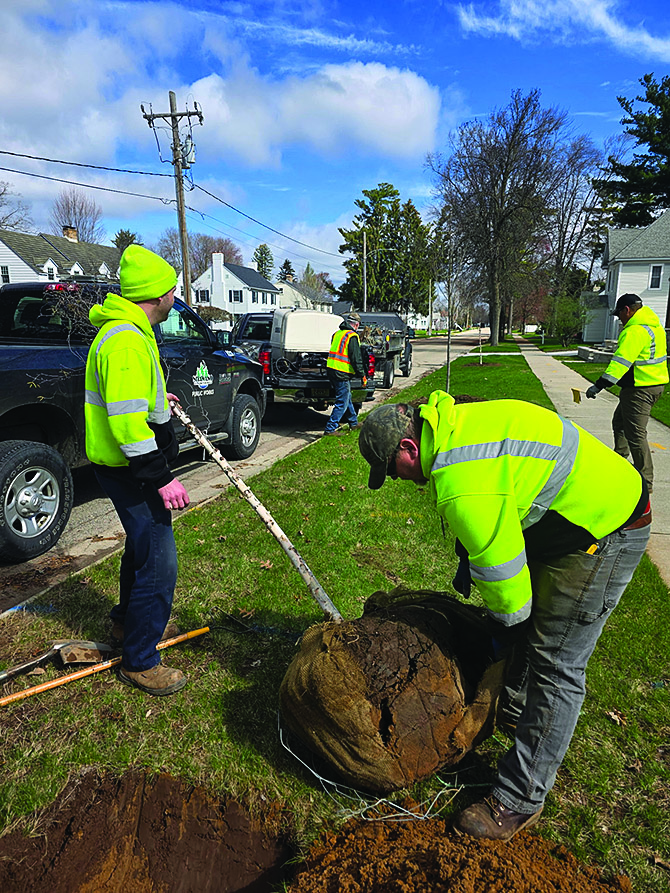
The city of Shawano has been making efforts to restore trees lost to disease and invasive species over the last few years using hybridized species and multiple different species in local parks and along local streets.
“What we’re trying to do is bring back the trees we’ve lost over time,” said Mike Kroenke, city forester. “Hybrid elms are mostly hybridized with American elms. They’re resistant, but they’ve also tried to find strains of elm that are native that made it through and that’s what they use for propagation.”
The city first planted some new horizon elm trees at Franklin Park in 2015, according to Kroenke, planting them near the amphitheater. When Shawano engages in any street reconstruction, the city tries to plant elm trees along some of the bigger boulevards, he said.
Other tree species are being planted that are less likely to be impacted by climate change, according to Kroenke. He said the Wisconsin Department of Natural Resources, through regional forest coordinator Patricia Lindquist, has been working with small and mid-sized communities throughout the state on making sure there are trees that can last well into the future.
“There’s a whole list of about 20 or 30 different trees, and we’re planting those all over,” Kroenke said. “We have 25 parks, and 10 years ago we started at Franklin Park.”
White pines are one of those the city wants to plant, and as other trees are removed, Kroenke looks at whether the pines can go there. He noted that they grow tall quickly, so it’s important to plant them where other trees or infrastructure are not at risk of being damaged.
Lindquist noted it’s important to plant a lot of different species together so that, when something affects the health of one species, whole areas don’t die out.
“We do this so, when something like the emerald ash borer or Dutch elm disease comes through, it doesn’t wipe out lots of trees all at one,” Lindquist said. “It makes the urban forest more resilient. This is wonderful that there are so many different species here (in Shawano).”
The DNR, in league with the U.S. Forest Service, has been researching various methods to keep trees in communities, and Kroenke said the city has been looking at that information when it works on expansion and restoration areas.
“We’re losing so many of the ash trees right now — all of them, actually — but we’re injecting about 100 ash trees in the city,” Kroenke said. “Not every city is doing that. About 8% of the trees that are owned by the city are ash. This is a commitment.”
Kroenke noted that the wood from ash trees can be used to make sleds and added that Indigenous tribes make baskets from ash.
“It’s too bad we’re losing that resource, but we’re trying to save some of them,” Kroenke said.
lpulaski@newmedia-wi.com
Tree restoration continues in Shawano