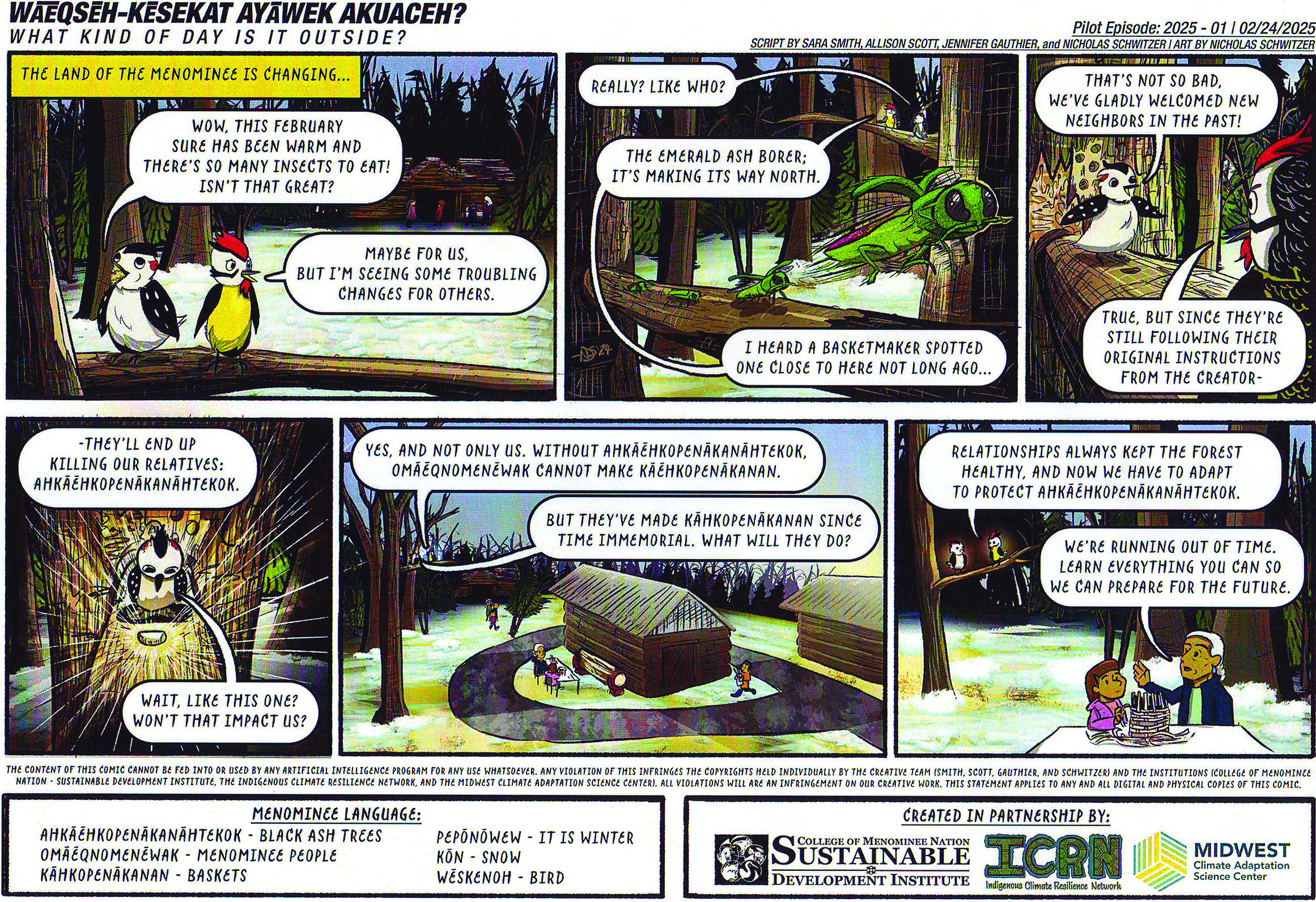
Comics have entertained and informed for decades, but the College of Menominee Nation’s Sustainable Development Institute hopes that its foray into the artistic side of things will help to not only educate people on the sustainability of the environment but also serve as a tool to help revive the Menominee language.
“We’re really happy to bring this idea and have it in print,” said Jennifer Gauthier, SDI director and one of four people involved with developing the climate comic series. “You can touch it and feel it and read it. What we wanted to do is take some of the science that we’re doing and start sharing with the community.”
The comics are being created on a monthly basis and will be in print in the tribal newspaper Menominee Nation News, as well as on the Indigenous Climate Resilience Network’s website, www.icrn.us.
The first comic, which debuted at a kickoff event March 3 at the college, features two birds common to the Menominee forests, the woodpecker and the sapsucker, and they both talk about a new visitor — the emerald ash borer. Over the course of the six panels, it is learned that, without the ash trees that are being destroyed by the invasive insect, it impacts the Menominee people’s abilities to make kahkopenakanan, translated as baskets, as well as limits where the birds can live. With winters becoming warmer in the Midwest, the borer has more time to spread to ash trees in the area and kill them.
“We’re starting to see changes, and that’s what we wanted to share and focus and make sure that everyone is aware,” Gauthier said. “This was our first time creating something like this, so we kind of went back and forth — ‘Let’s do this,’ ‘Let’s try that.’ We have a good process going now where we want to get out one of these to you every month.”
Besides Gauthier, the climate comics came into being with the help of Nicholas Schwitzer, SDI’s media expert, along with tribal resilience liaisons Sara Smith and Allison Scott.
“What I brought to the team was the Menominee language, the cultural aspects,” Gauthier said.
Smith and Scott noted they bring a lot of the scientific information to the project, while Schwitzer’s contribution was the drawing and coloring itself. Scott pointed out that a lot of scientists were consulted in developing the comics.
“We really were hoping that maybe this could be an opportunity for more place-based and culturally grounded communications to talk about climate change and impacts of the Native experience in the Menominee community,” Scott said. “This could be a model that other tribes throughout our region and the country could look to talk about climate change in their communities.”
Included with each comic will be a language box, which shows what the Menominee words mean. Gauthier noted the first comic’s final panel was interesting in that it showcased the intergenerational information passed down from the grandmother to the grandchild.
“This was intentional, because we wanted to give people some language to the imagery that we’re seeing,” Gauthier said. “This is something that we will include in every single one of our comic strips, and we’re hoping that, by the end of the year, we have a little glossary of seasonal terms.”
Smith noted that there are signs that the emerald ash borer has taken hold in the area, and showing how it’s impacting the Menominee and their cultural aspects is a way to explain why climate change and invasive species are such important issues.
“A lot of times, cold weather can hold off invasive species spreading in the region like the emerald ash borer,” Smith said. “Temperatures are warming everywhere, but here, the Midwest winters are warming up the fastest. There are a lot of times that we get rain in the wintertime; we didn’t used to have that back in the day. These changes that we’re seeing is going to impact the emerald ash borer, and it’s making it easier to come into our region.”
Gauthier noted that the first comic went through lots of drafting sessions, but the team enjoyed having the sapsucker and woodpecker talk so much about the environment that the pair are already being worked into the second comic, which should come out around the end of March or the beginning of April.
“We realized that we liked the wisdom of sapsucker and woodpecker, so they will likely be making appearances in all the comics,” Gauthier said.
Storytelling is important to the Menominee people, Gauthier said, and using modern techniques like comics can help that cultural knowledge to be spread and preserved. Topics for upcoming comics include snowshoe hares, sugar maple, lake sturgeon, moose and wild rice.
lpulaski@newmedia-wi.com
SDI using art form to drive home science