
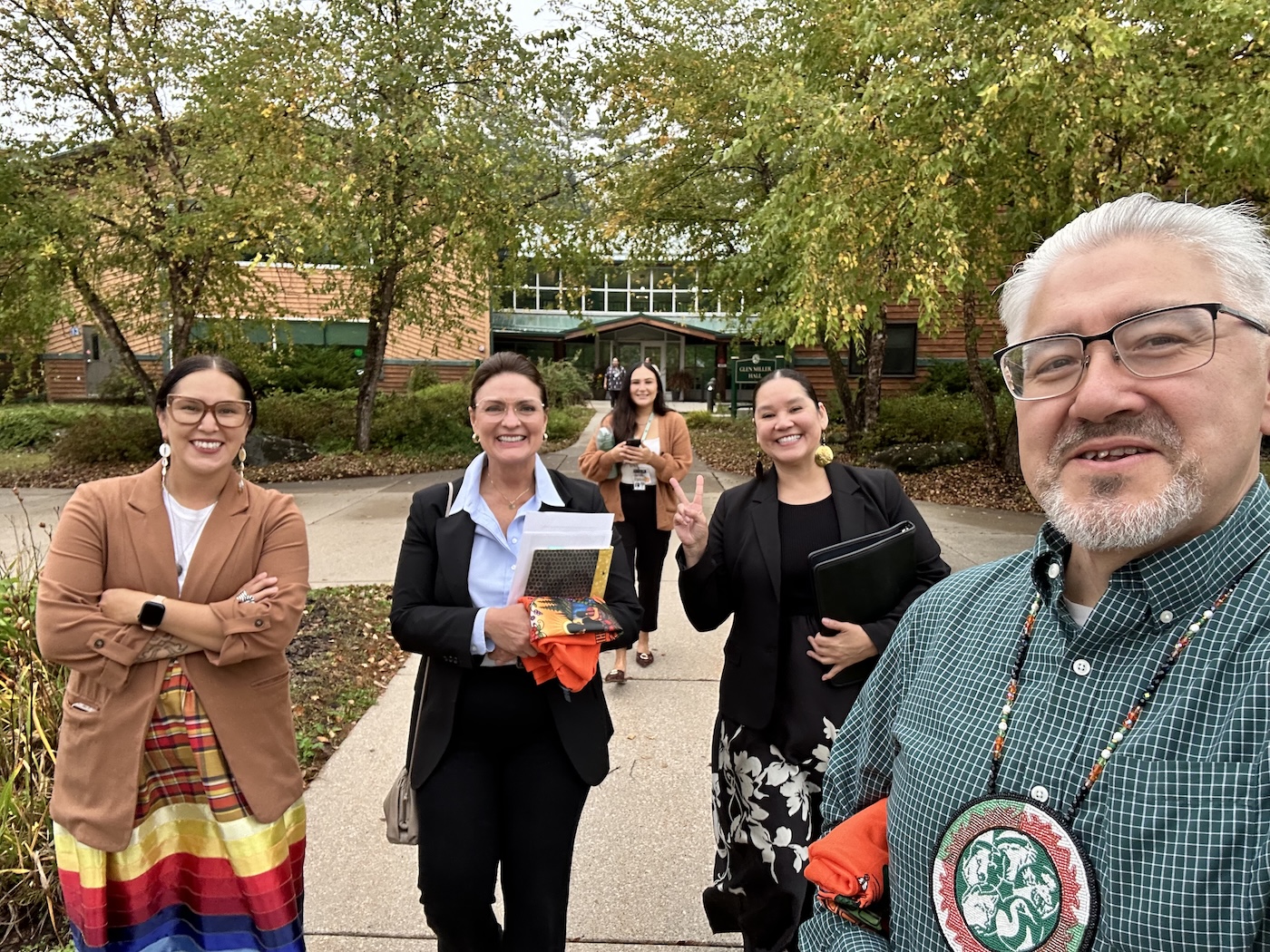
A parcel of land has a long memory. It has witnessed a past whose story was known to those who walked before us, and it has a future that will endure long after we all are gone.
As September turned to October, the College of Menominee Nation hosted the three-day 2026 Seven Generations Inter-Tribal Leadership Summit. An annual partnership with Lac Courte Oreilles Ojibwe University and the Universities of Wisconsin, CMN’s first time coordinating the event in Keshena bore the theme “The Land Remembers Us.”
CMN President Christopher Caldwell told the hundreds assembled that “Names tell a story of connection to place.” Referencing the conference subtitle of “Āwenew kanāwehtōkon mawaw-new kāēhkōh eneq kayēs-mēnekosiyah,” which means “We must care for the things we were given” when translated to English, Caldwell added, “Us coming together builds healthier, stronger communities.”
Menominee Tribal Chairman Joey Awonohopay concurred.
“Truly an honor to see all of you here who share our commitment to community and those who come after us,” Awonohopay said. “Our decisions are not just for today but for our children and grandchildren.”
LCOOU President Karen Breit echoed the sentiments, stating, “The name Seven Generations reminds us of the responsibility carried by our people. In that spirit, this summit is more than a conference.”
UW Systems Interim President Renée Wachter recognized the influence attendees had on their respective campuses, asserting, “Higher education has the potential to change lives and I don’t just mean a person. It’s throwing that pebble and watching it ripple out onto others.”
Some of the pebbles thrown at the conference came in breakout sessions that focused on four umbrella categories — economic and workforce development, education, environment, and health and safety.
In a session on Indigenous approaches to artificial intelligence, Ho-Chunk tribal member Marcus Lewis noted the role technology plays in connecting language teachers to instructional curriculum.
“AI has the ability to take us forward, but not at the expense of our past or who we are,” Lewis said. “It can enhance, not replace elders, teachers, or Indigenous knowledge keepers.”
Menominee tribal member Annie Jones noted that rushing to action is the antithesis of Indigenous educational philosophy at UW-Madison.
“She kills,” Jones said. “Very, very slowly.”
CMN student Gracie Waukechon, member of the Bad River Band of Lake Superior Chippewa, delivered a keynote titled, “Strengthening Our Relationship with the Planet Through Community Organizing.”
“Extractionist companies rely on the public to remain silent, but when our individual voices become a collective roar for justice, the threat of destruction falters,” Waukechon said.
The Woodland Bowl amphitheater celebrated its 90th anniversary this year, and I had the privilege of speaking about this storied place’s history of hosting fairs, pageants and powwows. Yet, it was the Bowl itself that took the literal spotlight on the second night of the gathering.
That evening, MenominiyoU hosted an exhibition powwow that showcased an exhibition of dances that included hand-drum contests, Woodland and Appliques exhibitions, and a night filled with revelry.
From his place at the emcee stand, tribal member John Teller Jr. regaled the powwow’s guests with Menominee cultural knowledge.
About his people’s teachings, Teller said, “It wasn’t a fairy tale. It wasn’t a lullaby. It was very real to tell our young people to listen to their parents and follow our ways.”
Tribal member Marci Hawpetoss elaborated upon how those ways are applicable. In her keynote, she compared using generative artificial intelligence to the cautionary maple sugar story shared by Menominee and Ojibwe people. The story explains how things that are “too easy” are not appreciated.
“We are thinking about stories in a global context,” Hawpetoss said. “The land is reactive and we all have relational accountability.”
Caldwell closed the summit by acknowledging that its success was another step in the journey of elevating Native ways of knowing.
“Over the past few days, I saw different people coming together, sharing their ideas, and shaping our perspectives. I think the things you will carry with you are the important part. By being here, you are becoming leaders in your community,” Caldwell said.
As the assemblage departed from CMN, I reflected upon the themes shared by the speakers. Their words took a foothold in Keshena, adding to the enduring story of wisdom shared on Menominee soil.
A parcel of land has a long memory, and the 2026 Seven Generations Inter-Tribal Leadership Summit in Keshena created recollections that will reverberate.
Ryan Winn, Ph.D., teaches communications, English, history and theater at the College of Menominee Nation. Visit www.menominee.edu for more information about the school.
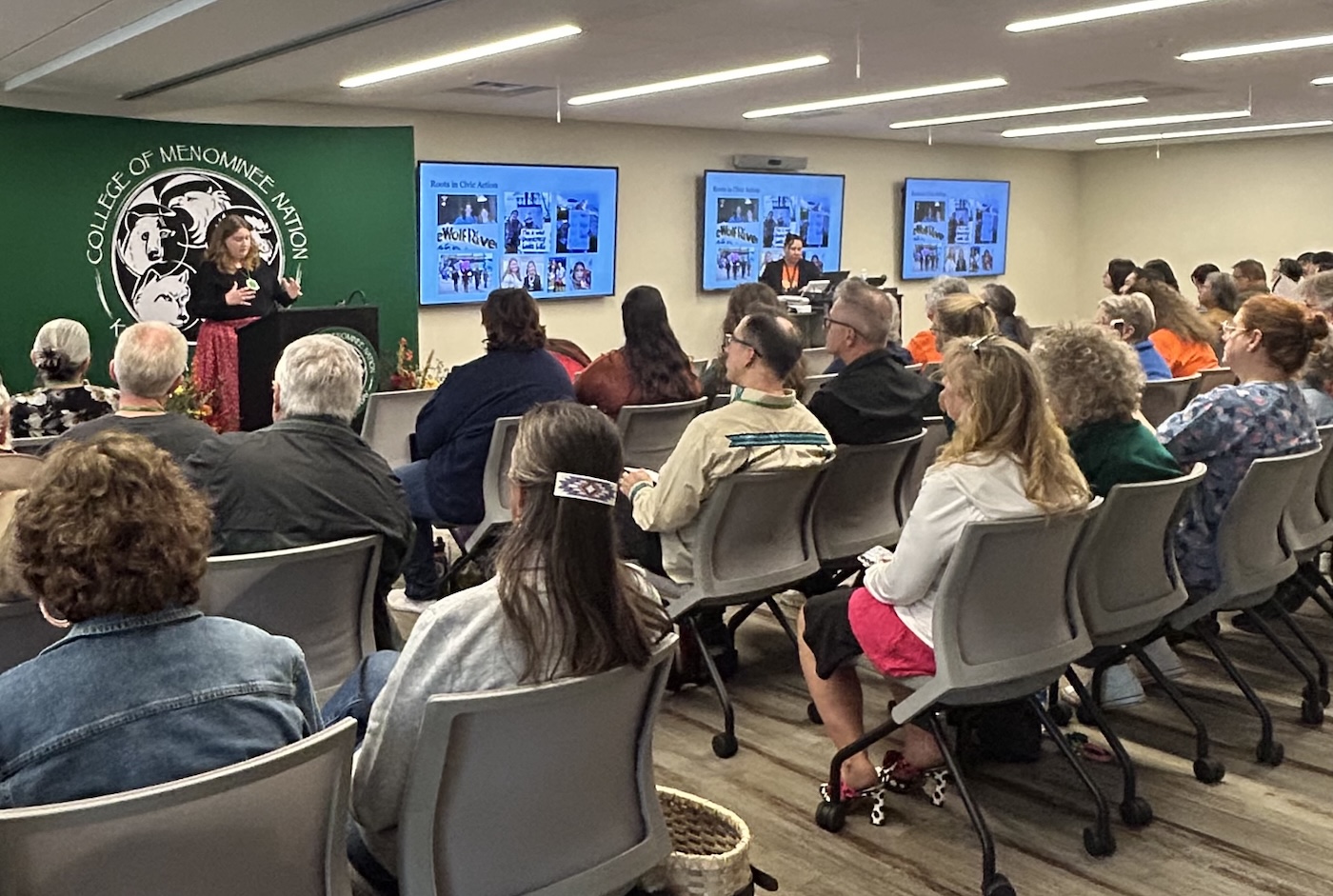
College of Menominee Nation student Gracie Waukechon delivers a keynote presentation at the 2026 Seven Generations Inter-Tribal Leadership Summit. (College of Menominee Nation)


