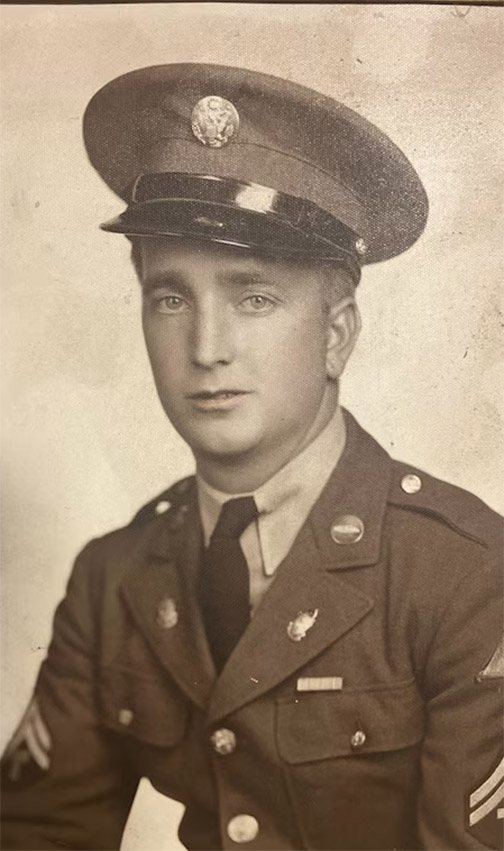
The remains of a Shawano man killed in the attack on Pearl Harbor on Dec. 7, 1941, have been identified more than 80 years after his death.
The Defense POW/MIA Accounting Agency announced May 20 that U.S. Army Air Forces Pvt. Herbert E. McLaughlin, 31, of Shawano, was accounted for on Dec. 17, 2024.
During World War II, McLaughlin was assigned to Headquarters Squadron, 17th Air Group at Hickam Airfield on the island of Oahu, Hawaii. On. Dec. 7, 1941, following the attack on Pearl Harbor, Japanese aircraft expanded to Hickam Field, targeting U.S. aircrafts, ships, barracks, supply buildings and the base chapel. The attack lasted four hours. McLaughlin was reportedly killed during this time.
McLaughlin, who enlisted in the Army in October 1940, was an aerial photographer at Hickam Field. He was stationed there in December 1940.
Shawano VFW Post 2723 is named after McLaughlin, the first Shawano County casualty of WWII. The son of Mary A. McLaughlin, he was a 1928 graduate of Shawano High School.
In the days following the attack, Navy personnel recovered the remains of U.S. Army and U.S. Army Air Forces casualties, which were subsequently interred in the Schofield Barracks Cemetery on Dec. 9.
In August 1947, tasked with recovering and identifying fallen U.S. personnel from World War II, members of the American Graves Registration Service (AGRS) disinterred the remains of U.S. casualties from the Schofield Cemetery and transferred them to the Central Identification Laboratory at Schofield Barracks.
The laboratory staff was unable to confirm the identifications of 12 men from the Hickam Field attack at that time. The AGRS subsequently buried the unidentified remains in the National Memorial Cemetery of the Pacific, known as the Punchbowl, in Honolulu.
On Jan. 5, 1949, a military board classified those who could not be identified, including McLaughlin, as non-recoverable.
In June 2019, DPAA personnel exhumed the 12 Schofield Barracks Unknowns from the Punchbowl for analysis.
To identify McLaughlin’s remains, scientists from DPAA used anthropological analysis, as well as circumstantial evidence. Additionally, scientists from the Armed Forces Medical Examiner System used mitochondrial DNA and Y-chromosome DNA analysis.
McLaughlin’s name is recorded in the Courts of the Missing at the Punchbowl, along with the others who are missing from WWII. A rosette will be placed next to his name to indicate he has been accounted for.
A narrative in McLaughlin’s personnel file indicates that the Japanese destroyed the Hawaiian Air Depot’s engineering building and hangers at Hickam Field, attempted to take out the underground fuel tanks and attacked the barracks. Fighter planes also made strafing attacks on personnel caught out in the open.
In the meantime, the men at Hickam cobbled together a makeshift ground defense: men broke into weapons lockers and retrieved machine guns and Springfield rifles and began firing at low-flying planes. Some climbed into planes and began firing their machine guns from the ground. Others tried to get planes into the air. By then though, the attack was over.
Ninety-one men died at Hickam Field that day. McLaughlin was killed during the attack on Hickam Field, but the exact circumstances of his death are unknown.
McLaughlin will be buried in Shawano on a date yet to be determined.
kpasson@newmedia-wi.com
Remains of man killed at Pearl Harbor identified