
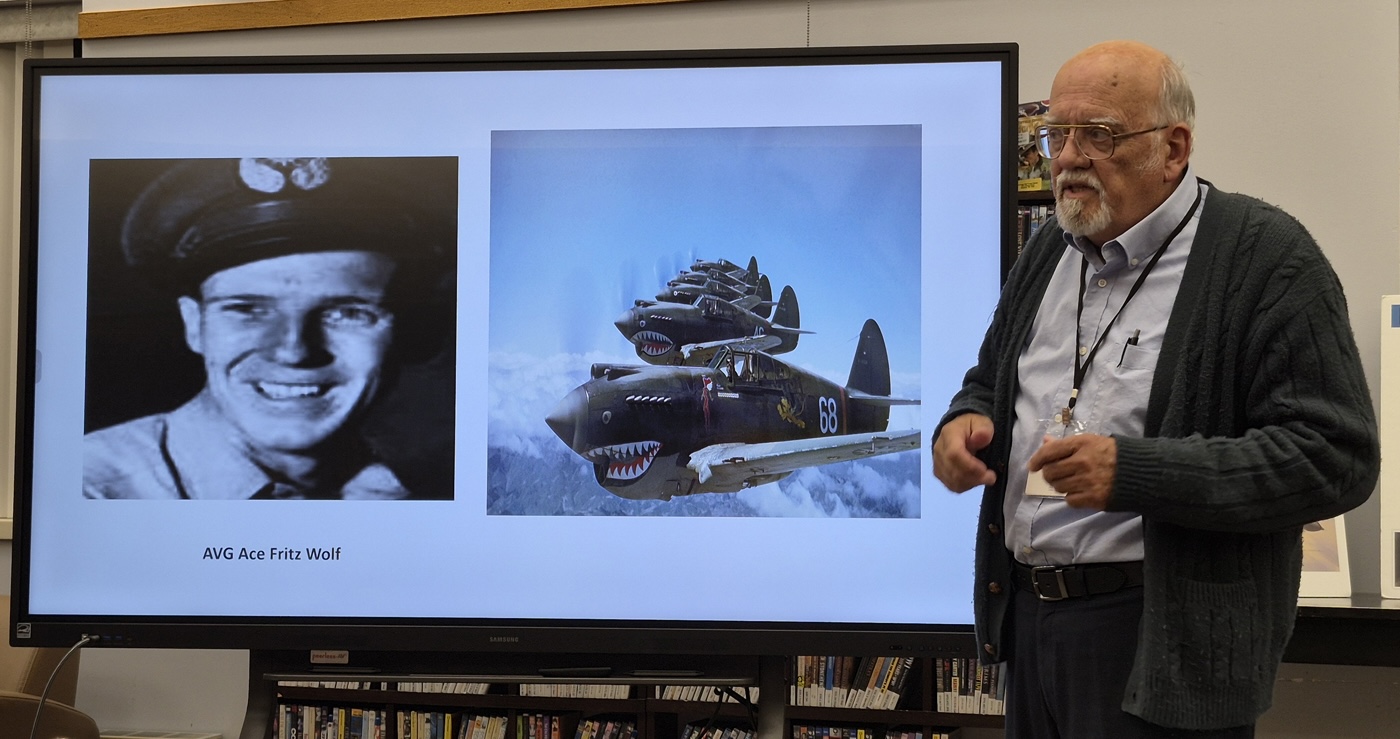
Fritz Wolf was a stellar athlete at Shawano High School and later at Carroll College (now University) in Waukesha.
He was so good that he was going to try out for the Green Bay Packers, but a case of appendicitis caused him to miss the tryouts. Instead, the 1933 Shawano High School graduate joined the Navy and would go on to become one of Wisconsin’s 44 flying aces — men credited with shooting down at least five enemy aircraft during times of war.
Wolf’s story, and those of several others, were shared Nov. 4 at the Shawano Public Library, when author Mike O’Connor gave a presentation on his book “Badger Aces.”
Wolf, who is buried at Woodlawn Cemetery in Shawano, joined the U.S. Navy in 1939 and became a dive bomber pilot.
Before the U.S. entered World War II in December 1941, the Japanese had been bombing China for years. Chinese leaders had little success in stopping them and devised a plan to hire American pilots to fly on China’s behalf. Anyone who joined the American Volunteer Group, also known as the Flying Tigers, would be paid $750 a month with a $500 bonus for shooting down a Japanese aircraft.
Wolf was one of 99 pilots who joined.
“Fritz Wolf went over there, and he shot down four Japanese bombers and fighters,” O’Connor said. “He didn’t see a lot of combat, because he came down with malaria and a number of different diseases. At one point in time, he was so sick, they started to build a coffin for him, because they thought he was going to die from all these diseases.”
According to the Shawano County Historical Society, on Dec. 20, 1941, Wolf took part in the first AVG action near Kunming, China.
He shot down two Mitsubishi bombers and assisted in downing a third before his ammunition ran out. In February 1942, somewhere near Rangoon, Burma, Wolf took part in a dogfight with 14 Japanese fighters. He shot down one before he had to turn tail and run. This victory was confirmed but combat records were lost.
On April 8, 1942, near Loiwing, China, he took part in another AVG action where he shot down two more Japanese fighters.
That same month, near Magwee, China, Wolf was almost killed when he was caught on the ground when the Japanese bombed the airfield.
He served in the Flying Tigers from December 1940 to July 1942.
“Fritz comes back to the U.S., rejoins the Navy and goes into fighters instead,” O’Connor said. “He flies combat off the Yorktown and the Hornet, and in 1945, he becomes (commanding officer) of a squadron and he downs a Japanese fighter over Japan. That is kill number five, so he becomes an ace.”
There were more than 70,000 U.S. pilots in the 20th century. Of those, 1,447 were credited with downing at least five enemy aircraft, thereby becoming an ace. And of those aces, 44 were from Wisconsin.
Wisconsin’s aces included two in World War I, 39 in World War II, two in Korea and one in Vietnam.
After leaving active duty with the Navy in April of 1946, Wolf became the first paid employee of the new Wisconsin Aeronautics Commission.
When the commission merged with the newly formed Department of Transportation, Fritz was named bureau director. Fritz retired from state service in May 1981.
In 2006, the State of Wisconsin honored his contributions to aviation by renaming the State Aviation Facility at the Dane County Regional Airport in Madison the Fritz E. Wolf Aviation Center.
Wolf was inducted into the Wisconsin Aviation Hall of Fame in 1989 and died in 1997.
kpasson@newmedia-wi.com

Author Mike O’Connor discussed the true-life stories of Shawano’s Fritz Wolf and more than 40 other Wisconsin pilots who shot down at least five enemy aircraft during times of war. O’Connor featured the stories in his book “Badger Aces,” which he discussed Nov. 4 at the Shawano Public Library. (Kevin Passon | NEW Media)


