
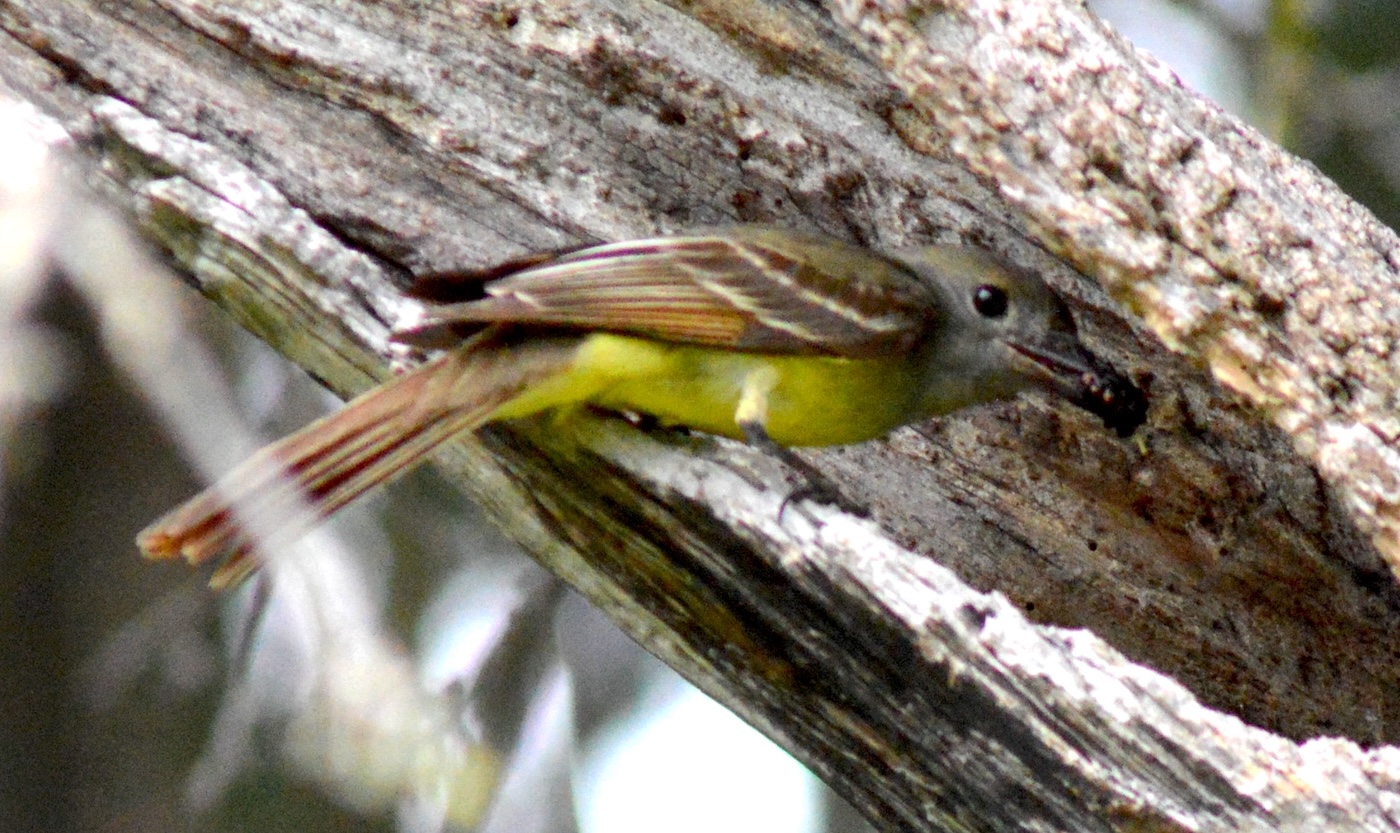
We have a new neighbor in our yard this summer, the Great Crested Flycatcher. It lives up to its name with its distinctive gray crest giving it a big-headed look, seemingly at odds with its small slender body size. The bird’s back, neck and head are brownish gray, belly yellow and its long tail is mostly rusty red. It’s a dapper looking bird.
What first clued me into the bird’s presence was its distinctive call described by The Cornell Lab All About Birds (AAB) website as a loud “whee-eep” whistle that rises fast in tempo and ends sharply. This is one of four basic calls made by both the males and females during the day. It is thought to serve as a contact call between a mated pair or between parents and young and is also made by either parent to warn of an intruder or predator near the nest site.
It’s the bird’s call rather than a sighting of it that will likely alert you too to its presence. This is because, according to AAB, these flycatchers prefer being high up in tree canopies where they are hard to see. From these high vantage points, they hunt for larger insects, peering in all directions, bobbing their heads and swooping to give chase to flying prey.
Flycatchers are persistent when pursuing prey, darting and hovering to snatch up insects. In their haste, may even crash into foliage in pursuit of it. Now that’s being laser focused. They spend little time on the ground, preferring to fly from place to place rather than to walk or hop.
To our delight, after hearing the flycatchers for a few days, a pair decided to nest in our old apple tree. I noticed them flitting about the branches of the tree seeming to assess it for a suitable nesting site.
Nest building is done mostly by the female with the male staying close. We saw the female busily bringing nesting material to an old hollow limb in the tree — first a beak full of dried grass and then a fluffy bright yellow artificial looking feather, half the size of the bird, was slipped into the nesting cavity. Interestingly, AAB reports that shed snake skins are often used in nest construction as are feathers, fur, bark, egg shells, paper, cloth, onion skins, twigs and grasses.
While Great Crested Flycatchers prefer to nest in tree cavities, according to AAB, they will also use nesting boxes, hollow posts, and even pipes, cans and boxes if they are of suitable size.
If you’d like to attract flycatchers to your yard, AAB suggests setting up a nest box and outfitting it with a predator guard to protect the eggs and young from intruders. Hang the nest about 3-20 feet above the ground in an open woodland located where there are clear flight paths to the box opening. You can find a flycatcher nest box plan at https://nestwatch.org/learn/all-about-birdhouses/birds/great-crested-flycatcher.
Once settled in their nests, females lay four to eight eggs, according to AAB, and chicks fledge about 15 days after hatching. The male is a daunting protector guarding his mate, especially during nest-building and egg-laying.
Invaders are not tolerated. If calls won’t deter them, the male will raised his crest, lean forward and pump his head aggressively. He adds a snapping bill, fast chase, grappling and feather pulling as necessary to ward off intruders. Threats to females, eggs and young include snakes and squirrels that raid nests.
We eventually heard young in the nest and watched as the adults brought mulberries from our tree across the yard to their already “whee-eep” whistling chicks. Berries and fruits are part of their diet, as well as insects such as dragonflies, butterflies, cricket, bees and wasps.
The Great Crested Flycatcher can be found in woodlots and open woodlands, especially those with deciduous trees and forest edges, according to AAB. Dead snags and dying trees provide important cavities used as nest sites. Because they tolerate human presence, you may also find them using nesting cavities in old orchards, woody urban areas including parks, cemeteries, golf courses and maybe even your own backyard.
Great Crested Flycatcher breed throughout the eastern U.S. and much of southern Canada. AAB notes that they are medium-to long-distance migrants. Most of the birds winter in southern Florida, southern Mexico, Central America and northwestern South America. Leaving their northern breeding grounds in September, they start returning north to the southern U.S. by mid-March. Rather than migrating in flocks, they migrate alone.
Listen for the breezy “whee-eep” whistles of the Great Crested Flycatcher in your neighborhood or when in wooded areas. Remember to look up high in the trees for them, and maybe you too will get to see them flitting energetically in and out of the canopy intent on the chase.
Cathy Carnes is a retired biologist in Oconto who worked with the U.S. Fish and Wildlife Service Green Bay Field Office and prior to that with the U.S. Army Corps of Engineers Regulatory Branch in Buffalo, New York. As endangered species coordinator for the USFWS, she helped conserve and recover federally listed threatened and endangered species in Wisconsin.


