
More than 2.7 million military personnel (Army, Navy, Marines, Air Force, Coast Guard) actively served in Vietnam, with 1 million to 1.6 million who either fought in combat, provided close support or were at least fairly regularly exposed to enemy attack.
Vietnam veterans weren’t discharged back home with parades or recognition of any kind. This was unlike military who returned home from other wars.
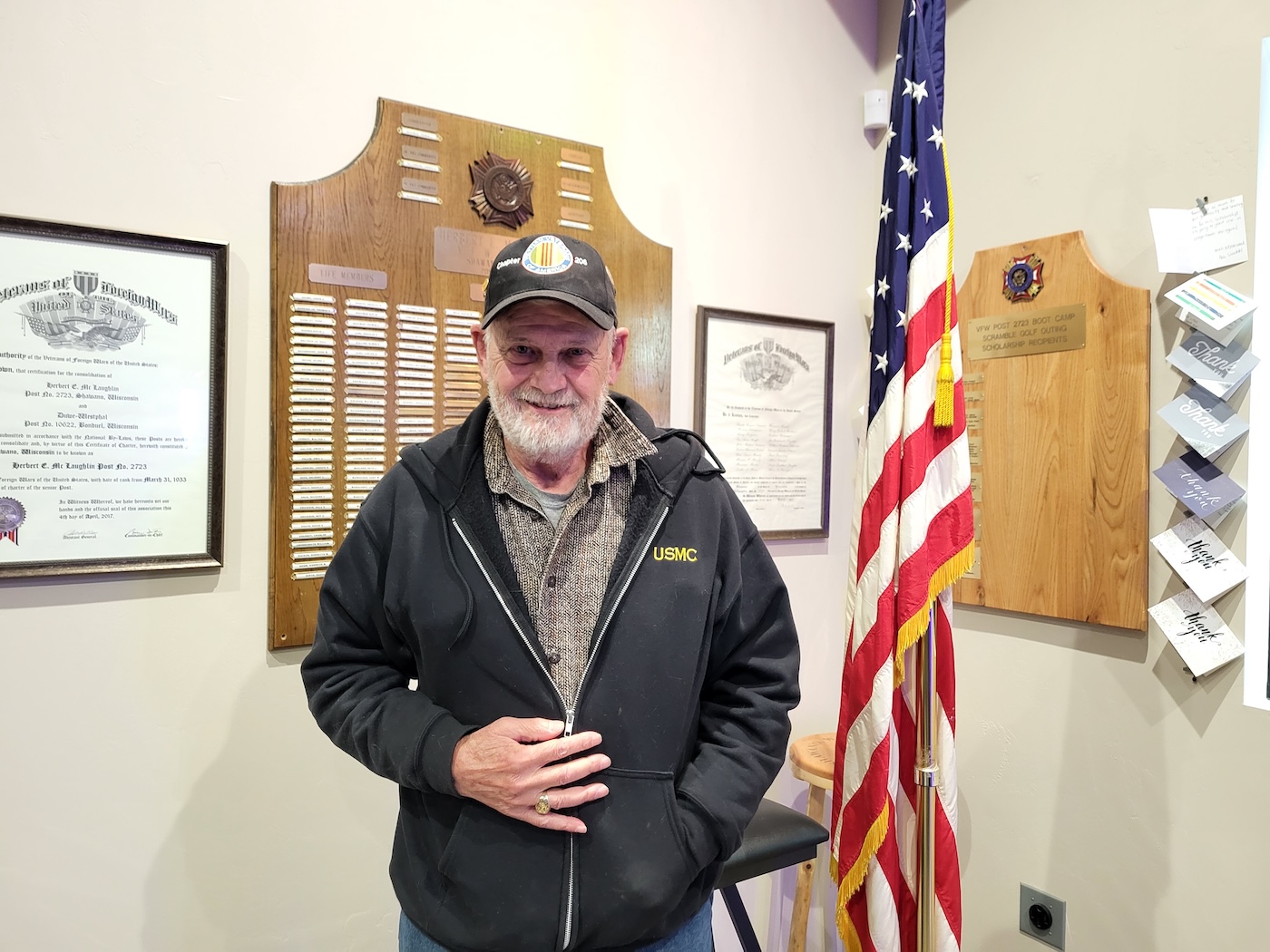
Dave Ensrud is a U.S. Marine who enlisted Sept. 15, 1966, when he was 19.
“A lot of us didn’t particularly want to go to war, although we felt it was kind of our duty,” he said.
Ensrud noted patriotism “was on a big high” while he was in high school, and there was a lot of enthusiasm.
“When I came home in 1969, it was exactly the opposite. I heard of a lot of people having problems dealing with civilians or ex-military. I never had any of that. I don’t think I was really ostracized, but I felt that I was. I was suffering from PTSD.”
One time long after the war, when he was hunting with his sons, he experienced something like a flashback to his time in service. He heard shots fired in the woods and immediately dropped to the ground in a prone position with his rifle at the ready.
“Being a Marine, we were very well indoctrinated with whatever had to happen,” Ensrud said. “I was happy that the person who had shot didn’t step out.”
A year after high school graduation, Ensrud made a decision to enlist.
“I had made a pact with a friend of mine, that whoever got his draft notice first, would go in with him, or him with me,” he said.
Ensrud’s friend was drafted first. The two of them went to visit the Air Force recruiter. The date of his friend’s draft notice was apparently too recent, so they couldn’t enlist. The same thing happened when they went to the Navy Recruitment office.
Neither of them wanted to go into the Army, so they tried the Marine Corps.
“No problem there,” Ensrud said.
He enlisted for three years.
After boot camp at the Marine Corps Recruit Depot in San Diego, Ensrud was trained for electronics-radar. Then he went to Marine Corps Air Station in Cherry Point, North Carolina, to join a light anti-air missile battalion and spent about a year there.
Ensrud said he got tired of being in the Marines and stateside during a war.
“Not a good place to be,” he said. “The first time a billet came up for Vietnam, I volunteered.”
He served in Vietnam from June 1968 to July 1969. His initial duty station was in Chu Lai, a major Marine base situated on the coast in central Vietnam.
“I was in what was called ‘I Corps,’” Ensrud said. “Vietnam was divided up into different sections, Corps I, II, III, IV. I Corps was in the very northern area, Chu Lai north up to the DMZ (demilitarized zone).”
According to Ensrud, in 1968 they were already downsizing his location when his unit arrived.
“We never fired a missile, he said. “I was there about 3 1/2 months.”
Ensrud said that the unit he was with shipped back home. He was moved on to Da Nang, where he spent the rest of his tour.
In 1965, the U.S. Marine Corps had deployed an MIM23 Hawk Missile Battalion to South Vietnam, a pivotal moment marking a shift from advisory roles with the Army of the Republic of Vietnam to direct combat operations.
“Because the Hawk Missile Battalion was made up of mobile units, and because there wasn’t much air attack coming from the north, we didn’t have much to do,” Ensrud said. “So, they would send us out on patrol. I was on Hill 327 to the west of Da Nang, overlooking the air field.”
He earned the rank of corporal during his time in-country.
“I was on guard duty in Vietnam from the very first day I got there to the very last day I was there,” he said.
Ensrud recalled about being on the hill in a bunker on his very last night in Vietnam, when fire started coming in near his perimeter. It turned out to be that there was a bunker of motor transport people who were stoned on barbiturates and were seeing enemies everywhere and were shooting at everything, including Ensrud’s bunker.
“When that night finally ended, I got my seabag and hopped on a Jeep after I got my orders,” he said. “It was quite a night. Weird stuff happened like that all the time. It kept us on our toes.”
After his discharge, finding a job was difficult at first.
He pursued his education through the GI Bill and earned degrees in geology, then computer science and finally a teaching degree. These mostly kept him employed, and he retired from a teaching position in northern California.
Originally from California, Ensrud said that his son was instrumental in his moving to the Shawano area and settling in Pella. He said that he’s never regretted the move.
“I love it here,” he said.
Ensrud hunts and fishes and is active in the Shawano Vietnam Veterans of America, which he joined about five years ago.


