According to Jennifer Gauthier, it’s all about the “ahkēw, the land.” The director of College of Menominee Nation’s Sustainable Development Institute (SDI) said: “That’s why we’re all here.”
The specific “here” claimed was the Indigenous Planning Summer Institute (IPSI), which was held on the CMN campus the first week of June.
“It’s an opportunity for Indigenous people to learn, share and exchange knowledge. We are facing similar issues with climate change, language, and culture revitalization, and strengthening our Indigenous food systems to name a few,” Gauthier said. “ISPI creates intentional space to find connections and work collectively to address these challenging issues. For our Menominee community, it is a unique opportunity to share our sustainable forestry practices, our foods, and in general, our Menominee hospitality.”
CMN hosts its IPSI gathering biannually, but their relationships are fostered through continuous, intentional care.
“For the past two years, SDI has been building relationships with a number of different Indigenous communities both on Turtle Island and around the globe. We felt the time was right to strengthen those relationships and build our collective work,” Gauthier explained.
While IPSI has hosted important conversations around land-based learning in its past iterations, this year brought together an especially rich collective of perspectives.
“We were intentional and extended invitations to Indigenous communities we are building relationships with,” Gauthier said. “This includes Sami from Norway, Indigenous Ireland from Ireland, Maori Whanau from Aotearoa/New Zealand and Inupiak from Alaska. IPSI is an opportunity to take our work to the next level.”
Speaking on behalf of the SDI staff, Gautier added: “We are excited at building connections and friendships. We are excited for our summer interns and anxious to see how this experience will shape their summer and research projects. As it regards SDI, it is our hope that we are strengthening our relationships with our guests and that we can find connections that lead to some innovative work around common issues.”
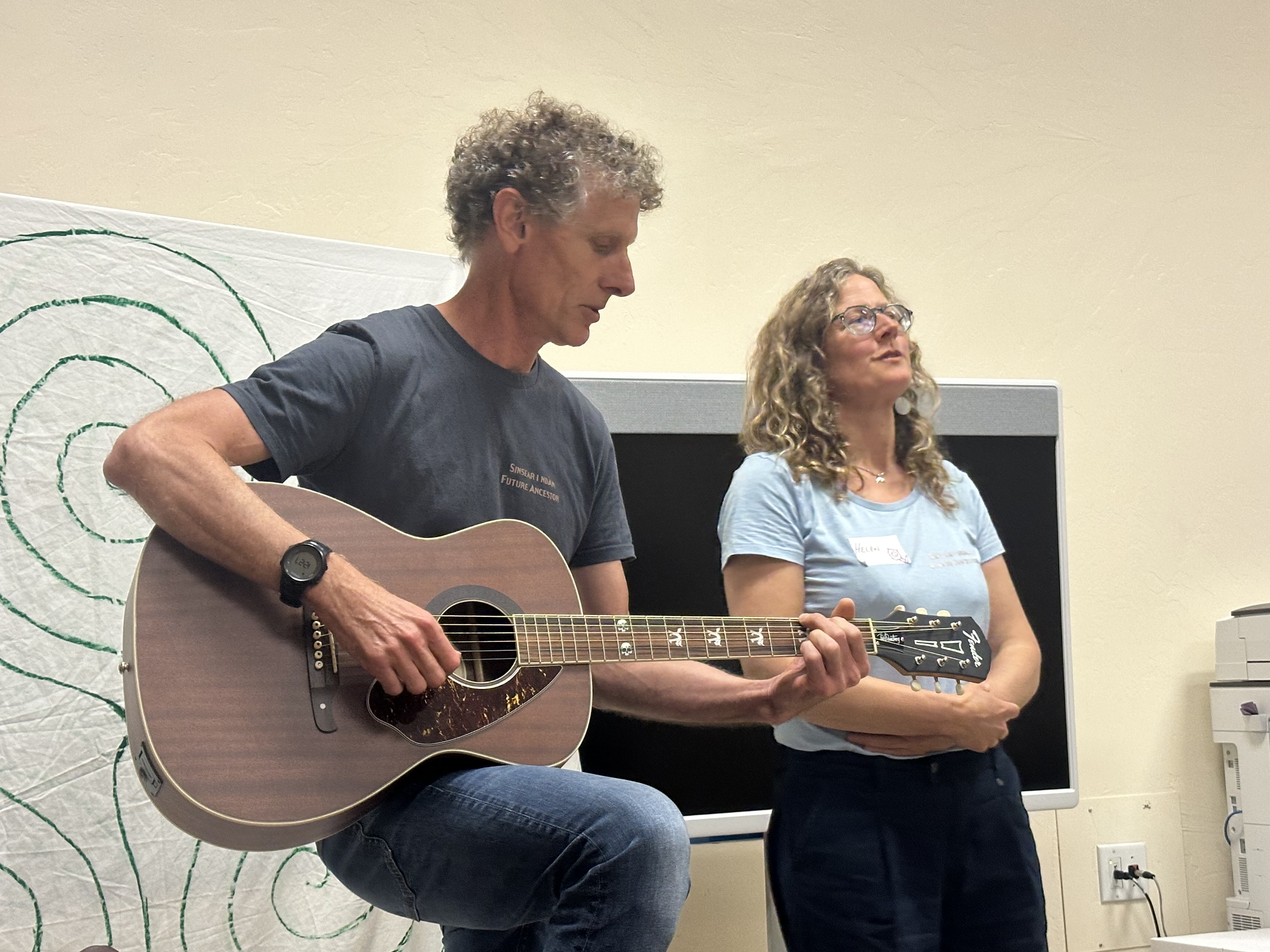
Lorcan McBride and Helen Henderson from Indigenous Ireland were among the first to share how issues Indigenous people face manifested in their homeland.
“We’re super-colonized to the extent that people don’t understand how we are colonized,” McBride said. “From the 1100s on, we were a place to experiment with colonization. The essential rubrics of colonization were developed and experimented with on our land.”
As with other Indigenous groups, the keys to earliest culture are embedded within Ireland’s original language — Gaelic. Henderson stated that “In our language, our emotions are on us.”
McBride added that “Gaelic is a natural environment language,” but there is no word simply for nature alone. Dúchas is the term used by Gaelic speakers, which he translates to “being, identity, belonging to nature.” While the opposite term is déiriocht, which McBride said means “exile, loss, depression, disembodiment, disconnection.”
According to Indigenous Ireland’s website, “Indigenous Ireland is an education and training association exploring what it means to be Indigenous or hold Indigenous values on the island of Ireland. We are concerned with connecting and relating to the land and sea territory of the island of Ireland in an embodied way. This means building experiential evidence to understand and heal our past, establish health and balance in our present and build fortitude for our future together as people sharing the land and waters of Ireland.”
One such corrective teaching McBride offered IPSI attendees was that in traditional Irish culture,
“At the end of the rainbow was the bridge to the other world and the crow took you across,” he said.
He noted that in Gaelic, the word for crow is prehaun, which rhymes with the English word leprechaun and likely shows the origins of the modern-day story.
McBride and Henderson also shared books about their culture, photos of their homelands, a Brigit Cross made from reeds and a song honoring the salmon.
Indigenous Ireland is focused on continuous learning rather than a stated end point.
“The learning place is the really interesting place, not the knowledge place,” McBride said. “The process of learning is where the real excitement takes place.”
IPSI itself could be described as a learning place centered around the Menominee Theoretical Model.
“This model encompasses our Indigenous values and can be easily adapted to other cultures,” Gauthier said. “It is also my hope that our attendees see how we have carried our ancestors’ knowledge to the present day and how our community not only fosters this knowledge, but is ensuring those ways are here for future generations. I also hope everyone leaves with a whole new set of friends and family.”
As Gauthier noted in her welcome to all of CMN’s guests, “When you see other lands, you start to see home in a different way.”
It’s all about the ahkēw, indeed.
Ryan Winn, Ph.D., teaches communications, English, history and theater at the College of Menominee Nation. Visit www.menominee.edu for more information about the school.
IPSI takes look at land-centered learning