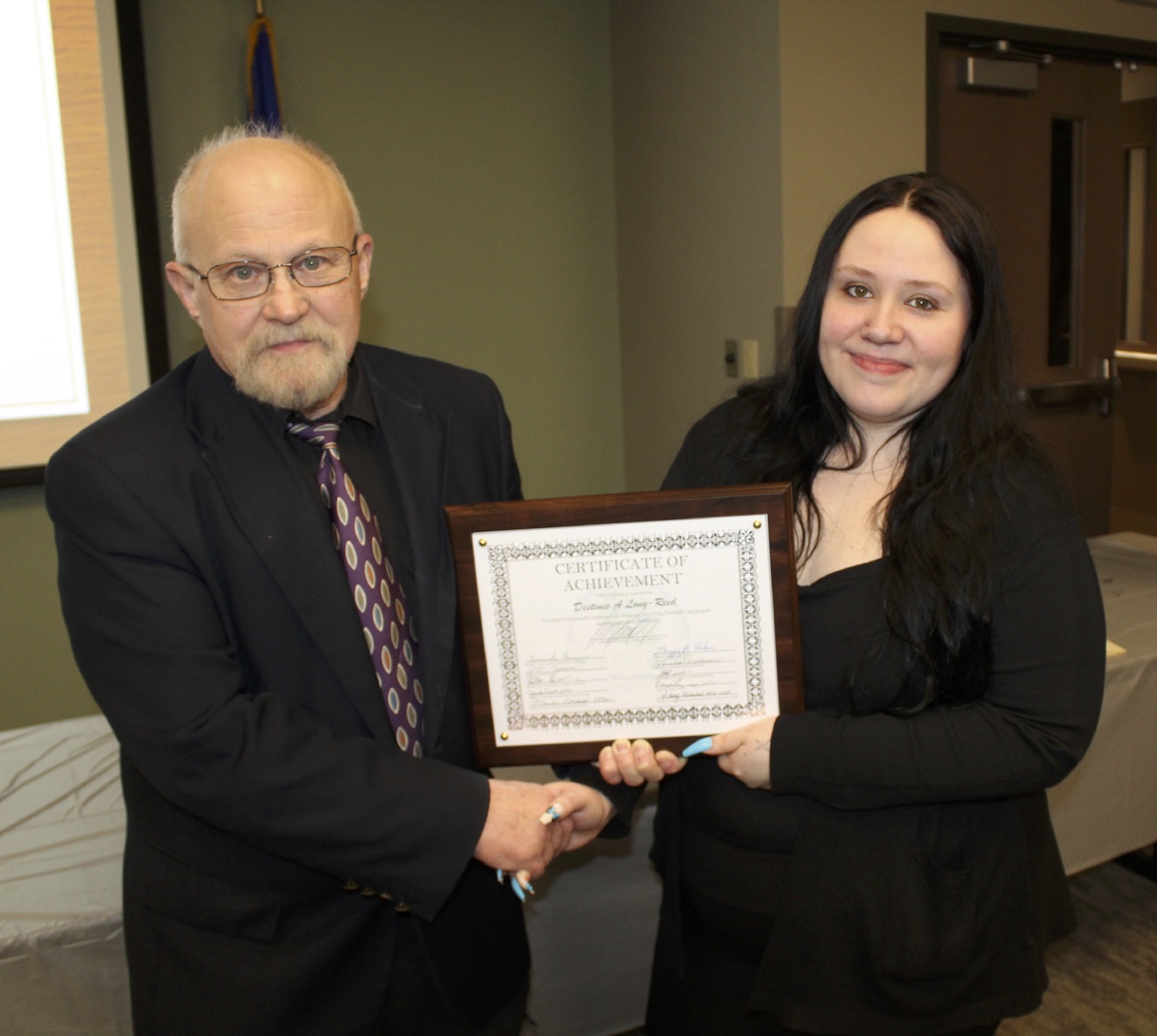
The past several years for Destinee Long-Reed have seen plenty of highs and plenty of lows, but one of the biggest highs came Feb. 28, when she graduated from the Shawano County Treatment Court, commonly known as drug court.
“Growing up around drugs and being around people who felt the same and used for some of the same reasons I had became my life when I was just a freshman in high school,” she said.
Long-Reed was arrested a couple of years into her addiction, referred to the drug court and placed on a waiting list.
“I wasn’t really ready to be sober, so I continued to use,” she said.
She was caught again.
“I’m very thankful for, because my PO (probation officer) had seen something in me I couldn’t see in myself at the time,” she said. “My whole life has changed.”
Her graduation ceremony marked the completion of a long process — one that must be undertaken by anyone who volunteers for the alternative court.
Amanda Farmer is the treatment court coordinator, a position she has held the past five months.
She started working for the Department of Human Services two years ago in an evening crisis manager role.
She would go on her earn her master’s degree in social work.
“We dropped the word ‘drug’ from the name to reduce the stigma and help get more community buy-in,” Farmer said, of the treatment court.
It usually takes someone 18 months to pass through the five phases of the court. Farmer said the fastest it could happen is 14 months.
“Destinee is our first graduate in 15 months,” Farmer said.
Being part of the treatment court is voluntary. A maximum of 12 can be enrolled at any one time.
“We aim to end the recidivism and allow the individual to gain stability in his or her life,” Farmer said.
Since its inception in 2018, the court has had 38 individuals in the program. Fourteen of those have graduated, and 10 others are still in the program.
Among the eligibility requirements are Shawano County residency, on probation for 36 months, and no pending violent felony offenses or current charges for a violent felony offense.
There are five phases during the process. These include learning basic life skills, maintaining complete sobriety, landing a full-time job, having continual individualized treatment and establishing an after-care plan with a support network.
Rewards are given for positive behavior, and sanctions are imposed for recovery-interfering behavior.
Additional program components include random drug and alcohol testing (average twice a week), referrals to community resources, home visits, community service and recovery-focused opportunities.
The treatment court targets adult, non-violent felony offenders or repeat misdemeanor offenders who have been arrested for a drug or drug-motivated offense. All participants are on supervision with the Department of Corrections and the program also accepts Alternative to Revocation referrals. All prospective participants must be screened to be high-risk and high-need and have a clinical diagnosis of a moderate to severe substance use disorder.
For Long-Reed, she faced many challenges along the way, including moving out of her mother’s home and finding a new home for her dog who had been with her since the start of her treatment.
She intends to stay connected with her peers in the program, continue her employment as a peer support specialist and continue to improve upon on stable home life.
The court is overseen by Judge William Kussel Jr., who presented Long-Reed with a certificate and medallion in recognition of her graduation.
“When drug court ends, this doesn’t mean I’m completely recovered or healed at all,” Long-Reed said. “This just means I’ve put in the work I’ve needed to be successful out in the world.”
kpasson@newmedia-wi.com
Long-Reed graduates from treatment court