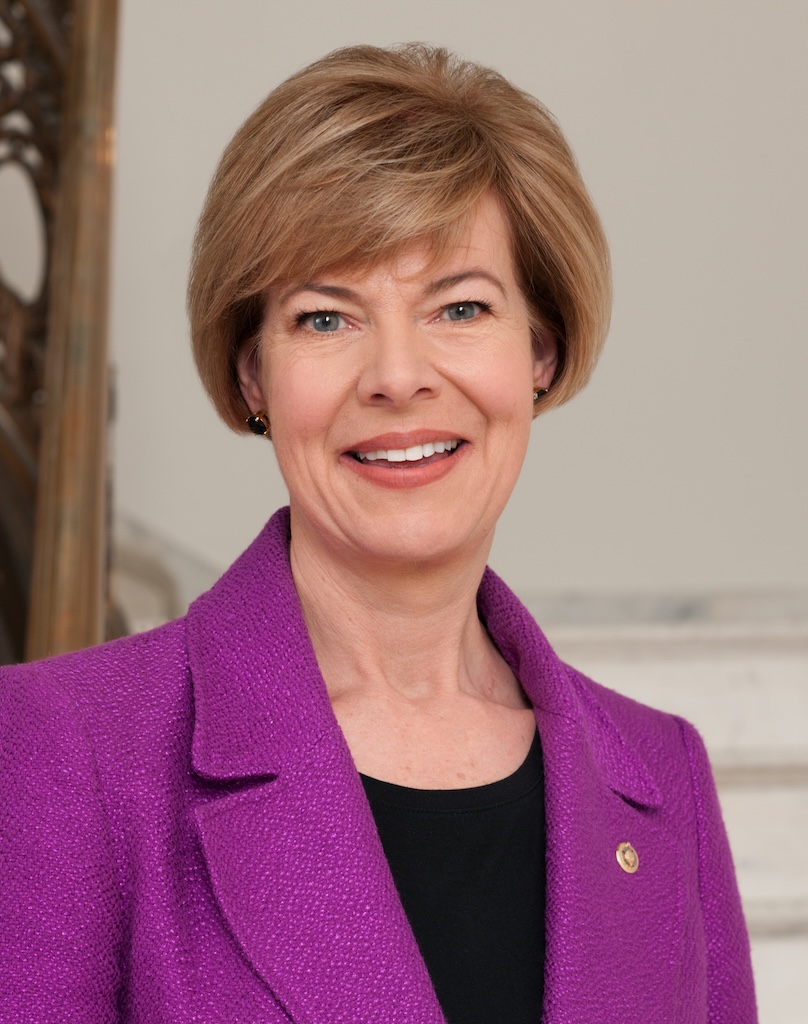
U.S. Sen. Tammy Baldwin joined nine other Senate Democrats urging President Donald Trump to revive his 2016 campaign promise and pressure the GOP congressional majority to close a loophole in the tax code that’s been a long-time boon to Wall Street fund managers.
Using this carried interest loophole, investment fund managers pay a significantly lower tax rate on the profits they earn from managing investment funds like private equity, venture capital and hedge funds. Instead of the normal income tax rate, which is about 37%, these managers pay the capital gains rate, which is about 24%.
The May 18 letter, which also included the signatures of Sens. Bernie Sanders, Elizabeth Warren and Amy Klobuchar, called for the end of the carried interest loophole as Republicans work to pass Trump’s massive tax bill.
The bill passed the U.S. House without any Democratic support in a 215-214 vote on May 22.
That bill did not eliminate the loophole, but before it can become law, it must go through the Senate, where Republicans enjoy a 53-seat majority.
“As middle-class families live paycheck to paycheck, wealthy Wall Street insiders continue to get tax breaks,” Baldwin wrote on her Facebook page. “It’s past time to get rid of this unfair loophole. President Trump claims to be on board, so let’s get it done!”
Hoping to reignite Trump’s opposition to the loophole, Democrats could have an ally in Republican Sen. Josh Hawley of Missouri, who has said publicly he favors ending it.
Baldwin did not respond to repeated requests for comment.
Republicans’ “One Big Beautiful Bill” expands major tax cuts from 2017, cuts funding to some programs like Planned Parenthood, while raising it on things like the military and is projected to greatly raise the national deficit, by about $3.2 trillion over 10 years, according to one study from the University of Pennsylvania.
The original argument for the carried interest loophole was that it would help encourage investment and risk-taking, said Brian Jacobsen, the chief economist for Annex Wealth Management in Brookfield, and a finance instructor at Marquette University.
In 2016, Trump called the loophole “ridiculous.” His 2017 Tax Cuts and Jobs Act didn’t end the loophole, but it did extend the time required to hold onto an investment in order to qualify for the tax break.
If thought of like a bonus, then carried interest could be taxed like normal income, Jacobsen said. Right now, it’s treated like income from an investment.
If the loophole were closed, the estimated revenue gained from taxing the profit as normal income rather than as capital gains would be modest, about $13 billion over a 10-year period, according to the Congressional Budget Office.
To put it in perspective, the federal government has spent more than $4 trillion since Oct. 1, 2024, according to data from the U.S. Treasury Department.
Baldwin pushes for end to Wall Street tax break