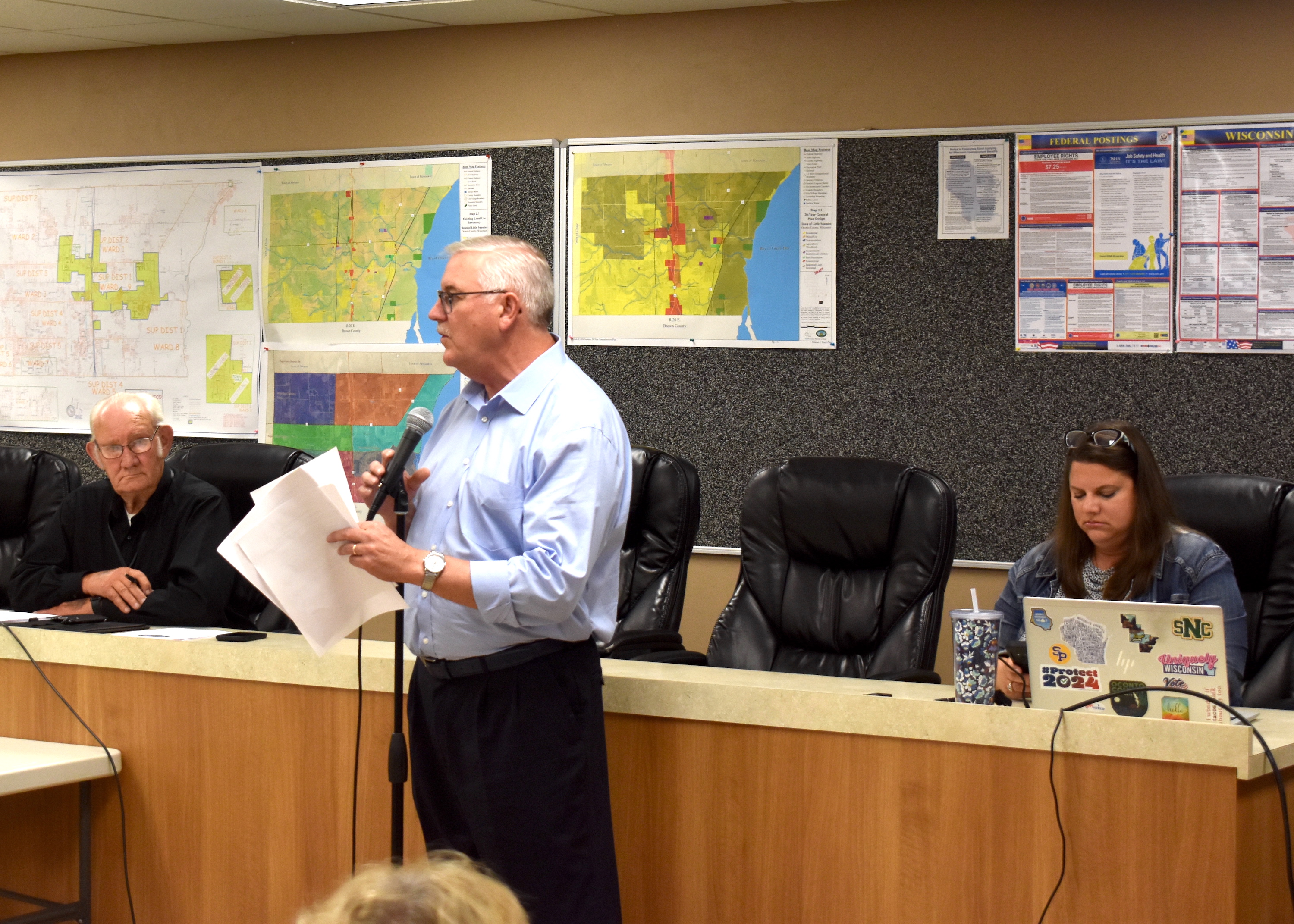
Oconto County officials say the proposed new five-year library services plan creates a more fair funding system that takes some of the pressure off municipalities not currently served by libraries.
County Administrator Richard Heath, County Board Chairman Al Sleeter and County Clerk Kim Pytleski spoke at public hearings Aug. 15 and Aug. 20 in Gillett, Little Suamico and Lakewood to explain the revised plan, which was developed over the past 18 months by a special ad hoc committee.
Speaking at the Little Suamico Town Hall, Sleeter said the committee explored almost every avenue of funding the system, including a consolidated library system merging the six independent libraries, which didn’t go over because the communities didn’t want to relinquish local control of their libraries.
“I also realized it wasn’t beneficial to the county to create another department,” Sleeter said. “When you talk about a consolidated library system, then the county’s involved in agreements or possession of all the buildings, all the employees, and you’re basically expanding the government.”
The focus turned to finding a more equitable way to collect and distribute the property tax for library purposes, he said.
“What we’ve come to here is, I think, a really good plan for the next five years to help level the playing field as far as the tax burden is concerned,” Sleeter said.
Pytleski explained that three cities, two villages and 12 towns tax their residents directly for the services provided by the municipal or joint libraries in Oconto, Oconto Falls, Gillett, Lena, Suring and Lakewood. The other 11 towns and one village — considered “unlibraried” because they are not part of those six local systems — pay taxes to the county to reimburse the libraries.
As more municipalities bought into the joint libraries in Lakewood, Lena and Suring over the past decade or so, the tax burden on the remaining unlibraried municipalities grew larger, she said. The math involved with shifting to a consolidated county library actually increased the burden on those municipalities.
“One of the things that we were asked to consider is how do we give relief to towns, especially those that are unlibraried, because they don’t have a seat at the table,” Pytleski said. “They don’t have a say in how libraries are run; they’re not on the library boards.”
An annual review is built into the new plan to avoid the funding imbalances that led to the need for an extended study, Pytleski said.
“Over the previous five years, there were changes to the structure of our library agreements, but there was no financial change to reflect when those changes occurred,” she said. “That was something this new plan will take into consideration. It’s written that it will be reviewed annually.”
The new plan follows state statutes by providing local libraries with a minimum of 70% of the amount determined by dividing each library’s operational expenses by the total number of loans reported, not including capital expenditures or federal funding. The committee found that the libraries in Oconto Falls, Gillett, Suring, Lena and Lakewood have been getting more than the minimum, while Farnsworth Public Library in Oconto was under that amount.
The county also pays Brown County — and, to a lesser extent, other neighboring counties — for services used by residents of the unlibraried municipalities in those counties’ libraries. In 2024, Oconto County budgeted $457,035 to support the six local libraries and $157,048 to other counties.
The proposed 2025 allocations have been adjusted to ensure compliance with the statutory minimum, according to a fact sheet prepared by the committee. The result is a reduction in the allocation for Oconto Falls ($15,623), Lakes Country ($10,344), Gillett ($7,803), Suring ($6,261) and Lena ($5,534), and an increase of $9,857 for Oconto.
The final five-year plan is expected to reach the full Oconto County Board for approval when it meets Sept. 19.
wbluhm@newmedia-wi.com
Proposed library services plan rolled out