A good home, secure from the weather and a solid place to raise a family not only works for us humans, but also for the birds. One species of birds that especially needs our help with home building is the purple martin.
The purple martin is hard to miss. It’s North America’s largest swallow. According to The Cornell Lab All About Birds (AAB) website, it is one of the earliest South American migrants to arrive in the spring. Older males arrive in Wisconsin as early as late March, the females a bit later. The adult male is a striking glossy bluish purple that seems to glow in the sunlight; the wings and tail are brownish black. Females are duller in color with varying amounts of gray on their heads and whitish lower belly.
Masters of flight, purple martins get their food (insects) and water, according to AAB, on the wing. They snap up insects (e.g., mayflies, wasps, dragonflies, etc.) while in flight but also water by scooping it up in their lower bill as they skim along its surface.
Purple martins are considered cavity nesters. Herein lies the rub. Natural cavities such as those occurring in older trees or the tops of old wooden fence posts are lacking in our modern developed landscape.
In addition to the lack of housing, according to AAB, the martins suffer from competition for nesting sites and predation of eggs and young from aggressive house sparrow and European starlings. Fewer insects due to pesticide use has reduced the amount of food available to the birds.
What is helping to conserve the purple martin population is people, people who put up purple martin houses and tend them. According to AAB, in eastern North America purple martins nest almost exclusively in human-built nest boxes near cities and towns. Providing housing for purple martins is an age-old tradition; even the early Native Americans hung empty gourds for purple martins to use as nest sites.
Over the last several years, Bird City Oconto has been helping to boost purple martin numbers by providing three purple martin houses at City Park, and another two houses at City Docks. This year, the houses provided homes for 122 adult martins and 250-300 young, a record year.
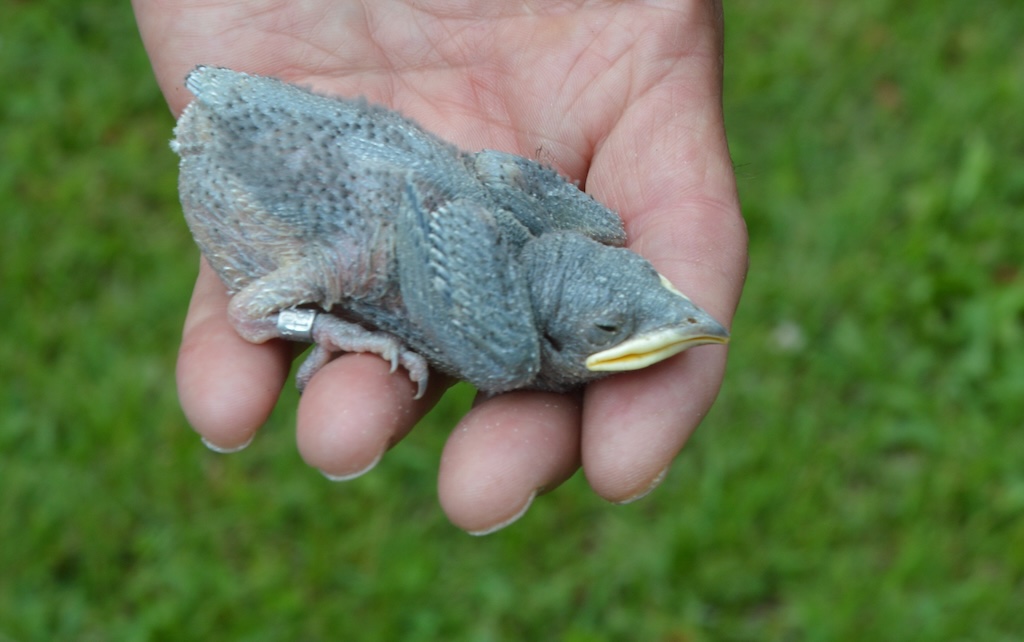
Banding purple martins helps us learn more about these birds and how to help them. This year the Wisconsin Purple Martin Association’s (WPMA) 15th annual MartinFest held at City Park in Oconto on June 28 provided information on bird banding.
Dick Nikolai, an expert on purple martins and board member of the WPMA, demonstrated how he bands the martins. While gently cradling the bird in his hand, he affixes a numbered band onto one of the bird’s legs using a special bird banding pliers that prevents injury to the leg. All the purple martin chicks at City Park and the city docks in Oconto are fitted with bands, as are some of the adult birds.
Bird banding is an important conservation tool within the Migratory Bird Program of the U.S. Fish and Wildlife Service. The bands provide information on breeding and wintering locations, behavior, migratory routes, survival and reproduction that is used to help manage and conserve birds. You can contribute to this effort, by reporting bird bands you find on any species of dead birds including those legally harvested during hunting seasons. To report bird bands, go to http://www.reportband.gov.
Since 2013, the Wisconsin Department of Natural Resources has listed the purple martin as a species of special concern.
According to Dick Nikolai, the purple martin population has declined 5-6% annually over the last 55 years in Wisconsin. There are no longer purple martins in the northern one-quarter of Wisconsin, and the population in the northwest part of Wisconsin has declined due to the tornados that passed through this area from 2021-2023.
If you are interested in helping purple martins, check out the WPMA’s website, which provides a wealth of information and guidance on how to construct and manage purple martin houses. It is a time commitment, but well worth it and with lots of great support.
You can also donate to Bird City Oconto. Because the purple martin houses at the City Docks are full, they would like to purchase another martin house for this site. Donations can be made to Bird City Oconto at the Oconto City Hall by calling 920-834-7711.
The reward in helping these birds is seeing them move into new housing and the satisfaction of knowing you are part of a larger conservation effort. And the purple martins will certainly repay your efforts with their lively company, chatty songs and calls, and their aerial acrobats as they pursue and catch a myriad of insects in your own backyard.
Cathy Carnes is a retired biologist in Oconto who worked with the U.S. Fish and Wildlife Service Green Bay Field Office and prior to that with the U.S. Army Corps of Engineers Regulatory Branch in Buffalo, New York. As endangered species coordinator for the USFWS, she helped conserve and recover federally listed threatened and endangered species in Wisconsin.
Purple martins need good homes in northeast wisconsin