I recently participated in the 27th annual Acadia Birding Festival in Maine.
After each bird festival I attend, I reflect upon my experience. Not only does it help to solidify what I learned while birding, e.g. bird identification field marks and new bird calls, but it also helps to bring some thought-provoking lessons to light. I thought I’d share some of these with you.
Lesson 1: The grass is not greener on the other side.
My first experience birding out west was the Festival of Cranes at Bosque del Apache National Wildlife Refuge in New Mexico. On my list of birds I hoped to see was the western meadowlark. One day, I joined a busload of birders to ride around the refuge. We were instructed to yell out when we saw a bird, and the bus would stop so everyone could get out to see it.
It wasn’t long before I saw it, atop a telephone wire in all of its glory. I hollered with all my might, “Stop!” They asked what I saw, and I joyfully answered, “A western meadowlark.” My reply was met with immediate laughter as the bus continued on. “What?” I asked, confused.
Someone wittily replied, “We see those all the time. They are not worth getting out of the bus for.“
Later, as we were driving through woodlands, someone yelled, “Downy woodpecker!” The bus came to an abrupt stop. Everyone jumped up and hustled out as they quickly raised their binoculars to get a look at this bird that I see almost every day through my kitchen window.
As they climbed back into the bus with ear-to-ear smiles and giddy laughter, someone saw me seated and asked, “Don’t you want to see the downy?” I facetiously replied, “I see those birds all the time. They aren’t worth getting out of the bus for.”
While everyone laughed, it became clear – the excitement value of a bird to a birder often depends on where you live and how often you get to see it. However, as I watched birders marvel at my everyday birds, I began to once again find beauty in and appreciation for those birds. Through their eyes, I realize that the birds I regularly see in Wisconsin are just as remarkable as the birds elsewhere.
Lesson 2: Especially when you are traveling, don’t disregard a bird because you think it is a bird you know.
While birding in the Baja Peninsula, I kept seeing what I thought were northern cardinals. Able to see them often in Wisconsin, I spent my time photographing birds I don’t usually see. The exception was photographing one of these birds, because it posed on a cactus in beautiful light.
When I got home and looked at the photo more closely, I discovered it was not a northern cardinal but rather a pyrrhuloxia, a beautiful bird I’d never seen before, found only in the southwest U.S. and northern Mexico.
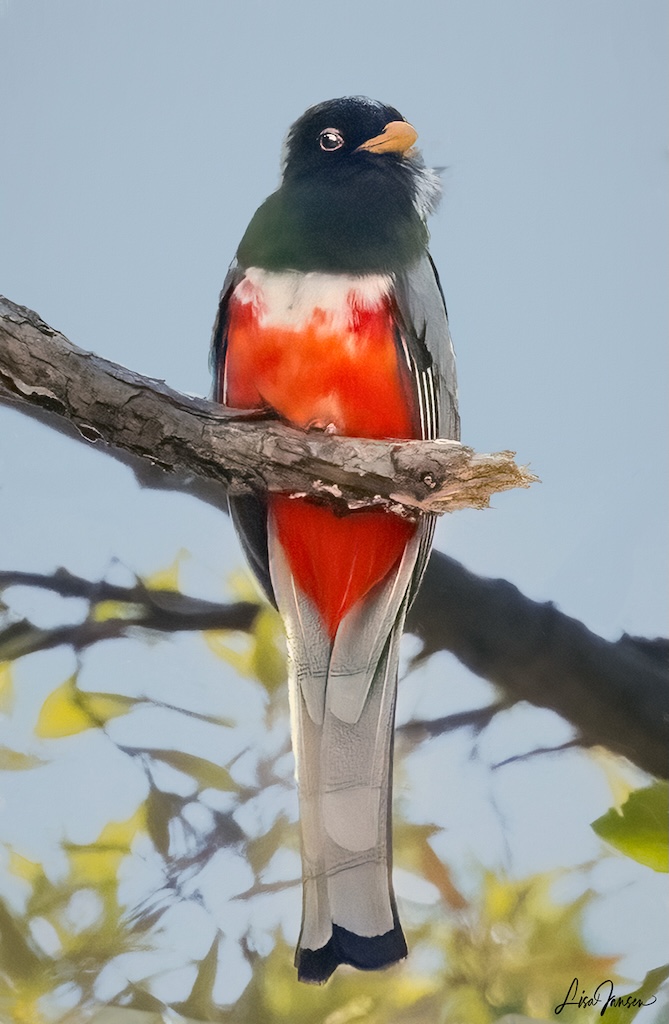
I had never heard of an elegant trogon, but while birding in the Huachuca Canyon in southeast Arizona, I learned this area was one of the few places in the U.S. to find one. With determination and learning its odd croaking call, I found one. It was quite large and stunning with a dark head, white chest band, red belly, yellow bill, and metallic green back perched upright with a squared-tail. An unforgettable sighting.
Years later while birding in Panama, someone asked “What is that bird?” Recognizing the silhouette I replied, “It is an elegant trogon.” I was correct about the trogon part, but unbeknownst to me, there are 47 species of trogons in the world. This one was a black-tailed trogon. I made the mistake of not considering there may be other birds that are similar but not the same species of bird as one I know. Studying the birds where you are traveling will help.
Had I not learned this lesson, I could have easily misidentified mangrove swallows for tree swallows, a pygmy nuthatch for a white-breasted nuthatch and a Mexican chickadee for a black-capped chickadee, just to name a few.
Lesson 3: Traveling helps us appreciate what we have here at home.
No matter where I go and how unique and exciting the birds, plants and animals are, I am always happy to be back home. Not only is it the feeling of being safe, happy and at peace, but it is also a realization. As I return from a trip with fresh eyes, I see the most amazing natural world right here in Wisconsin. There really is no place like home.
Whether your travels take you near or far, I hope you consider these birding lessons from the road. They will keep your eyes and mind open to new birding experiences while keeping your heart close to home.
Lisa Jansen is a Wisconsin master naturalist, nature writer and award-winning photographer. She specializes in raising awareness of birds and butterflies of the Midwest.
Birding lessons from the road