Individual report cards for students contain the culmination of all the work they’ve done in school. But the school report cards issued by the Wisconsin Department of Public Instruction are considered by many school districts — including Wittenberg-Birnamwood — to be a snapshot and not show all that schools have done to ensure students are learning.
The DPI report cards were discussed in detail Dec. 16 by the Wittenberg-Birnamwood School Board as they tried to understand why the elementary schools received a three-star rating indicating they met state standards, while Wittenberg-Birnamwood High School only received two stars.
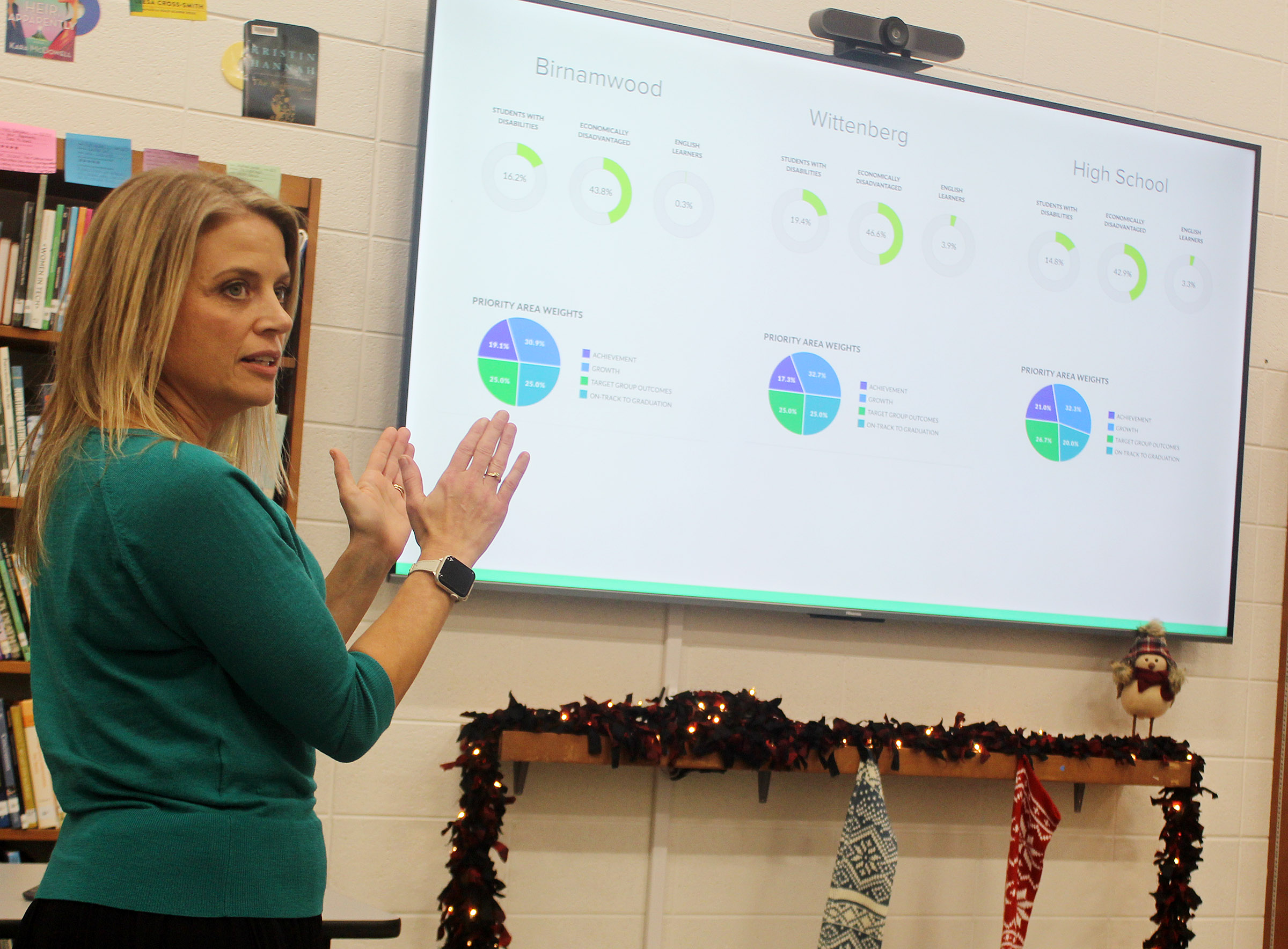
The recommendation from Kara Muthig, the district’s psychologist and data analyst, is not to read too much into the scores, because factors differ from district to district. There are four things that determine a district’s score — achievement, growth, target group outcomes and whether students are on track for graduating in a four-year period. The problem, according to Muthig, is that those four items are not factored evenly among districts or even between schools.
“It really isn’t apples to apples or oranges to oranges when you look at report cards,” Muthig said. “If you look at our report card compared to Antigo’s report card, they actually aren’t weighted the same on how they calculate the scores, which is kind of deceiving, unless you know about it.”
Muthig added that demographic numbers are not the same even within the three schools, so the scores come out vastly different. Schools and districts with low percentages of students receiving free and reduced-price meals have a higher percentage of their score going toward achievement over growth, while it’s the flip side for schools in poorer areas.
That frustrated some board members, as schools’ results are publicly released but DPI is not always clear on why certain factors gave a school its particular score.
“Why don’t they make it so it can be compared?” asked board member Rich Olson.
Board member Trevor Szutkowski also expressed frustration, noting that Antigo High School scored worse on achievement than Witt-Birn, but then wound up with a higher overall score.
“It’s just mind blowing to me,” Szutkowski said. “We had great growth last year, but how can you continue to have great growth year after year? You can’t just expect to grow in leaps and bounds every year. It’s almost setting these rural school districts up for failure.”
Muthig noted that Wittenberg Elementary-Middle School did better on growth, while Birnamwood Elementary-Middle School performed better with achievement. Yet, the two schools had almost identical scores when the report cards came out. There were also questions on how the elementary schools had three stars this year but had been rated four stars in the past.
Board member Dan Stewart noted that the district has its own data on student learning and suggested looked at doing an internalized report card that looks at all the testing and learning in the school district.
Chronic absenteeism can impact schools’ scores, Muthig said, and the district was below the state average, although she noted that Birnamwood Elementary individually was above. The district will be sending out letters regarding the importance of being in school every day if healthy.
“Our overall attendance is pretty good, but that chronic absenteeism, sometimes we have to watch that,” Muthig said.
Muthig noted that the district isn’t able to compare its results this year with last year’s due to the changes made to scoring thresholds on the Forward exam, which is distributed to grades 3-8.
Olson said the DPI system needs some work so that average people can understand it.
“They understand that students with disadvantages are going to need more help,” Olson said. “If your potential for the growth is with those students, I see that as a weighted average and having more impact. We all want everybody to grow, yes. We all want to succeed, yes.”
Megan Rothmeyer, WBHS principal, noted that her school continually tries to improve, and she tells families that even if WBHS only has two stars, that doesn’t mean it’s falling behind on learning.
“We’re trying to improve everyone’s growth overall,” Rothmeyer said. “I tell the kids that I’m proud of our academics here, but there’s always room for growth. So we try to grow a little bit every year. It’s not just about the stars. There’s so much more that we do here.”
lpulaski@newmedia-wi.com
AT A GLANCE
School and district report cards include outcomes in four priority areas:
• Achievement measures the level of knowledge and skills among students in the school, compared to state and national standards. It includes a composite of English language arts and mathematics performance by the “all students” group in the Wisconsin Student Assessment System (WSAS) for all tested grades in the school.
• Growth measures changes in students’ English language arts and mathematics performance over time. Each student’s value-added score is calculated based on test score improvement from the prior year to the current year compared to similar students statewide. Similar students statewide are determined using the following variables: prior test scores, economic status, race/ethnicity, disability status, gender and English learner status. District and school value-added scores are an average of value-added scores across students.
• Target Group Outcomes demonstrates outcomes for students with the lowest test scores in their school — the target group. Outcomes are displayed for achievement, growth, chronic absenteeism, and attendance or graduation rate.
• On-Track to Graduation indicates the success of students in the school in achieving educational milestones that predict postsecondary success. It includes chronic-absenteeism and the graduation rate for schools that graduate students, or the attendance rate for other schools. It also includes measures of third grade English language arts and eighth grade mathematics achievement, as applicable to the school.
Source: Wisconsin Department of Public Instruction
Witt-Birn board looks at report card results