Every year, dozens of deer hunters nationwide die not from an errant bullet, but from a heart attack while dragging out their prized buck or tasty doe.
Hunters 35 and older, especially those who smoke, chew tobacco or are overweight, may have a ticking time bomb inside, according to the Heart and Vascular Institute of Wisconsin.
“Hunting can be a lot a more work than people give it credit for,” said cardiologist Dr. Tom Wilson. “You might be sitting still for long periods of time, but hiking out to your spot, climbing up the stand and dragging a deer back to your vehicle can all put a lot of strain on your heart. Even just seeing a deer can be enough to get your heart racing.”
“As you get older, your chances of having damaged or narrowed arteries increases, as well as your chances of having weakened or thickened heart muscle,” added cardiologist Dr. Ben Ciske.
A simple $25 CT scan can determine the amount of calcified plaque build-up in your heart and arteries, potentially saving you an ambulance ride — or worse.
Some hunters like to travel light and sometimes prefer to do things the hard way, the same as they did when younger and in better health. But thinking smarter about moving a deer, whether it’s an 80-pound doe or 200-pound buck, could make the hunt more enjoyable and potentially save your life.
Let’s take a look at some of your options, whether it’s a new four-wheel-drive pickup truck, an all-terrain vehicle or something a bit more affordable.
If you hunt on private property that has plenty of dirt roads and wide trails, the truck, a family SUV or van, or an ATV, are obvious choices. Drive up, get a hunting buddy or neighbor to grab two legs and toss it in the back.
Deer have a habit of dying in ravines, creek bottoms, swamps and on top of steep hills. Many of us hunt on public land that may not allow motorized vehicles. The tried-and-true rope or tree stand back harness with strap are two easy-to-carry options that work, if you are fairly strong and in decent shape. There are much smarter and easier choices.
Enter the high tech e-bike, a battery-powered marvel that can move you and a deer through thick brush at speeds exceeding 20 mph, depending on motor size and gearing. Some of these mountain bike designs have fat tires as wide as 4 inches for traveling over timber and snow and may weigh more than 80 pounds.
QuietKat, Bakcou and several other brands cater to hunters, offering attachable wheeled carts that make it easy and fun to move a deer, tree stand, ground blind or other gear in style. The electric motors are much quieter than any gas machine, too.
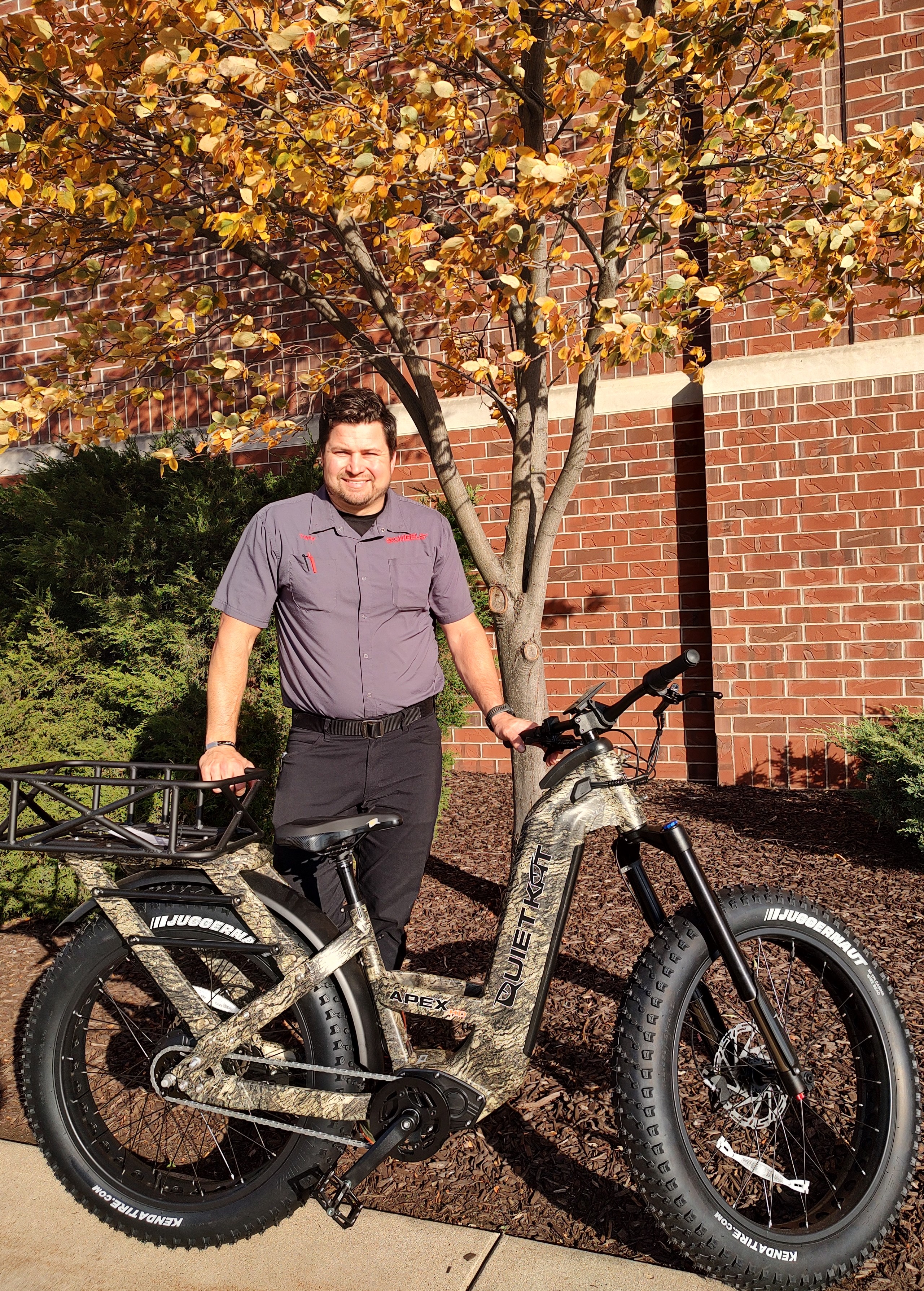
These beefy, cargo haulers are very popular in Western states and have started to catch on here for big game hunting, according to Taylor Bentz, bike and service shop leader at Scheels in Appleton.
He demonstrated one model of QuietKat, the e-bike brand that has focused most of its attention on hunters, as well as Bakcou, a popular brand that may be phased out at his store.
Both brands use popular Bafang Chinese motors that have been extensively tested.
They also both feature variable power output (VPO) to allow riding on public trails and private land. Some bikes are rated class 1 (motor requires pedaling to assist, top speed of 20 mph and often allowed on most bike trails); class 2 (throttle can be used separately or in tandem with pedals, top speed of 20 mph and allowed on some trails); or class 3 (pedal assist only to 28 mph, generally allowed on roads but not bike trails).
The VPO feature is like having all three bikes in one for use in most situations (check your trail rules before riding).
The 1,000-watt standard motors use either a 15 amp hour standard battery or 30 amp hour upgrade battery for 25-30 miles on a charge (the more throttle used, the more the battery drains). It takes about six hours to restore the battery to 80% power. Cold weather saps battery life, and the battery should be stored indoors during the winter, Bentz said.
The QuietKat HD model shown with this article has an internal two-speed hub drive to eliminate the derailleur that hangs down on many off-road e-bikes, which can catch on cornstalks and brush.
Tires are 4 1/2 by 26 inches, and hydraulic disc brakes provide quick stopping.
The Bakcou uses a mid-drive (which typically produces more torque than a hub drive) and offers models with external or internal gearing.
The QuietKat HD sells for about $4,000, and the Bakcou is $4,500.
QuietKat offers a game trailer and a cargo trailer that attach to the frame for hauling deer and gear.
I’ve had great luck moving deer with wheeled carts made especially for the job, and sold at Fleet Farm, Cabela’s, Scheels and other sporting goods stores. The biggest buck I ever shot (on public land, mind you) occurred in the early 2000s, and I had just bought a deer cart. Once I managed to drag the 168-pounder onto the cart (the hardest part), I had a nice, easy downhill jog behind the cart toward my van — much like a mom jogging behind her stroller, That folding steel cart was worth thousands that day but cost me under $100.
Avoid cart tires that require air, because they will go flat at the worst possible time. Also opt for wheels with large, plastic spokes, as opposed to the bicycle-type wire spokes that can easily bend in thick brush.
If you are too cheap to buy a dedicated deer cart, consider some lightweight lawn carts, although they may buckle under Ol’ Mossy Horns. The small wheels may prove trouble, but for smaller deer, it’s better than dragging.
Ice fishermen have discovered the plastic sled for hauling buckets, rods, tackle boxes, augers, heaters and even occasionally fish. The heavy-duty sleds made by Otter, Shappell, Eagle Claw, Clam, Pelican and others work great on the ice, whether pulled by an ATV, snowmobile or human, but they also shine in the woods for deer carcasses and hunting gear.
You don’t need a thick-bodied, overbuilt sled to move even a big deer, however. Those oversized plastic sleds made for snow hills work perfectly for venison evacuation. They slide over dry leaves and sticks with ease. Some frugal hunters even use those little roll-up plastic sleds, although I have not tried it. I keep a sled in my van or at my favorite hunting spot for that rare occasion when I actually kill one.
A friend of mine shot three deer in one day during gun season. After I helped him gut and drag out the morning deer (he used a modified golf cart bag with wheels that kept tipping over), he shot two more in the afternoon. He paid $40 to a father-and-son duo to field dress and drag out those last two. That was a bargain at the end of a very long but successful day.
How do you move your deer out of the woods? Maybe you have a new idea that you’d like to share with our readers.
Save your heart: Use these tips to get deer out