
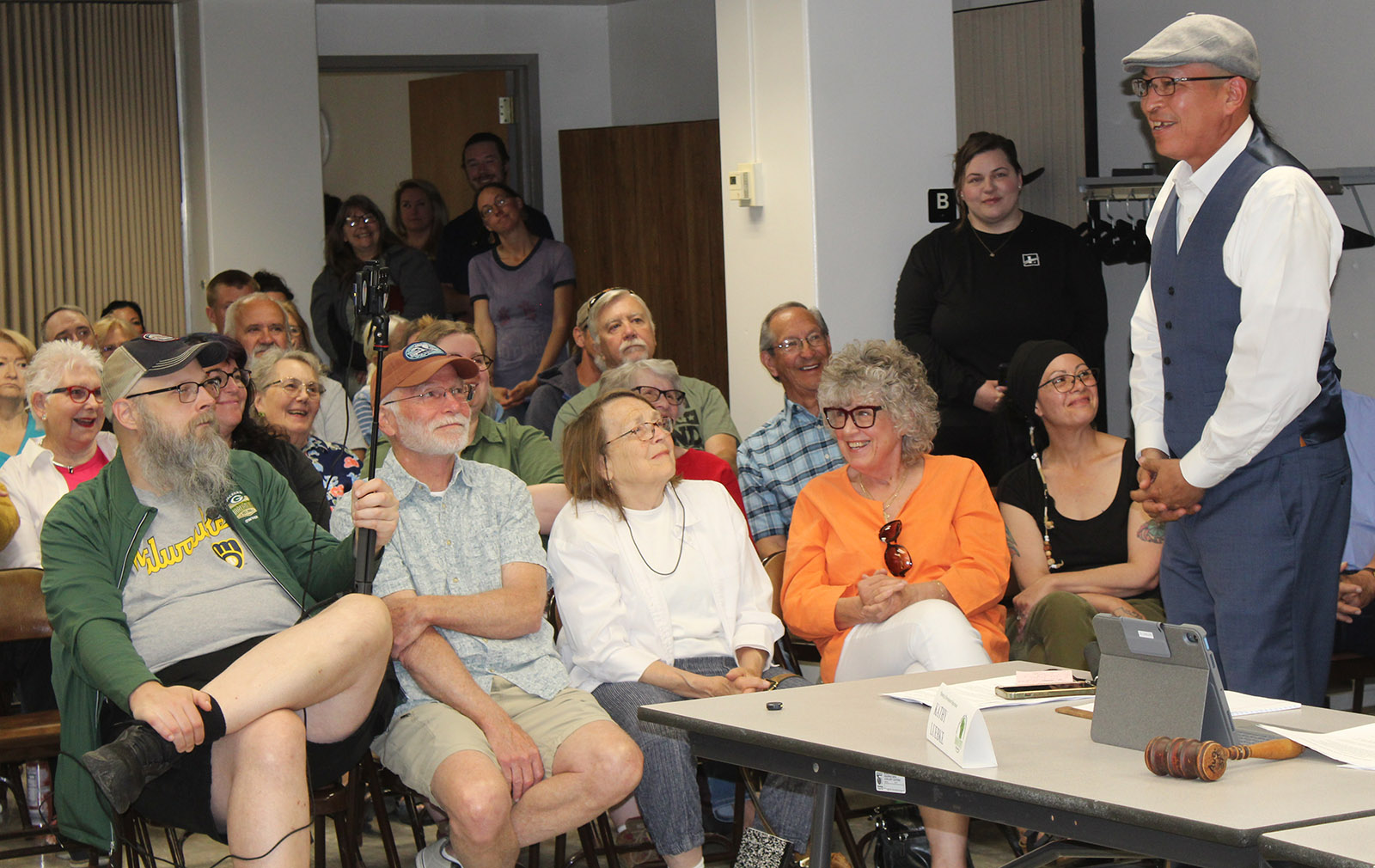
Members of the Shawano County Planning, Development and Zoning Committee voted unanimously June 3 to halt development of data centers for the next 12 months.
The moratorium on the siting, construction, establishment and operation of data centers affects only those towns in the county that are under the county’s zoning rules. It does not affect any cities, villages or the towns of Almon, Bartelme, Belle Plaine, Hartland, Hutchins, Lessor, Pella, Richmond and Wescott, all of which have their own zoning laws.
The matter will go in front of the county board June 24 for final approval.
“At that time, we’re going to study, analyze and look over ordinances or whatever needs to be done,” said Kathy Luebke, committee chairwoman, in describing what’s next if the county board gives the OK. “We want to keep the public involved and informed.”
More than 100 people attended the public hearing, and several dozen addressed the panel.
“Once these data centers come in, it is damn near impossible to get rid of them,” said Bonduel’s Gracie Waukechon. “We really need to take a year and figure out how this will impact us economically, how this will impact us ecologically and how it will impact everyone in Shawano County seven generations ahead.”
She noted that large data centers can require up to 5 million gallons of water each day to cool the infrastructure.
“I would rather our water goes to supporting our farmers,” she said. “This is going to pollute our waters. It’s going to pollute our air.”
Marion’s Sarah Brewer cited several issues, including noise pollution; water usage; water discharge that is warmer than before, which can harm fish, aquatic life and drinking water; high electrical costs for the community as infrastructure updates are needed; and misleading job promises.
Spencer Gauthier, of Gillett, is a gaming professional working spent years analyzing data and metrics. He said he can’t perform as efficiently as his younger peers if he does not use AI.
“We have beautiful land here,” he said. “We have farms. We have timber. We have loggers. We have farmers. We have dairy. We’re neighbors. This is our community. We love it here.”
Gauthier said pollution from data centers would harm fishing and other water sports.
“This is the best place in the world to live,” Gauthier said. “This (moratorium) needs to happen all throughout the state, because we’ve seen what happens. They don’t care about us. They don’t care about our land. They don’t care about our water. All they care about is their profits. We can do better. We deserve better. Let’s not let this happen. Let’s push back on this.”
Kyle Waelchli, zoning administrator, said no company has approached officials about constructing a data center in the county.
Sarah Zarling, a statewide activist from Watertown, congratulated the committee on taking action before it is too late.
“I really commend you for even considering the moratorium,” she said. “In the data center space, I believe it to be the most important issue to address.”
She said that in Beaver Dam in Dodge County, where a data center is being built, there are reports of wells drying up, water contamination and cracked foundations of nearby properties, with no protections in place to help those affected.
“It’s very vital that, moving forward, we need to pause new data center approvals and take a step back and get protections in place for residents and communities,” Zarling said.
Shawano’s Lori Hayes said any data center should be required to be a good community member like any other business.
“Rules can be put into place that make them give money back or provide energy back to the county that they’re actually living in, so that they’re not a user, they’re now part of the community,” Hayes said. “They can be part of a community, but they have to be responsible members of a community.”
In May, residents packed the Pella Town Hall for a discussion about data centers and solar farms, with several residents noting they have been approached by firms interested in their land.
“The impact of data centers does not stop at the edge of the town,” Pella resident Marcena Neil said. “It doesn’t stop at a property line. We share groundwater. What affects one absolutely affects the other.”
Lucas Hartwig, of Shawano, said he used AI a lot to learn different things, but he added that because so much knowledge is now available online, he interacts less with friends, neighbors, teachers and others.
He also said that even though he personally learned from AI, the good of the community outweighs any personal benefits.
kpasson@newmedia-wi.com

State Sen. Eric Wimberger registers to speak at a Shawano County public hearing June 3 on whether to have a 12-month moratorium on the development of data centers. Pictured with him are Supervisors James Radtke, left, and Curt Korth. (Kevin Passon | NEW Media)

Desirae Grignon, of Neopit, speaks in favor of Shawano County temporarily halting any development of data centers. She and others expressed concerns about noise pollution, water usage, high electric rates, damage to lakes and rivers, fish and aquatic life, and how they affect tourism, housing and lifestyles. (Kevin Passon | NEW Media)

This is a rendering with a northeast view of the Lighthouse campus, a massive $15 billion-plus artificial intelligence data center located in Port Washington. Developed by Vantage Data Centers with major tech tenants OpenAI and Oracle, the 672-acre campus is scheduled for completion in 2028. (Contributed)

This is a rendering with a southwest view of the Lighthouse campus, a massive $15 billion-plus artificial intelligence data center located in Port Washington. Developed by Vantage Data Centers with major tech tenants OpenAI and Oracle, the 672-acre campus is scheduled for completion in 2028. (Contributed)


