
We try to keep our family vacations real and natural. That means we avoid Disney World and other theme parks like the plague. The natural world is so much more unpredictable, and it’s reality, not fake concrete waterfalls and $20 plastic mugs.
I’m always surprised at people who spend a week in Florida and never see a roseate spoonbill, an alligator or live sand dollars at the beach. And you will never stand in a long line to see nature in natural habitat.
My wife, Michelle, is a master at planning vacations. When we decided to return to Myrtle Beach, South Carolina, this June, she mapped everything out and booked our nights on the road and our beachfront condo months in advance. Our daughter, Kalispell, and Michelle’s dad, Roger Nitschke, of Oshkosh, were joining us.
When Michelle booked the condo through VRBO, we never realized that the Cherry Grove Beach location would play an important part in finding ancient treasures we hadn’t expected.
After a few days of collecting shells, we planned to go to Murrells Inlet to look for shark teeth.
Michelle had read that it was a hotspot for them, but when we did further research online, we found that our condo was smack-dab in the middle of one of the best beaches in the state for them.
I started looking up shark tooth hunting clubs on Facebook, and the first video I watched of some successful hunters was a stretch of Cherry Grove Beach about 300 yards from our condo.
We canceled the trip to Murrells Inlet and went back to our beach.
Like morel mushroom hunters who have never found their first ’shroom, Kali and I had no idea what to look for. One morning, I walked all the way north to Cherry Grove Pier about 8/10 mile away, and stumbled upon an elderly gent patiently sifting the sand with an odd long-handled sifter with a small round end that looked like a golf-ball retriever.
I struck up a conversation with John “Butch” Aughtry from Charlotte, North Carolina, who said he had been hunting shark teeth since childhood. He showed me a small pill bottle half full of tiny, black teeth that still had their serrations along the edges. Most were about the size of a pinky fingernail. I had been looking for something two or three times bigger.
“For every 100 black teeth, you find one white one,” he explained.
The black ones are fossilized, having absorbed the phosphate from mineral deposits in the soil where they rested for thousands of years. The white ones are from live sharks. According to online experts, one shark can shed up to 30,000 teeth in its lifetime. There are other colors, too, including one in the Carolinas called “Carolina cream.” This explains the color variations: https://www.fossilguy.com/topics/shark-teeth-colors/index.htm.
Aughtry dug at least three teeth from the sand while I watched him. He’d see an edge sticking out of the sand, usually next to a pile of shells that the tide had brought in.
“Look for piles of shells, and you’ll find shark teeth,” he said.
I thanked him for his help and hurried back to the condo with my newfound knowledge.
I ran into two members of a local tooth-hunting club (one was wearing a club shirt), who advised hunting three hours before and after high tide. High tide brings large quantities of seashells and other materials from the ocean floor, including these toothy treasures of the deep.
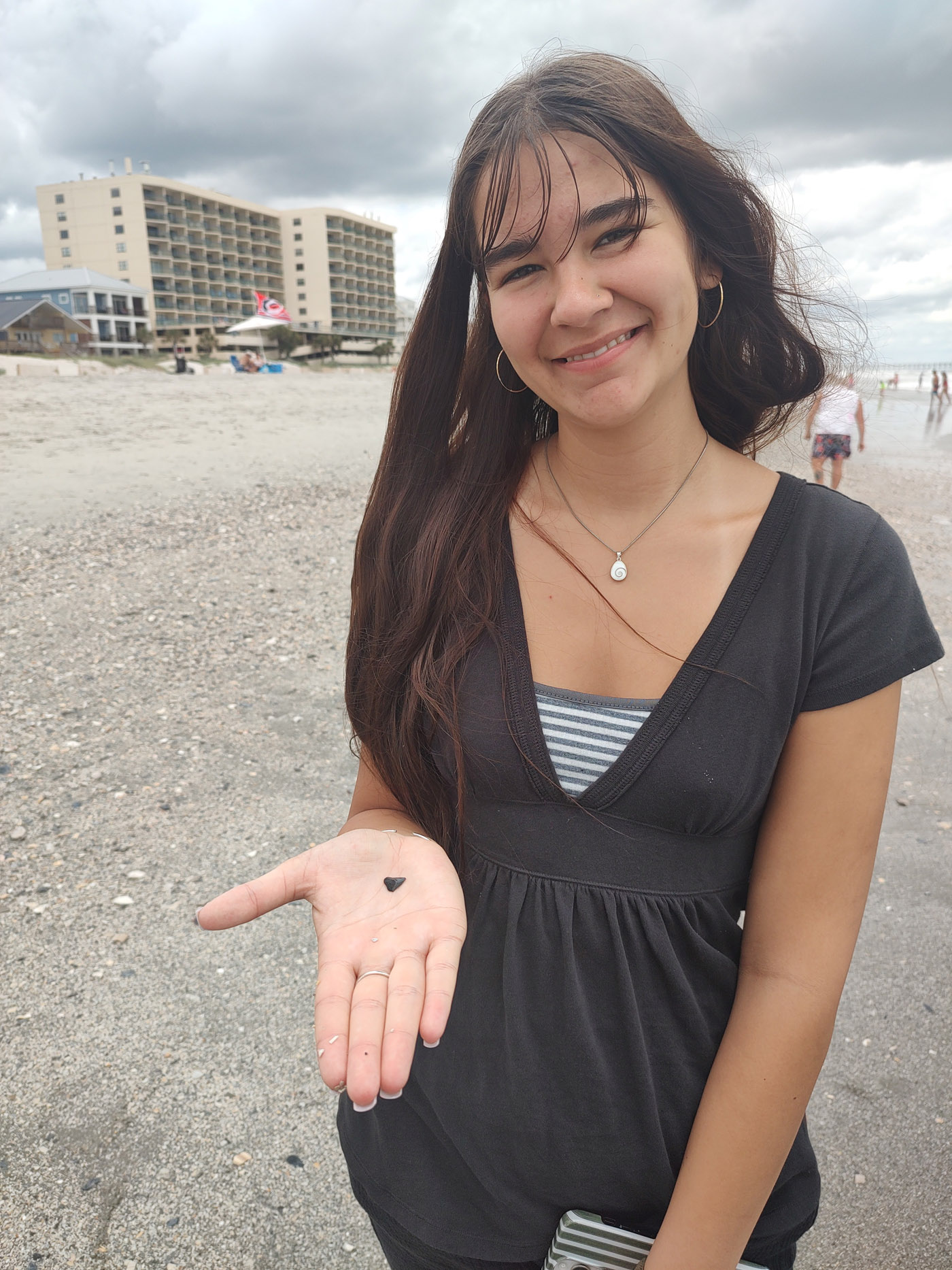
With renewed enthusiasm, Kali and I hit the beach again on our last day. Kali crouched down near a large mound of shells, and in about 10 minutes let out a shout: “I found one!” It was a near-perfect black shark tooth, bigger than most of the ones Aughtry had found earlier.
I began searching where the water lapped at the shore, in the same area with large shell deposits. Although many shells and pieces are black, I spotted a flat one with an unmistakable triangle shape and grabbed it before the next wave hit it. Jackpot! It was a black beauty, slightly larger than a dime, with clear serrated edges. Our first shark teeth were the highlight of our trip.
We are already planning our next shark tooth hunts, perhaps going for megalodon teeth normally found by diving. I have purchased some of these giant teeth that belonged to the largest animal on earth, prehistoric sharks that exceeded 60 feet and made T. rex look wimpy.
There are many books on the topic and plenty of information online, too. When seashell hunting gets boring, look a bit closer for these fascinating fossils that will grab your attention and take a nice bite out of your beach vacation time.
Ross Bielema is a freelance writer from New London and owner of Wolf River Concealed Carry LLC. Contact him at Ross@wolfriverccw.com.


