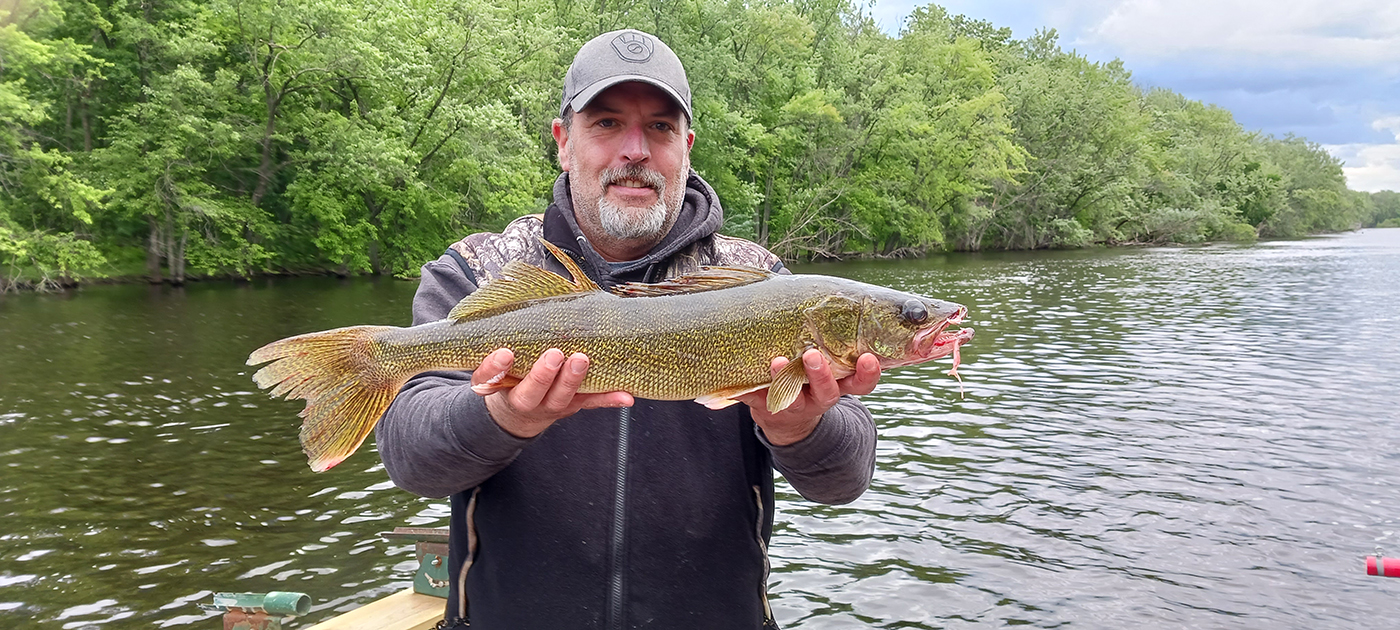
State fisheries biologists have cracked the case of more than 100,000 “missing” walleyes that were not spawning in expected locations – and it may take genetic testing to prove that most of these baffling fish were simply following their natural instinct to return to their native waters.
Like a team of police detectives, Wisconsin Department of Natural Resources senior fisheries biologist Elliot Hoffman and his field staff remained persistent on finding about 110,000 walleyes tracked by their clipped fins and PIT tags. They were among more than 221,000 large fingerling fish stocked in Shawano Lake from 2011 to 2017.
Biologists expected to find the clipped-fin fish with most of the other walleyes during their surveys – done with spring netting and fall electroshocking – at two key locations: Schumacher Island and Rosenow’s Point, southeast of the island, Hoffman said. But very few were showing up during that seven-year span, Hoffman explained during a Feb. 11 seminar on fisheries surveys at Shawano Community Middle School.
Biologists finally cracked the case in 2023 during a comprehensive survey that included Loon and Washington lakes. Survey boats hadn’t travelled into the shallow inlets during previous annual surveys. During the 2023 survey, about 60% of the captured walleyes on the 327-acre Loon Lake had fin clips.
Stocked fish from the state fish hatchery are the Lake Michigan strain and instinctively head for their “home” waters, compared with Lake Winnebago fishery native fish that seek out rocky or marshy areas for spawning, Hoffman explained. He wants to confirm his theory with genetic testing to confirm these wanderlust walleyes are Lake Michigan strain fish.
Biologists began seeing a decline in the Shawano Lake walleye population in the mid-2000s. The DNR began stocking large fingerling fish (6-9 inches) every other year starting in 2011 on Shawano, Loon and Washington lakes. More than 220,000 have been stocked to date.
He praised the Shawano Chapter of Walleyes for Tomorrow, created in 2011, and the Figure 8 Muskie Club of Shawano for helping with stocking efforts and habitat improvements, as well as funding.
Walleyes for Tomorrow has been releasing more than 6 million fry walleyes a year, using a portable hatchery. The group is building a larger portable hatchery that expects to release nearly 12 million fry this year, under its DNR permit. WFT also donated $3,600 to help fund the genetic testing and has helped fund the dime-sized PIT tags, which are implanted in captured fish and used to monitor their movements.
“I like the teamwork,” Hoffman said.
The club stocking has revealed some secrets, too. They have found that younger 20-inch females produce more eggs than the older 24-inch fish they had used in previous years.
Regulations changes in 2016 dropped the daily walleye bag limit from five to three fish and increased the minimum size limit from 15 inches to 18 inches. Surveys are turning up more older and larger fish since then.
The seminar also discussed populations of Northern pike, muskies, panfish, trout and flathead catfish.
Hoffman encouraged area anglers to attend or provide input on panfishing during the April 14 DNR and Wisconsin Conservation Congress spring hearings held statewide.
Surveys show no black crappies more than 5 years old on Shawano Lake, primarily due to heavy harvests. The DNR is proposing an aggregate daily limit of 10 panfish to encourage the growth of crappies and bluegills.
For information on northern Wisconsin fisheries surveys, go to https://dnr.wisconsin.gov/topic/Fishing/north/springsurveys.
The 2024 Shawano Lake survey slides from the Feb. 11 presentation can be found at file:///C:/Users/Owner/Downloads/Shawano%20LakeWalleyeMovement_SurveyResults2024.pdf.
Curious about fish stocking on a particular lake? Check the DNR stocking database at https://apps.dnr.wi.gov/fisheriesmanagement/Public/Summary/Index.
DNR surveys uncover ‘missing’ walleyes