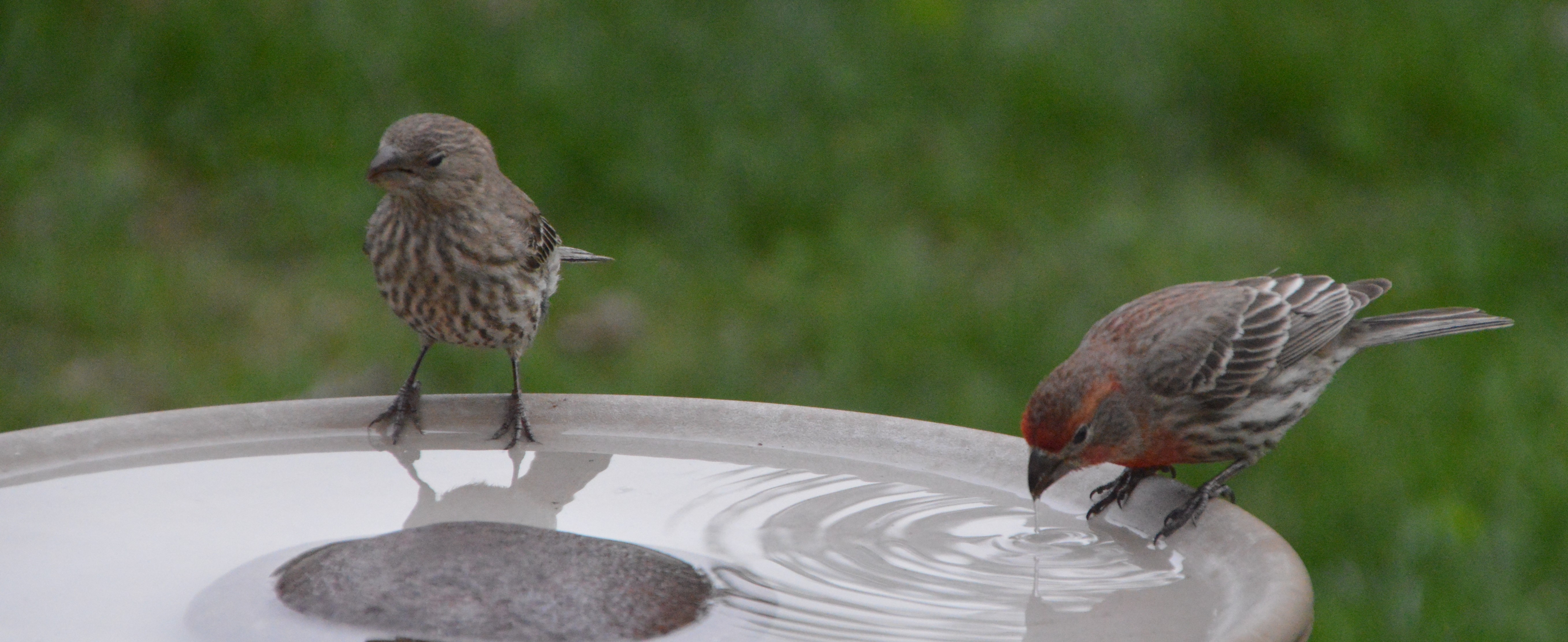
With fall well underway, we are seeing both house finches and purple finches at our feeders. They seem like old friends, some coming from the far north to spend some time with us as the world again slips into winter’s grip.
The two species of finches look much alike, and we have to remind ourselves each year of the markings that distinguish them from each other. The males have the brightest coloring, with the male purple finch sporting a raspberry red head and breast and the red mixing with brown on the back. The belly is off-white. The male house finch is also marked with red, but less so, having a patch of brown on top of the head and brown streaking along its sides and belly.
The females are much less showy. Both species are streaked with browns and whites and lack any red coloring. You can distinguish the female purple finch from the house finch by its white strip above the eye and another down the side of its throat. A pair of binoculars helps pick out these facial markings.
You are what you eat — or, more apropos for birds, coloring reflects what you eat. It’s interesting to learn from David Allen Sibley in his book, “What’s it Like to be a Bird,” that the red coloring in songbirds such as the finches, comes from eating carotenoid pigments found in red fruits and vegetables; these also contribute to a healthy immune system. Alan Haney, in his book, “Jewels of Nature,” notes that females of both species prefer males that are brighter red, perhaps because they are healthier or better at finding fruit, important attributes when raising young.
Heavy, short conical bills distinguish these birds as seed eaters. According to The Cornell Lab All About Birds (AAB) website, both species also eat soft buds, the nectar of flowers, and fruits including cherries, apricots and crab apples. While house finches do not eat insects, purple finches eat some; they are a small part of their diet and include aphids, caterpillars, grasshoppers and beetles.
The reproductive output of these finches varies significantly, according to Haney. While the purple finch raises one clutch of two to seven eggs per year, the house finch is busy raising three or more broods a year, each with three to five young. Haney notes that expanding house finch populations may have a positive outcome — their ability to outcompete house sparrows (a non-native species) for nesting cavities. House sparrows are aggressive when competing for nesting cavities and can limit nesting of other native songbirds, including bluebirds and chickadees.
The house finch has proved to be a survivor and wanderer. According to Haney, the house finch is only native to the western U.S. and Mexico. The story explaining its now-expanded range goes that it was marketed and sold as “a Hollywood finch” in the New York City area, but when this activity was made illegal by the Migratory Bird Treaty Act of 1918, many vendors and owners released their birds.
From the release of this small population of house finches, this well-adapted bird has winged its way throughout the U.S. and southern Canada. Official recognition of the house finch occurred in Wisconsin in 1983, and it now occurs year-round throughout its expanded range.
In contrast, the purple finch only occurs year-round throughout the region extending from the Great Lakes to the northeastern U.S. and southern Canada and along the West Coast. They breed mostly in the boreal forests of Canada and migrate south in the winter where they can be seen in the Midwest and southern states.
A finch conservation group called the Finch Research Network annually predicts the migratory pattern of the purple finch. The prediction is based on the condition of food sources used by purple finches in the boreal forests where they breed. These foods include the seeds of white spruce, tamarack, balsam fir and birch, as well as pit and deciduous fruit crops. These food sources can be affected by insect infestations (spruce budworm, tent caterpillar, etc.), drought and forest fires. When foods are more plentiful, fewer birds migrate south.
This year’s forecasts from the Finch Research Network predicts that the majority of purple finches that breed in Canada will migrate south to the Great Plains and southern U.S., with small numbers remaining in southern Ontario east to the Maritime provinces of eastern Canada. This means we will likely see more migrating purple finches this year.
According to the AAB website, both the house and purple finch are considered species of low conservation concern. However, some populations of purple finches may be suffering declines in areas now populated with the more recent arrivals of house finches.
We are lucky here in northeastern Wisconsin, snug up to Lake Michigan, that we are able to see both the house and purple finch year-round. We are likely to see more purple finches in the fall and early winter as they migrate south from the boreal forests of Canada. Providing them with their favorite food at our feeders, black oil sunflower seeds, helps them on their journeys and brings delightful color and song to our world.
Cathy Carnes is a retired biologist in Oconto who worked with the U.S. Fish and Wildlife Service Green Bay Field Office and, prior to that, with the U.S. Army Corps of Engineers Regulatory Branch in Buffalo, New York. As endangered species coordinator for the USFWS, she helped conserve and recover federally listed threatened and endangered species in Wisconsin.
Keep an eye out for the finches in Wisconsin