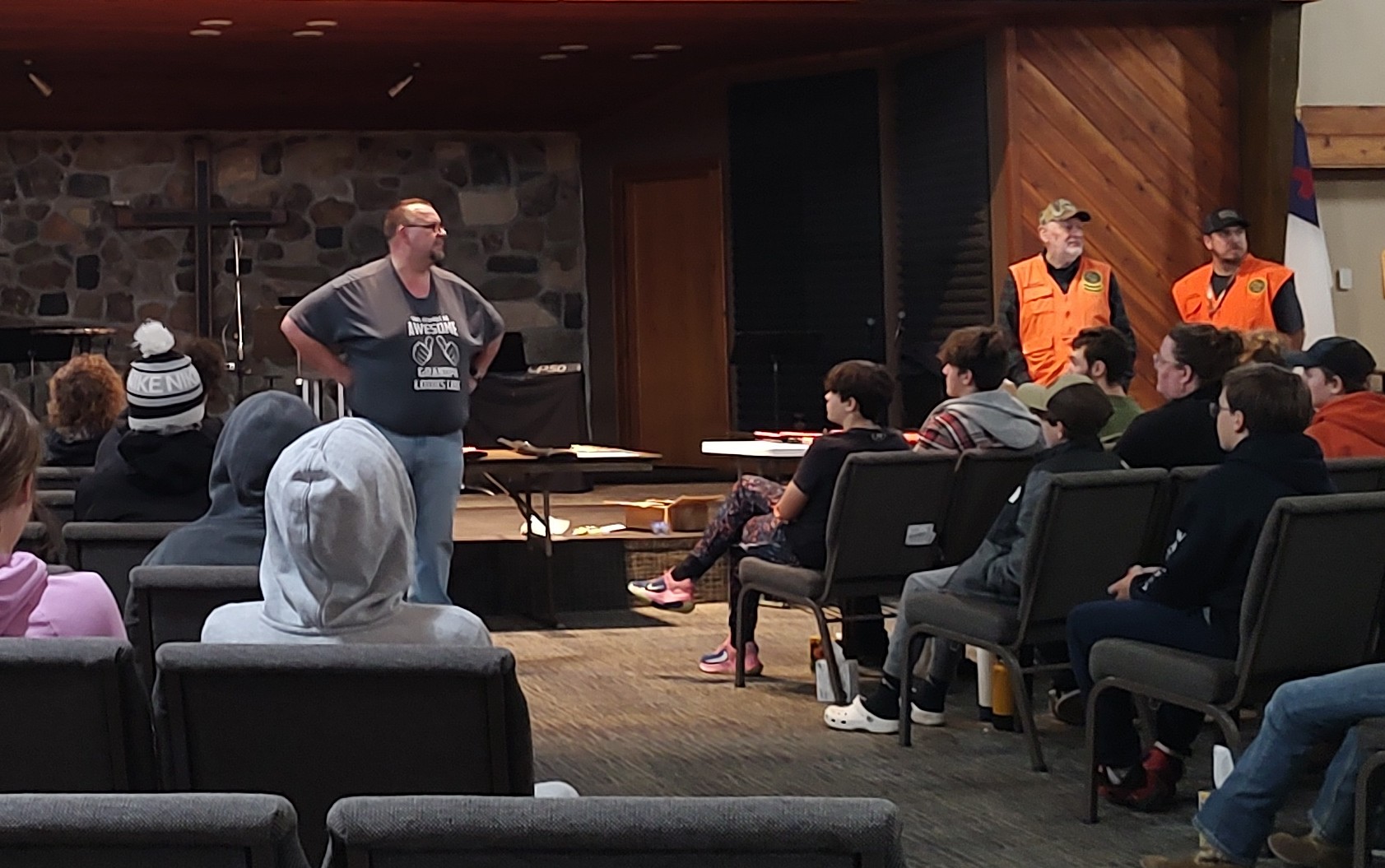
When is your son, daughter, grandson or granddaughter ready take a hunter safety class so they can carry a firearm, bow or crossbow on their own?
This is a simple question that often has no easy answers, but patience and empathy are the keys.
I’ve taught hunter education classes since the mid-1980s, first in Iowa and then in Wisconsin, with more than 20 years in Iola and Waupaca. I’ve had the privilege of working with one of the largest volunteer instructor groups in the state, led by the capable and award-winning chief instructor, Paul Piencikowski.
I sought out the expert advice of Piencikowski and our Wisconsin Department of Natural Resources outdoor skills trainer, Kayla Sasse of the Green Bay office, who coordinates the paperwork and equipment needed for our Waupaca Hunter Safety Group to field train and test as many as 120 students at a time.
Piencikowski, now in his 15th year as a volunteer instructor, has coordinated more than 100 classes with more than 4,800 students. His group has won Hunter Education Group of the Year honors several times, and the class draws students from as far away as Illinois and Michigan because of its reputation (hunter ed classes have reciprocity in all 50 states).
When I first taught Wisconsin traditional classes in Iola, our group there was under the false impression that we couldn’t fail any student, so we didn’t. If a youngster had clear attention problems or otherwise did something wrong, we’d tell the parent about it but then send him or her on their way with a passing grade. This was not only a disservice to the child and family, but also a potential safety issue as this immature or inattentive charge now went afield with a loaded firearm.
Piencikowski’s group, which teaches the internet field course, typically fails about 10% of their students. There is a minimum grade on the written test, but the most likely culprit for failing is either sweeping someone with the muzzle of a gun or putting their finger on the trigger. TAB-K is drummed into students’ heads throughout the day, and is a simple way to remember four fundamental gun safety rules that would prevent most mishaps if obeyed.
The internet field course is the hands-on portion of the DNR’s online hunter ed course, available to anyone for free on their website. The $10 field course teaches safe fence crossings, zones of fire, types of firearms actions, loading and unloading, tree stand safety and overall safe gun handling under the watchful eye of many instructors. The students then test one-on-one to prove what they’ve learned.
Piencikowski became an instructor shortly after taking a traditional course with his daughter in 2009.
“During one of the teaching sessions, the instructor placed an overhead on the projector and said, ‘You can’t see this, but if you could …’ These were the exact words I heard nearly 30 years earlier when I had attended hunter education,” he said. “I felt that there had to be a more effective way to instruct.”
The internet course alone is enough to obtain a hunter safety certificate for those age 18 and up, but it’s recommended that everyone takes a field course. During COVID, the state briefly allowed even youngsters to take the online course alone, and Piencikowski’s group rallied in Madison to argue against what they felt was an irresponsible and unsafe practice.
Although there’s no minimum age limit to take a class, “Curriculum is written at a sixth grade level, and your student will need to be able to comprehend the material and read and pass a written exam,” Sasse noted.
Piencikowski puts it this way: “Students under the age of 12 have huge challenges to overcome as the program is designed for the comprehension and physical capabilities of a 12-year old. However, safety is not a factor of age but rather responsibility. Students must understand the magnitude of the responsibility it takes to handle a firearm safely under all circumstances from the moment they pick it up until they set it down.”
It’s not just about pulling the trigger, he added.
“They need constant awareness of what is in their hands, where their hands are and where the muzzle is pointed at all times,” he said. “The moment a person loses focus, they create an unsafe situation.“
Mentor hunting — hunting with an adult hunter safety graduate — is an option for anyone who is both too young and immature for a class or even for an adult who hasn’t yet learned the safety basics, Sasse noted.
“You can still hunt with your young kid even if they haven’t taken hunter safety,” she said. “They’re required to be on a mentor license until they turn 12 anyway, so there’s no need to rush it. And even at 12 and 13 years old, they need to be accompanied within sight and voice distance, so they can’t go out truly on their own until they’re 14.”
This explains the mentor hunting program in detail: https://dnr.wisconsin.gov/Education/OutdoorSkills/mentor.
Parents or other adults can start their youngsters well before an official class to learn TAB-K and carry a BB or toy gun.
“It’s never too early to start working on firearm safety at home. Have them start memorizing TAB-K and make them recite it every time you do any shooting,” Sasse said. “Practice not only target shooting with a BB gun (or toy gun), but also walking around ‘hunting’ with it, reinforcing how to keep the muzzle pointed in a safe direction at all times.”
Parents sometimes force their kids to take a class before they are ready, and this contributes to the failure rate, Piencikowski noted.
“This results in myself personally guiding students and parents through the unsuccessful experience,” he said. “At best, it is emotionally devastating for the student. At worst, the student is turned off to anything relating to firearms. We do not experience joy in failing any student, but if we have to make a choice between keeping people happy and keeping people safe, we will default to safety every time. Parents, if your child fails, please do not take it as a personal attack on you. Rather, recognize that instructors want to keep you and the public safe.”
The failed test can become a positive “teachable moment” that a parent can use to work on until the next class.
If your child is constantly misplacing things or has difficulty staying focused on tasks for long periods, they may not be ready for a class, or the more important responsibility of carrying a loaded firearm, he advised.
Start here to find a hunter ed class: https://dnr.wisconsin.gov/Education/OutdoorSkills/safetyEducation.
ross@wolfriverccw.com
Are young hunters ready for hunter ed class?