When it comes to bowhunting, I’m old-school. I carry a vintage recurve bow (usually a Bear) with no sights and a feather-fletched carbon arrow tipped with some sort of fixed-blade broadhead. I may have a stabilizer, but that’s it for tech.
When it comes to turkey hunting, I put the bow down and pick up a 3 1/2-inch chambered 12-gauge pump shotgun with some serious copper-coated loads, usually either No. 4 or No. 5 shot.
I’ve not had many birds in gun range the past few years (I did take a jake about two years ago), and did misjudge the yardage on a nice tom last year. Carrying around my mini-tank known as a Remington 870 Super Magnum just isn’t fun, although that heavy gun certainly soaks up some of the recoil from those teeth-rattling loads.
I always say when it’s no longer fun, it’s time to go home and think of something else, so that’s my plan this year.
If you read the outdoors magazines (you know, those things made of paper with staples down the spine), you’ve probably read of “sub-gauge” turkey hunting with tungsten shot. Sub-gauge is anything smaller than a 12 gauge. Grown men are dropping turkeys at 40 yards and beyond with 20 and 28 gauge shotguns and even tiny .410s, thanks to this miracle shot that costs more than filling your gas tank.
I first became familiar with these sub-gauge turkey guns a few years ago as a volunteer for the Winnebago Strutters chapter of the National Wild Turkey Federation in Neenah-Menasha.
I had the fun task of selecting the guns for our banquet at Scheels, and we were introduced to the single-shot Stevens 301, a little import than can be purchased in black or camouflage, and with or without a red dot sight. We chose the camo ones with dot sights for our dinner, but last year, I bought a black one in 20 gauge with a plain bead sight. It cost about $200 and weighs under 6 pounds.
Then came buying the ammo.
As much as I was pleased with the gun’s modest cost, I was dumbfounded by the tungsten costs. I bought one box each of Federal 3rd Degree (3-inch 20 gauge with 1 1/2 ounce of 5, 6 and 7 shot), Browning TSS 3-inch 1 1/2 ounce of 7 and 9 shot and Hevi-Shot Magnum Blend 3-inch 1 1/4 ounce of 5, 6 and 7 shot). One was around $44 for five shells and the other two were $28-$35. Ouch!
Tungsten is up to 60% denser than lead, the gold standard, and even with small shot sizes, it can kill a turkey at amazing distances. Most hunters use No. 4, 5 or 6 shot in lead (the smaller the number, the larger the pellet diameter), but with tungsten, smaller sizes from 5 to 9 are common (often a “matrix” or mix of shot sizes for a combination of wide patterns and more retained energy at a longer distance).
After years of hunting coyotes, bobcats, geese and turkeys with nothing smaller than No. 4 shot, and even as large as BB on the predators, I can’t yet wrap my brain around shooting 20-pound turkeys at 40 yards or more with No. 7 or 9 shot. I guess when I finally kill a gobbler with this new-fangled ammo, I’ll believe it.
Where do you aim at a turkey? With a shotgun, I prefer to go with what the experts say: where the feathered neck meets the bare neck. This centers the pattern on the head and neck. If you aim only for the head, about half your pattern will shoot over the head (assuming your shotgun hits point-of-aim, which many do not).
One advantage of using a red dot sight is that you can adjust it so you can hit wherever your actual point-of-aim is. I suspect my bead sight is higher than where my gun is patterning. I’m seriously considering a red dot now, something I’ve never used on a shotgun before.
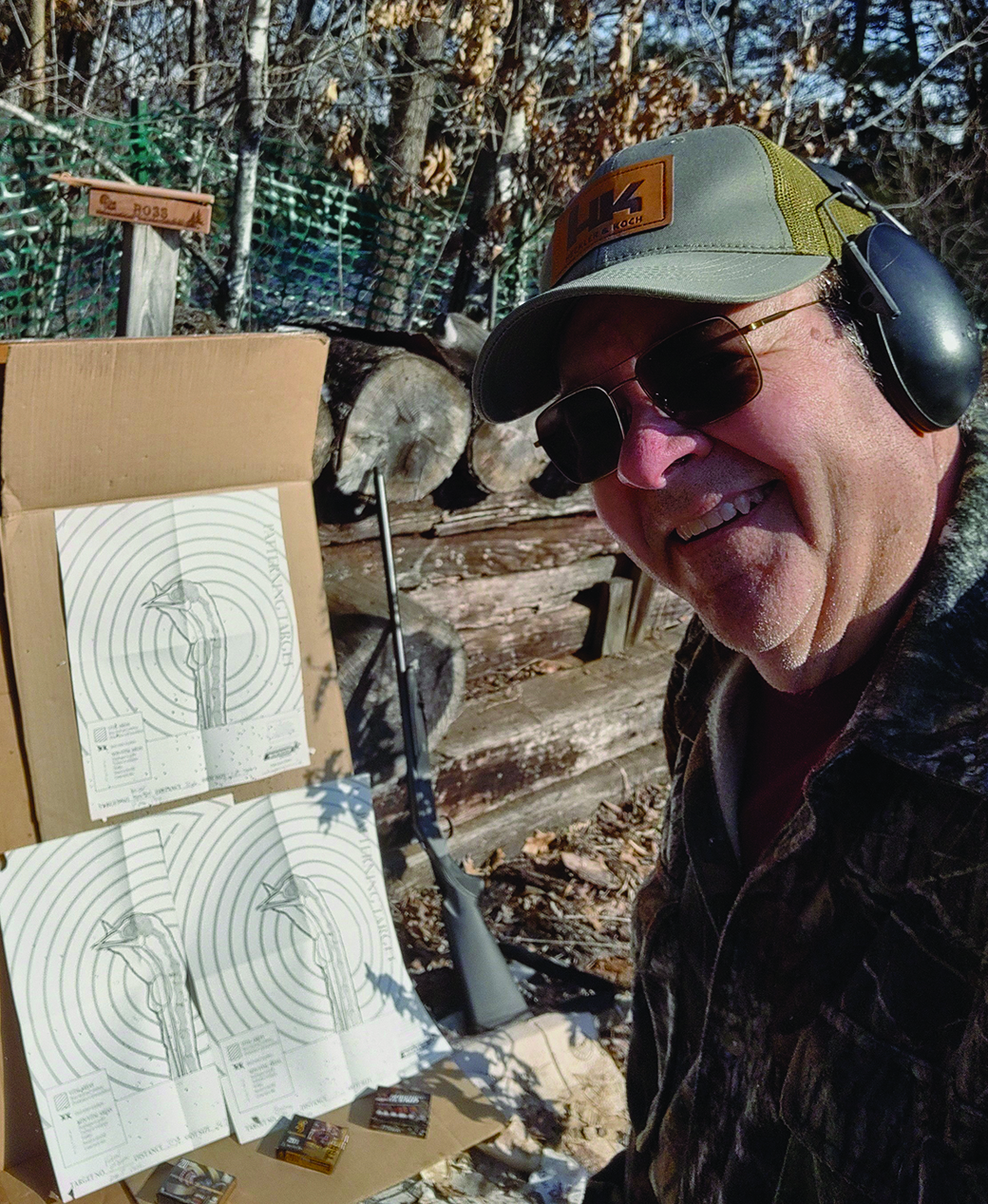
An Outdoor Life article talks about a scientific study on which vertebra in a turkey’s neck is the best spot to aim at (no, you can’t actually see it unless you have X-ray vision). I happened to be using the Winchester targets mentioned in the article and agree with the author that it’s better to aim a bit lower. Read it at www.outdoorlife.com/hunting/where-to-shoot-a-turkey.
There are lots of numbers on these boxes of TSS (Tungsten Super Shot). I noticed “18 G/CC” on the box of Federal 3rd Degree. This means 18 grams per cubic centimeter, a density about 60% greater than lead (meaning it is heavier and will in theory hold its energy at longer ranges). Read another article about tungsten shot at www.outdoorlife.com/guns/tungsten-super-shot-deadliest-bird-shot.
I tested one round of each brand I bought from 35 yards, using a plastic shooting rest. I counted the pellets in the head and neck of each turkey target, extending down into the imaginary bodies. The Browning load did the best, putting 77 pellets in the kill zone. Federal was next with 41, and Hevi-Shot came in third with 26.
I didn’t flinch, but it was difficult to precisely aim with the large bead. The gun appeared to have all three patterns below point-of-aim, so a red dot might be worth it on this particular gun.
Be sure you pattern your shotgun before hunting, especially if you are shooting $6-$10 tungsten rounds. You just can’t afford to miss too many times.
Let me know how you do this spring. The fun begins April 13-14 with the youth season, then April 17-23 for Period A. Period F is May 22-28. Good luck.
Ross Bielema is a freelance writer from New London and owner of Wolf River Concealed Carry LLC. Readers can contact him at Ross@wolfriverccw.com.
Tungsten shot loads make turkey hunting new again