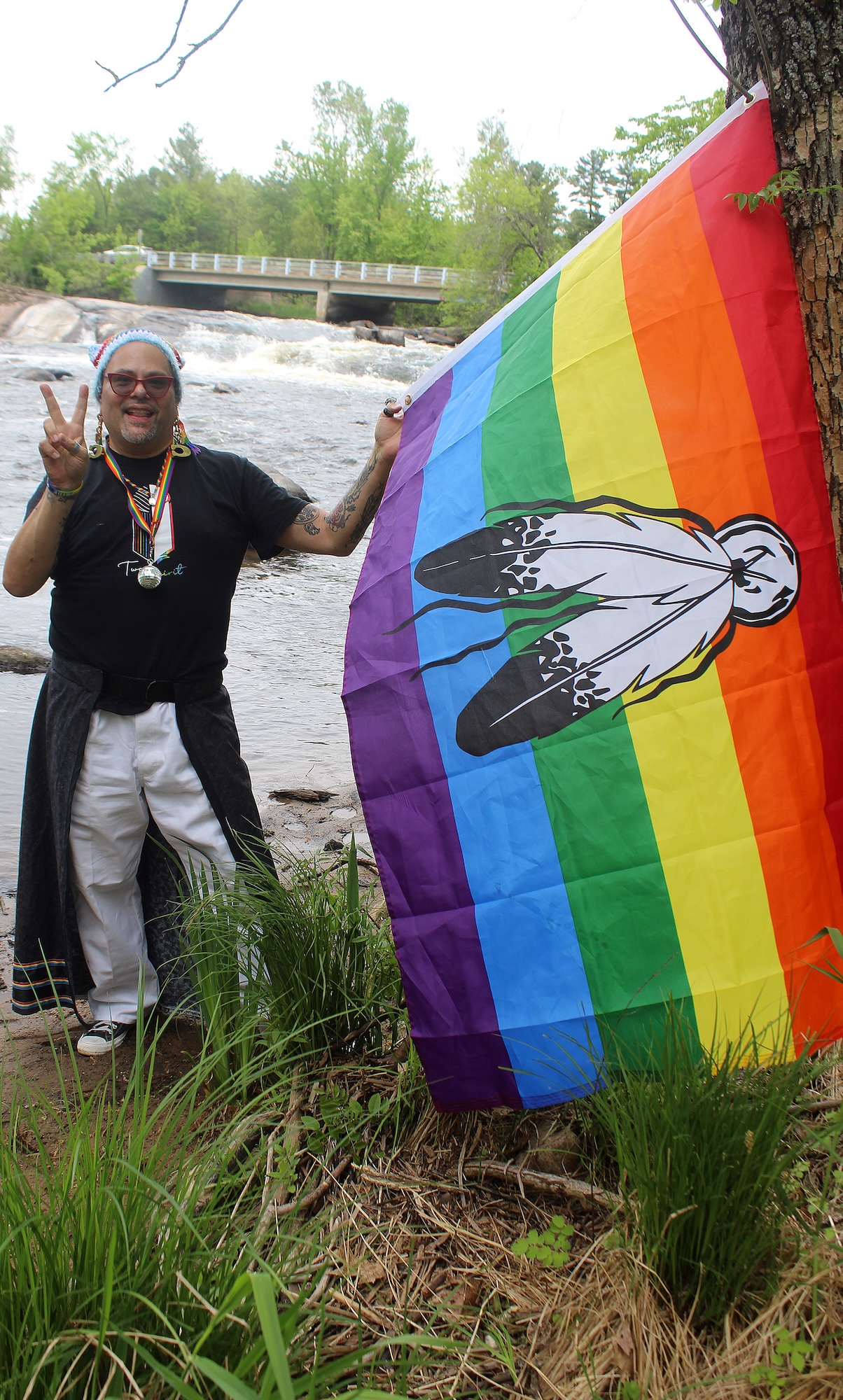
For Patrick Firgens, being a gay man living on the Menominee Reservation was something he’s always known.
However, there is another aspect to his life: being two-spirit.
The term two-spirit did not exist when Firgens was born 52 years ago. According to Wikipedia, it was developed and finalized at the third annual Intertribal Native American, First Nations, Gay and Lesbian American Conference in 1990, mainly as a way to distance themselves from non-Indigenous gays and lesbians.
Firgens, however, doesn’t see two-spirit as something that is necessarily limited to Indigenous culture or to particular sexualities. While he feels the description fits him, he feels the neologism applies to anyone who can teach cultural things to both males and females.
“The new kids have so many different terms that I ain’t aware of,” Firgens said. “When I grew up, it was just gay, lesbian, bisexual and trans. Now there’s a million other things like non-binary. We didn’t have that then. Two-spirit is new to me, as well.”
Firgens noted that two-spirit, for many people, means that someone is Indigenous and gay; the symbol for two-spirit is a pair of feathers in front of the colors of the rainbow flag. He only half believes it.
“Two-spirit could be a straight person. A straight person could have two spirits,” Firgens said. “A male could. A female could.”
There are different roles that a person can play within a culture. For Firgens, he had difficulty embracing his Indigenous culture because he grew up in the boarding school system through the Catholic church. He was one of the lucky ones never to have been taken advantage of, abused or beaten, but growing up in a system where being told his cultural ways were wrong required him to search for who he was going to be in life.
“I didn’t learn about my Menominee culture, much less Native culture, from anywhere in America,” Firgens said. “We didn’t learn about the Siouxs. We didn’t learn about the Apaches.”
The term two-spirit can be confusing at times to Firgens, but he believes being gay gives him two spirits. He is able to contribute something to future generations, no matter their gender, and he feels that’s a two-spirit’s main role.
“I can teach my nieces how to cook, how to sew and how to bead,” Firgens said. “I can teach my nephews how to hunt, how to gather, how to fight and protect and serve. I can teach them both. Not a lot of people can.”
While being two-spirit can confuse Firgens, he had no problem figuring out he was gay, even if he didn’t understand the term in childhood.
“I was told by everyone that that’s what I am,” he said. “I never looked at it as a derogatory term. I never had to come out of the closet, because I’ve just been skipping and prancing and sprinkling glitter the entire time.”
Firgens also believes it’s important for members of the LGBT community to come together and support one another. Besides his Menominee culture, it’s important to continue the tradition of standing strong against oppression against gay people, he said.
“I wasn’t the first one to throw the brick,” Firgens said, referencing the Stonewall Riots that took place in 1969, three years before he was born. “There were a lot before us that paved the way for us. I have many to look up to.”
A few years ago, the Menominee started a two-spirit pride festival to support its LGBT tribal members. Firgens has enjoyed seeing that the tribe supports all of its members, especially those deemed different, noting it hit him in “the heart and soul.”
“We needed Pride Month 30 years ago,” Firgens said. “It’s so important to spread the awareness and the knowledge and to share that with everyone in the world.”
Despite the strides that American culture has made in accepting and supporting the LGBT community, Firgens feels the fight has not ended, especially with the current presidential administration.
“I think we’re only halfway there,” Firgens said. “It’s changed 100% for the better, but I still think we’re only halfway there.”
He currently runs a talking circle for those in recovery from drugs and alcohol in South Branch, but he hopes to eventually start a talking circle for the LGBT community and anyone who identifies as two-spirit.
“Sometimes they’re not comfortable going to a women’s circle. Sometimes they’re not comfortable going to a men’s circle,” Firgens said. “They can come to my circle. It’s a safe space, and I will hold space for anybody in them initials — or even not. If you feel like a weirdo or a freak, you don’t have to have an initial, and you can come to the talking circle.”
In the end, the term two-spirit is fluid, in Firgens’ view, and it’s up to each person to seek their true identity.
“People will have to look up their own definition of two-spirit,” Firgens said. “I’m glad that I’m two-spirited.”
One body, two spirits