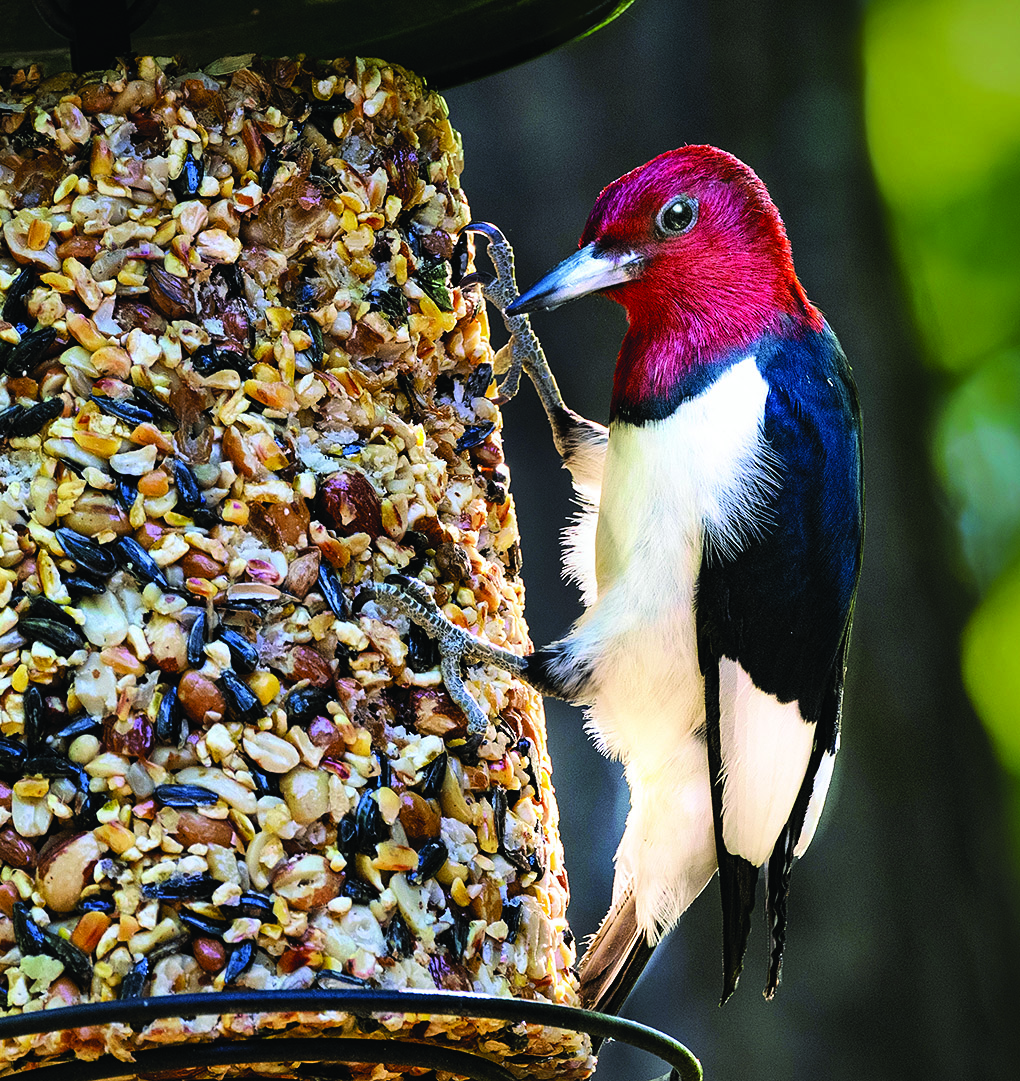
When people ask what is my favorite bird, it is like asking which is my favorite child. I have different choices for different reasons — perhaps their beauty, melodic singing or silly personality. One bird that I always include in my answer is the red-headed woodpecker.
I seldom saw red-headed woodpeckers until 15 years ago when I drove through Necedah National Wildlife Refuge. It is a 43,696-acre wonderland, in the middle of the state, with a wide variety of wildlife, plants and waterways that support an amazing 230 bird species.
On my first visit, I came upon an oak savanna, a combination of trees and open space, and quickly learned that this is where red-headed woodpeckers hang out. I counted not just one or two, but close to a dozen, as I slowly proceeded through the savanna. Hearing their raucous calls and watching their entertaining antics as they flew from snag to snag, I felt in awe of this magnificent bird.
Since then, I go to Necedah National Wildlife Refuge every summer, and these remarkable birds never disappoint. In fact, when I tell my family, “I’m going to get my red-headed woodpecker fix,” they know where I’m off to.
This year, something entirely new happened. It was late spring. I looked out my back window, and I couldn’t believe my eyes. There, on my suet feeder, was a red-headed woodpecker, and it has been coming to my feeder almost every day since, and not only to my feeder. All around the state, people are reporting red-headed woodpeckers, a first for most. Although it seems that it is great news, it makes me wonder why.
While the red-headed woodpecker is considered a common bird, its population has been declining at an average of 6% every year for the last 50 years. This is mostly due to habitat loss. According to avibirds.com, “Artificial nest cavities, preservation of dead trees and establishment of new nesting sites are critical for supporting and potentially increasing the red-headed woodpecker population.”
Elena West, a University of Minnesota biologist, is studying red-headed woodpecker populations in Minnesota. She is using autonomous recording units, small devices you strap to a tree to record sounds, and artificial intelligence to pick out recorded sounds, to learn where red-headed woodpecker populations are breeding successfully. Her findings will help drive habitat restoration and conservation efforts for the species.
Adult male and female red-headed woodpeckers look alike. They sport a completely red head, glossy black back with white wing patches, and a snow-white belly and rump. When they fly, the contrasting white and black really stand out, helping in their identification.
Red-headed woodpeckers have very unique feeding strategies. Like flycatchers, they perch on a branch, then take off into the air snatching insects mid-flight, then return to the same branch to eat their catch. This is called “sallying.”
They also eat nuts and fruits. They are one of only four woodpecker species known to store food. Even more impressive, they are the only woodpecker species that hides its cached food (in bark and wood) and the only woodpecker that defends its food stash from meddling birds and small mammals.
The red-headed woodpecker is both a “larder-hoarder” and a “scatter-hoarder.” When it finds a bunch of nuts, it will hide them all in one place (the larder), so that it can quickly collect the nuts before other nut-eaters come along. Then later, it will move and store the nuts in many different scattered locations to prevent a competitor from stealing it all.
I have learned so much about my new backyard visitor. For starters, he is very territorial. He takes total control as to which birds can and cannot hang out at “my” feeders. For those he deems unworthy, he will chase not only away from the feeder, but also through the woods back and forth and all around, to ensure the poor outcast is totally aware it is unwelcome. When he does this, he is not only seen, but also heard.
He has a wide variety of calls including shrills and kwirrs, chirps and char-chars. The rolling kwirr is sweet, but some calls remind me of the guttural sounds I hear when I try to wake up my teenager in the morning.
Regardless of his feeding station dictatorship, I welcome him to my backyard. I watch as he gracefully maneuvers through the branches. I listen as he calls out, commanding all to hear. I admire him as he sallies for insects and defends his food stash. I revel in the flash of white and black as he flies. I become mesmerized by his crimson red head. I am once again in awe of this magnificent bird.
Lisa Jansen is a Wisconsin master naturalist, nature writer and award-winning photographer. She specializes in raising awareness of birds and butterflies of the Midwest.
Red-headed woodpecker regularly comes to visit