
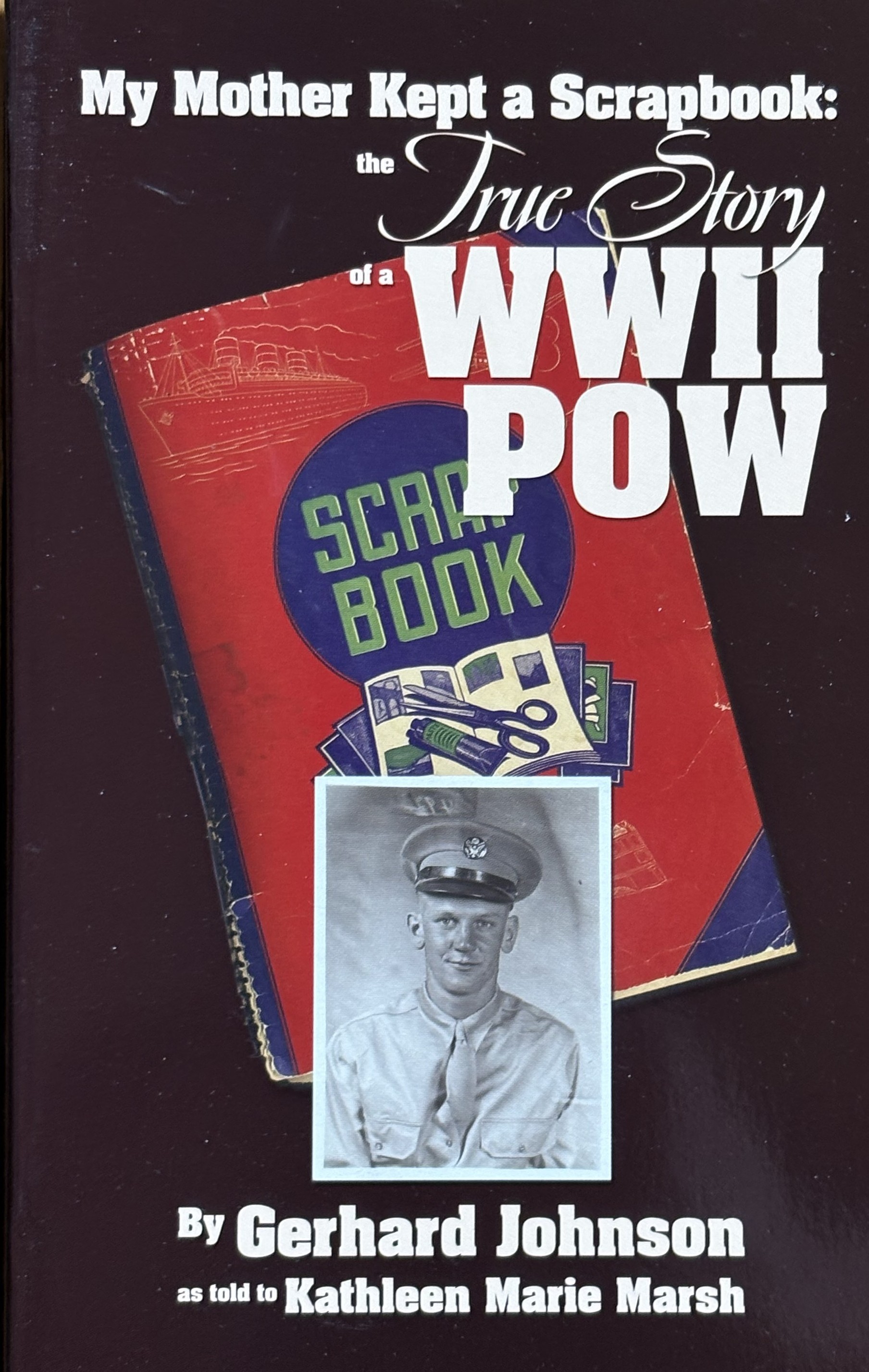
I joined the American Legion Auxiliary in 2004. Jon had joined the Legion, and I’d just published “My Mother Kept a Scrapbook: The True Story of a WWII POW” by Gerhard Johnson. Lifelong fishing buddies, Jon and Gerhard were both born and raised in Elderon.
After two years doing lengthy interviews and extensive research on surrounding events, I was able to help Gerhard preserve his story for posterity. Its main focus is his horrific experience of being captured and held by the Germans from January 1944 to April 1945.
Gerhard had not publicly shared that part of his life until April 1, 2003, when we ran into him and his wife, Elaine, at a party in Elderon. They lived in Wausau, so we didn’t see them often. It was good to catch up.
We were talking at the bar when breaking news about Iraq War prisoner of war Jessica Lynch flashed onto the TV. Seriously injured and captured on March 23, 2003, Jessica was safely back in the USA. Her recovery was the first successful rescue of an American POW since World War II, and the first ever of a woman.
We watched as Jessica was carried down the airplane steps on a stretcher and loaded into an ambulance.
Suddenly, Gerhard blurted out, “That little girl’s brave, but she doesn’t know a thing about being a POW.”
“And you should know, Gerhard,” I replied. “Jon told me you were a POW during World War II.”
Jon was mortified. “Kathie, be quiet. He doesn’t talk about it.”
Gerhard shocked us with his response. “Maybe it’s time.”
The next day we were at his house where I would conduct our first interview. Jon, Elaine and I sat with him at the kitchen table, accompanying him on his difficult journey through long-buried memories. He’d recently suffered a minor stroke, but he bravely told the story as best he could. When we left, I was committed to publishing it.
As the broader narrative began to take shape, Jon and I understood why Gerhard had chosen to keep his time in an earthly hell private. Occasionally, I could see he was shutting down and would cut the session short; sometimes I would ask questions, but mostly just listened and took notes.
Gerhard was 19 when he was drafted in April 1943. He insisted that if he hadn’t been drafted, he’d have enlisted. After boot camp, he was assigned as a replacement troop in the 36th Texas Lone Star Division. The storied unit had fought valiantly, achieving success on the battlefield with the casualties to prove it.
Commanded by Lt. Gen. Mark Clark, the 36th was sent to Africa and then Italy. Gerhard recounted the fallout of Clark’s ill-advised decision to unleash a two-day assault involving more than 8,000 American troops at what has been called the Bloody Blunder at Rapido River on Jan. 20, 1944.
Part of the battle plan was for the 36th to cross the flood-swollen Rapido River into Italy. Poorly timed and executed, the offensive was one of the worst American defeats of the war. Gerhard was one of only a few hundred men who even managed to cross the river.
During the doomed engagement, the 36th suffered 143 killed in action, 663 wounded and 875 missing — most of them taken prisoner. Gerhard spent the next 15 months in brutal captivity, most of it in Stalag IIB near Hammerstein on the Polish border. He struggled to describe unimaginable suffering and privation. Often fighting back tears, I somehow got it all down on paper.
While he was away, Gerhard’s mother, Anna, and his sweetheart, Elaine, wrote to him weekly. Anna saved telegrams, Army correspondence, and her son’s (censored) letters in a humble scrapbook Gerhard had started as a boy. Thanks to Anna, that scrapbook provided essential documentation to corroborate his story.
Told from his point of view, the book recounts how Gerhard somehow survived imprisonment until Stalag IIB was liberated by the British on April 21, 1945. His body was badly deteriorated; it was a miracle he made it home alive. His illnesses and injuries would plague him his entire life.
When he was drafted, Gerhard stood 6 feet, 3 inches and weighed 165 pounds. When he reached a hospital in England, he weighed a hundred pounds and couldn’t stand up straight enough to be accurately measured. Upon visiting him at a recuperation hospital in Chicago, Anna didn’t recognize him at first and fainted when she did.
In honor of Memorial Day, I’ll share something Gerhard once told me. “People think Memorial Day is about guys like me. It’s not. That’s Veterans Day. Memorial Day is about the ones who came home in a box and the MIAs who never did. All gave some, but some gave all.” Let’s remember that and celebrate the holiday accordingly.
Kathleen Marsh is a lifelong educator, writer and community advocate. She has published eight books, four on the history of Townsend, where she and husband Jon are happily retired on the beautiful Townsend Flowage.


