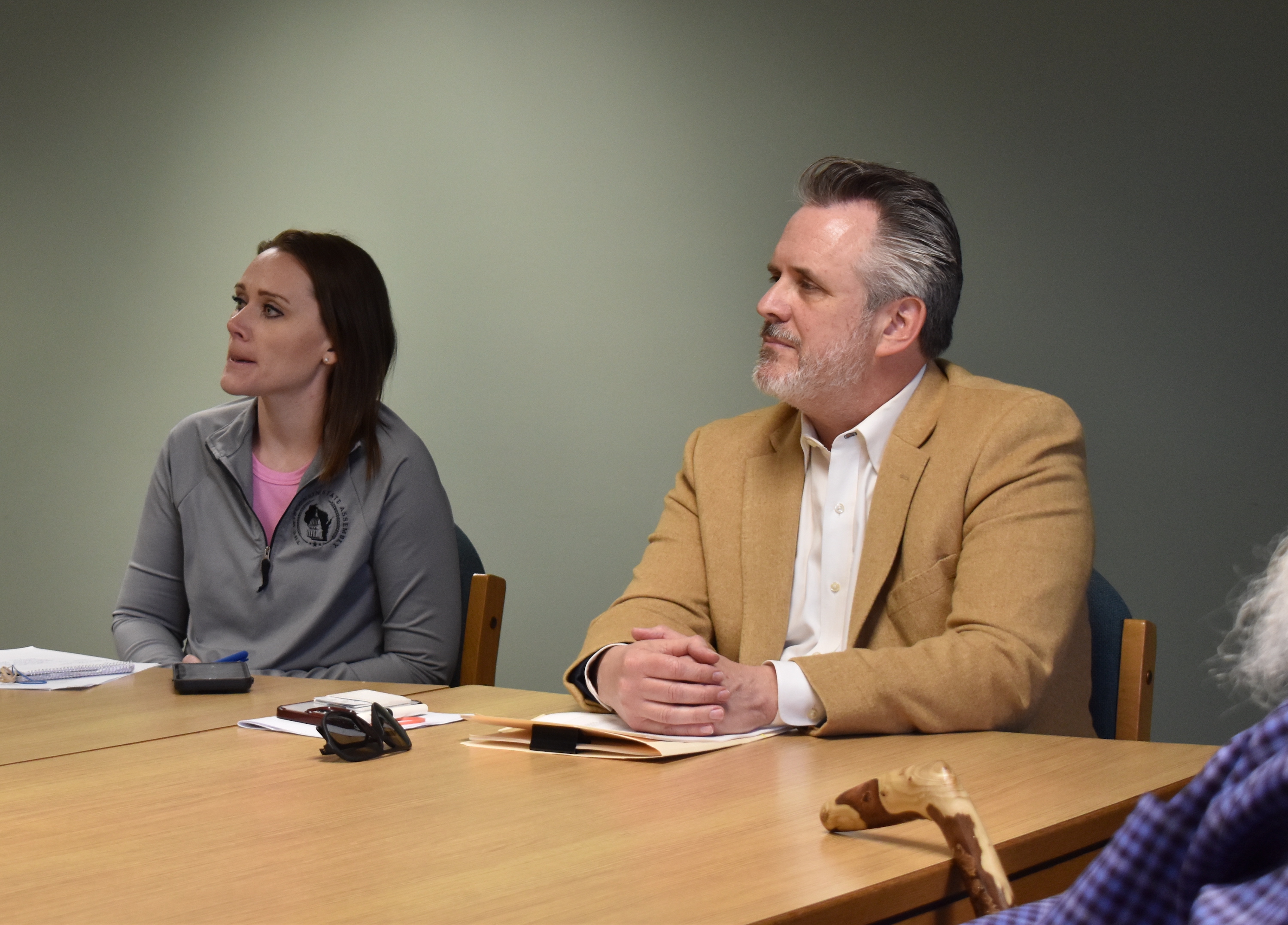
State Rep. David Steffen held a listening session in Oconto Falls on May 8 to start getting to know the needs of constituents he gained in the recent redistricting.
The maps drawn by Gov. Tony Evers, and approved last winter by the legislature after a court battle, reconfigured the 4th Assembly District to include part of southeastern Oconto County, beginning with the new term that begins Jan. 7, 2025.
“The district that I used to represent, or will until January, included the village of Howard and then south to include the west side of Green Bay, the village of Ashwaubenon and the village of Allouez, so primarily a suburban district. Lambeau Field is in that district,” Steffen said.
After 10 years of serving a mostly suburban constituency, the Howard Republican is now learning about the needs and interests of the more rural portions of the new district he will serve if elected to a sixth two-year term.
“I represented areas that only had large school districts, very large. Their issues and my concerns relating to some of their situations are different than the way I need to be looking at the rural smaller districts,” he said.
The 90-minute session included discussion of several topics around education and school choice. In response from a query from a teacher, he said he supports having state aid money follow the student, that is to say, the aid goes to whatever school the student chooses whether public or private.
“In my old district, there are and will continue to be a lot of private school options,” Steffen said. “In Oconto County, there are far fewer, which means the only option is the public school, so we need to make sure the public schools are robust and healthy and capable of providing those services.”
Only a dozen people took advantage of the opportunity to meet the area’s new representative at Oconto Falls Community Library, but Steffen said the smaller group lent itself to deeper discussion of the issues.
He said while serving a district entirely enclosed in Brown County, he generally focused on issues of interest to that group, which he identified as crime, inflation, affordability, workforce housing, workforce in general, taxes and election integrity.
Steffen said he worked with Oconto County Sheriff Todd Skarban on the new law that prohibits school officials from conducting student strip searches, after an incident in the Suring Area School District, as an example of how he works with law enforcement.
“It’s been a priority for me, and generally, if your sheriff or your local police believe it’s a good idea, I’ve been with them,” he said.
Among other issues Steffen said he was disappointed that Evers vetoed two of his bills that he said would have put the state’s large budget surplus back into the pockets of taxpayers.
“If we’re going to have extra money, I wanted it to either go to tax cuts or I wanted it to go to local communities,” he said.
The Republican-led legislature was able to convince Evers to increase the amount of money going to local units of government, but the second-term Democratic governor was not in sync with the GOP on the matter of tax cuts.
“I authored the largest tax cut in state history, $2.9 billion, it was called a returning your surplus bill, and he vetoed that,” Steffen said. “He also vetoed my bill — I was the lead author on it — to make Wisconsin a tax-free retirement state, so we’d be more comparable with states like Texas or Florida or Tennessee. There are nine or 10 that either have a tax-free retirement or no taxes at all on income.”
He said the latter bill would have provided relief for senior citizens who have the most difficulty adjusting to high inflation environments. He summarized Evers’ veto message as, “Money needs to be spent — we need more government.”
Steffen said he is interested in reducing the size of government, and one of the most effective ways is to reduce funding.
“The overreach that we see, where it’s in our schools and universities, wherever it is, it is harder to do if you have less money, because all of a sudden you have to stick to your core missions when you have less money,” he said. “That’s true for the rest of the bureaucracy as well. The electorate, the people, are far more in control the smaller the government is.”
Because of the various impasses between Evers and the legislature, Steffen said the state now has several billion dollars in its savings account, which allows Wisconsin to pay cash for some larger projects for which it once would have to borrow.
In response to residents’ questions Steffen gave his views on the state prison system and medical marijuana.
Green Bay Correctional Institution at 127 years old and Waupun Correctional Institution at 126 are each among the top 10 oldest prisons in the country, he said. GBCI is in especially bad shape — only 5% of that building is not in need of repair.
“We have failed the staff, we’ve failed the inmates, we’ve failed the taxpayers, we failed the system that’s designed not only to provide incarceration and that level of punishment but also to provide a pathway forward for a positive post-confinement environment,” Steffen said. “Ninety percent of the people who are in those maximum security prisons will be back in our communities, so the question is what type of person are we releasing? Are we releasing someone who’s more angry, more damaged, no skills, no education, and therefore a higher risk of return?”
The state appears to be moving toward closing the two aging prisons and replacing them with a single state-of-the-art facility, likely in the southeast corner of the state where the larger population means a greater employee pool and proximity to inmates’ families. But Steffen said that won’t happen until a Republican governor is elected.
“Unfortunately Gov. Evers has a belief that the only way to address our aging prison is to close it after we’ve found a way to release 1,000 extra into the communities,” he said.
A bill legalizing medical marijuana is more likely to pass in the next legislative session, Steffen said, because large majorities support the idea. On the other hand, he does not think recreational marijuana will be legalized anytime soon.
The medical marijuana bill will likely be limited to treatment of a specific number of conditions and diseases, he added.
“PTSD, cancer, epilepsy, there’s few other conditions that have shown tremendous positive results from it,” Steffen said. And there’s going to be some limits, it’s not going to be like California or Colorado.”
The new 4th Assembly District, which is part of the 2nd Senate District, includes the Oconto County towns of Abrams, Lena, Little River, Little Suamico, Maple Valley, Oconto, Oconto Falls, Pensaukee, Spruce, and Stiles; the cities of Oconto and Oconto Falls; and the village of Lena. The district also includes the Brown County villages of Howard and Suamico and part of Green Bay’s west side.
Democrat Jane Benson, of Suamico, who ran in 2022 against state Rep. Elijah Behnke, R-Oconto, in what was then the 89th Assembly District, has announced her candidacy to run in the new 4th District.
wbluhm@newmedia-wi.com
Steffen getting to know new district