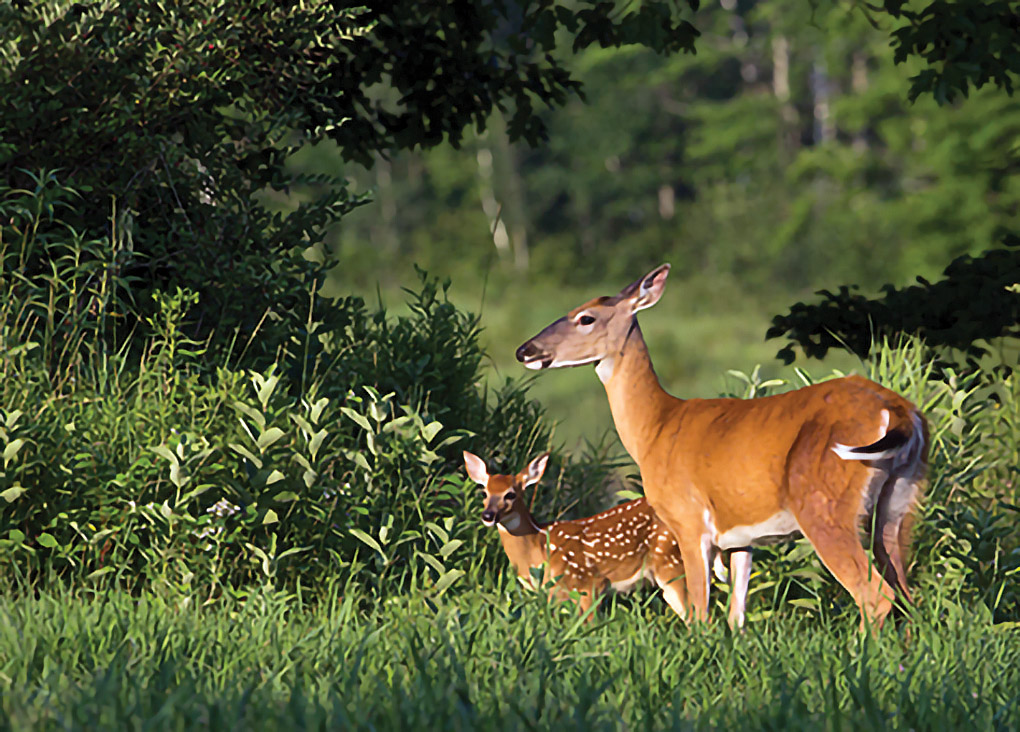
Hunters frustrated at seeing fewer and fewer deer in the northern forest counties may have been thinking that a four-year ban on doe hunting there would bring about the massive hordes of whitetails seen there decades ago that our fathers and grandfathers still talk about.
Gov. Tony Evers vetoed the bill March 29, along with several others related to the outdoors.
As much as I dislike almost everything he does as a radically liberal governor playing mostly to the fringe animal-rights groups, I agree with him on this one.
I’m lucky enough to hunt deer in the central farmland zone, primarily Waupaca County, where the annual deer kill normally is in the top three counties, and we kill more deer here than are harvested in some eastern states. We may not see many deer when hunting (I saw fewer deer this year than perhaps any season in my 24 years of hunting here), but when I drive around, there they are by the dozens.
On a recent early spring drive from our favorite neighborhood dive bar and grill, my wife and I counted more than 50 deer in a 3-mile stretch of backroads, and all those deer survived the 2023 deer seasons and a mild winter here. Where were these animals when I was sitting in my ground blinds? They were all living nearby and doing just fine.
I understand Northwoods hunting is not the same. Vast forests of national land, as well as county and state lands, make hunting more difficult. Last winter produced severe weather in some of the northern counties, just one factor in a 30% reduction in the deer kill there.
The Wisconsin Department of Natural Resources deer policy expert explained biological approaches to deer management and the many factors that some hunters with tunnel vision might not consider.
“A ban on antlerless harvest isn’t going to change anything,” said Jeff Pritzl, DNR deer program specialist in Plymouth. “The whole system is built on protecting the deer population, but that is not the case in 75% of the state. We’re killing as many deer per square mile as we did in the 1980s.”
If you hunt in one county, or one farm, you base your perception of the deer herd on that area and on how many deer you see on those few (or many) days you are in the woods. This “human psychology vs. biology” and a “stationary strategy” of hunting in one spot (versus the deer drives and still hunting practices of decades ago) are at the heart of the misperception, Pritzl said.
The biggest factor in reduced harvests statewide from their peak around the year 2000 is fewer hunters.
Pritzl said we’ve lost 100,000 hunters in the past 24 years, and Wisconsin is expected to lose another 100,000 hunters in the next 10-15 years.
Aging hunters is a closely related factor. Baby boomers were in their 40s during the millennium harvest boom but are now in their 60s. Older hunters in general don’t hunt as long or as hard, he noted.
Severe winters in the north can have a huge effect on the northern herds, as happened in 2013. Most of the northern counties then went to a bucks-only season and some counties in the northern forest zone have had bucks-only seasons for the past 10 years or so, Pritzl said.
“A bucks-only season is a last resort and biologically not necessary,” he said.
Deer biology dynamics vary greatly from county to county and even in smaller habitats. The bill Evers vetoed would have created a bucks-only season for four years in 20 northern counties, but deer in the southern tier of the forest zone, including Langlade, Lincoln, Rusk and others, were largely unaffected by last year’s winter, and the bill drew the ire of hunters in that area.
The County Deer Advisory Councils also annually help manage the herd on a county basis rather than on a larger scale, he noted. No matter how many bonus antlerless tags are issued, the average hunter bags 1.3 deer per season, Pritzl said.
Another major factor in the Northwoods is a lack of logging and even fires, which can help generate young forest. Habitat changes can create “areas of critical thermal cover,” including conifer and hemlock cover that protect deer from wind and deep snow.
“Deer thrive in disturbed landscapes,” he said.
Predators, particularly wolves, coyotes and bears, also take deer. There is frustration at not aggressively regulating the wolf population. Evers also vetoed a bill that would have required the DNR to set a specific wolf population goal. The state once had a goal of 350 wolves, but their estimate now exceeds 1,000 animals and many residents in the Northwoods believe it is much higher.
Sportsmen will have a chance to weigh in on 49 questions online from April 10-13. They include a number of fishing, hunting and wildlife questions that serve to advise the DNR Natural Resources Board. For details, visit https://dnr.wisconsin.gov/about/wcc/springhearing.
Ross Bielema is a freelance writer from New London and owner of Wolf River Concealed Carry LLC. Contact him at Ross@wolfriverccw.com.
Does a ban on doe hunting help the herd?