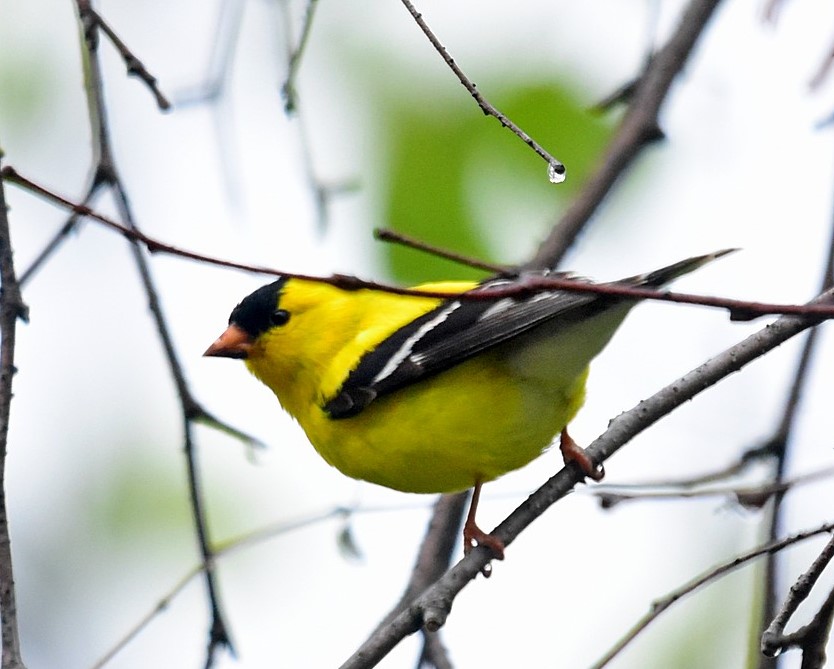
We are seeing American goldfinches in the company of house finches at our feeders now. The breeding males seem to glow in the sunlight as they show off their bright yellow plumage. Accented by black wings with white markings, dark eyes, a black cap and stout orange bill, this is a handsome bird. The breeding females are more subdued in coloring being duller yellow beneath and more olive in hue above than the breeding males.
Generally, goldfinches flock with other birds. In addition to seeing them with house finches, they often are found in the company of pine siskins and common redpolls, according to the Cornell Lab All About Birds (AAB) website.
Watch these birds and you find that goldfinches are very acrobatic, able to balance on the head of a sunflower or thistle plant to find their favorite food — seeds. Unlike many other birds whose diets include insects, according to AAB, the American goldfinch’s diet is exclusively seeds, although they may inadvertently eat an occasional insect. Two of their favorite seeds are nyjer and sunflower seeds.
According to www.audubon.org, the small black, thin, nyjer seed is very nutritious, being high in oil (30-40%), on par with black oil sunflower seeds. It is imported, mainly from India and Ethiopia where it is grown for oil and medicinal uses.
Even though nyjer seed is often referred to as “thistle seed,” according to www.forthebirds.com, it is not related to thistles but is the seed of the African yellow daisy. You can easily find nyjer seeds where you buy other bird seed.
Tune your ears to the most common call of the American goldfinch to detect whether it is in your neighborhood. According to AAB, this is the bird’s potato chip call sung with a very even cadence. In the spring and early summer, you may hear the male’s tee-yee courtship call when he lands near a female, often followed by a robust burst of song.
Another way to identify an American goldfinch is to watch for its distinctive flight behavior. According to AAB, they fly with a bouncy, undulating pattern and often call in flight making it easy to tell them apart from other birds.
Interestingly, the American goldfinches’ reproductive cycle is tuned to its favorite seed producing plants. As noted on the AAB website, they wait until June or July to build tightly woven cup-shaped nests as this is when milkweed, thistle and other plants have produced their seeds. Not only do the seeds provide food for the young, but the fibers and “down” from the seed heads are incorporated into the nests, making them soft and waterproof. Even spider silk is used in nest construction; the female uses the strong lightweight “threads” to lash the foundation of the nest to supporting branches.
According to AAB, the American goldfinch is a short term migrant. It can be seen in Wisconsin and other parts of the central U.S. year-round. Some migrate as far north as southern Canada to breed, and others head south to overwinter in the southern U.S. and Mexico. Their numbers grow here in the Midwest in the spring when the southern migrants head north. That’s why we are seeing more of them at our feeders these days.
The American goldfinch is considered a common species, and although their numbers declined between 1966 and 2019, the AAB website reports them to be of low conservation concern.
Put some nyjer or sunflower seeds in your feeders. American goldfinches are not fussy and will eat the seeds from a hanging tube feeder, platform feeder or off the ground. You can also plant some of their favorite seed plants like sunflowers and native milkweeds to attract them to your yard. Like the coming warming days, these golden birds with their energetic grip on life warm our hearts as they beckon in the summer.
Cathy Carnes is a retired biologist in Oconto who worked with the U.S. Fish and Wildlife Service Green Bay Field Office and prior to that with the U.S. Army Corps of Engineers Regulatory Branch in Buffalo, New York. As endangered species coordinator for the USFWS, she helped conserve and recover federally listed threatened and endangered species in Wisconsin.
Goldfinches brightening up area homes