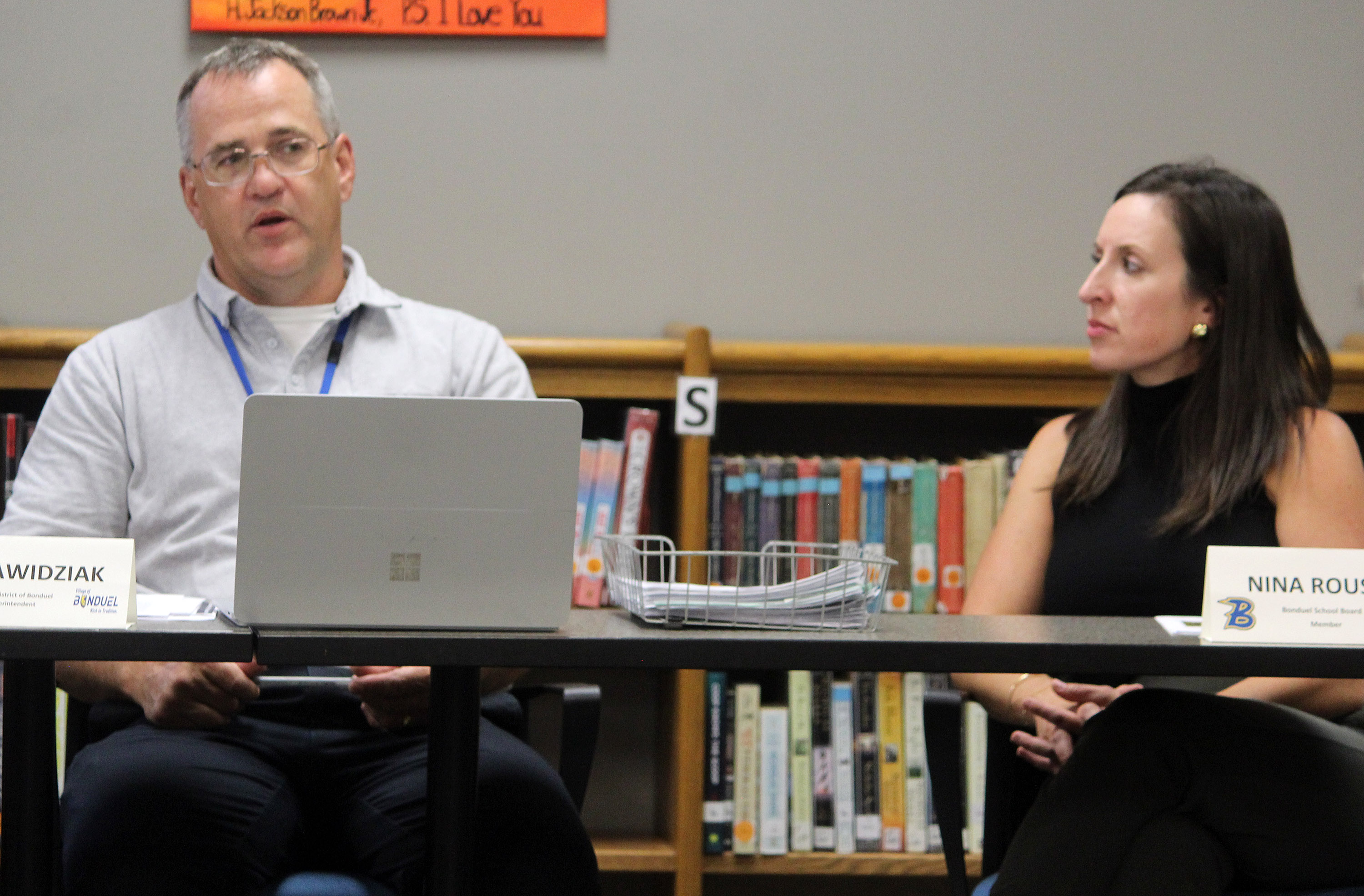
The Bonduel School Board approved the framework July 15 to ask voters for an override of the state-mandated revenue caps through two referendum questions in November’s election.
The first question will be initially familiar to longtime residents, as the Bonduel School District will be seeking a technology override but will be attaching safety and security technology to the mix. In years past, the district asked for $150,000 annually. Now, for each of the following six years, starting with the 2025-26 school year, the district is tripling its ask to $450,000 due to the inclusion of safety and security funding, as well as the skyrocketing cost of technology to be used in the classrooms.
Bonduel’s second question will be asking for another $300,000 annual override for six years, with the money going to provide benefits to the district’s part-time employees, something that hasn’t been done before, according to Superintendent Joe Dawidziak.
The technology override is something the school district has brought to voters every six years since 2006, Dawidziak said, and it started from the district’s desire to provide one-to-one technology to students, where every student received a tablet or laptop to utilize in learning. With most items seeing a steep jump in price, the $150,000 per year is no longer enough to cover all of those costs, he said.
“There are a lot of items that have moved from different departments into technology, and we’ve talked about things like controlling doors,” Dawidziak said. “A lot of the items are like safety and security things, and then there’s infrastructure. For example, our HVAC (heating, ventilation and air conditioning) system and all of those control type of things has moved into technology vs. where they used to be with the custodial or maintenance department.”
However, Bonduel’s security needs go beyond managing HVAC and keeping anyone from simply waltzing through the doors. Dawidziak noted that schools everywhere are dealing with cybersecurity, and the local district itself recently dealt with a cyberattack. He said the FBI had to come in and investigate the matter, but the attacker did not succeed in getting the district’s files.
“We had enough things in the background where they weren’t able to get in, but they definitely tried,” Dawidziak said. “Our tech guy was out of state at the time, but they showed us a screen showing how (the cyberattackers) were trying to get through our VPN (virtual private network) accounts and sell them on the black market.”
Dawidziak added that the screen showed how every attempt to get through the VPN showed a denial of the hacking. He pointed out other school districts in the region have not been as fortunate.
“Going forward, there’s going to be more discussion about that,” Dawidziak said.
In the coming weeks, the district plans to release a more detailed list of specific safety and security needs, how much they’re going to cost, and how they would be implemented, according to Dawidziak.
The one-to-one technology initiative is still in play, even with the additional technologies needed for the school itself. According to a chart Dawidziak has used while discussing the technology referendum, the one-to-one materials will cost the district almost $161,000 annually, which means that if the district had requested its usual $150,000, not all of the costs would have been covered.
“When you think about what a laptop cost back then versus what it costs now and all the other things that come with it, the cost of technology is dramatically different than what it was in (2006), and we’ve gotten to a point now where we think that the ask for the $450,000 is commensurate with what we actually need and what makes sense, and that’s why we’re asking the question,” Dawidziak said.
The benefits override is being seen as a way to keep employees from leaving the district. Full-time employees are staying put for the most part, but Dawidziak noted that part-time aides and other employees have almost become a revolving-door situation, because the district doesn’t provide health benefits or other perks that other school districts and private businesses offer.
“The idea is for part-time aides to get single-family insurance and dental,” Dawidziak said. “Usually, to get that, they’d have to go to full-time aides, so we’d have less aides, and they’d at least have insurance.”
Dawidziak hopes that passage of the $300,000 annual request will help to keep its employee situation stable.
“We’re competing against Kwik Trip, who pays a lot more than we do now, and now we’re competing with some other schools that are providing benefits, and it’s getting increasingly harder to retain those people,” he said.
lpulaski@newmedia-wi.com
Bonduel seeks $750K annually above state cap