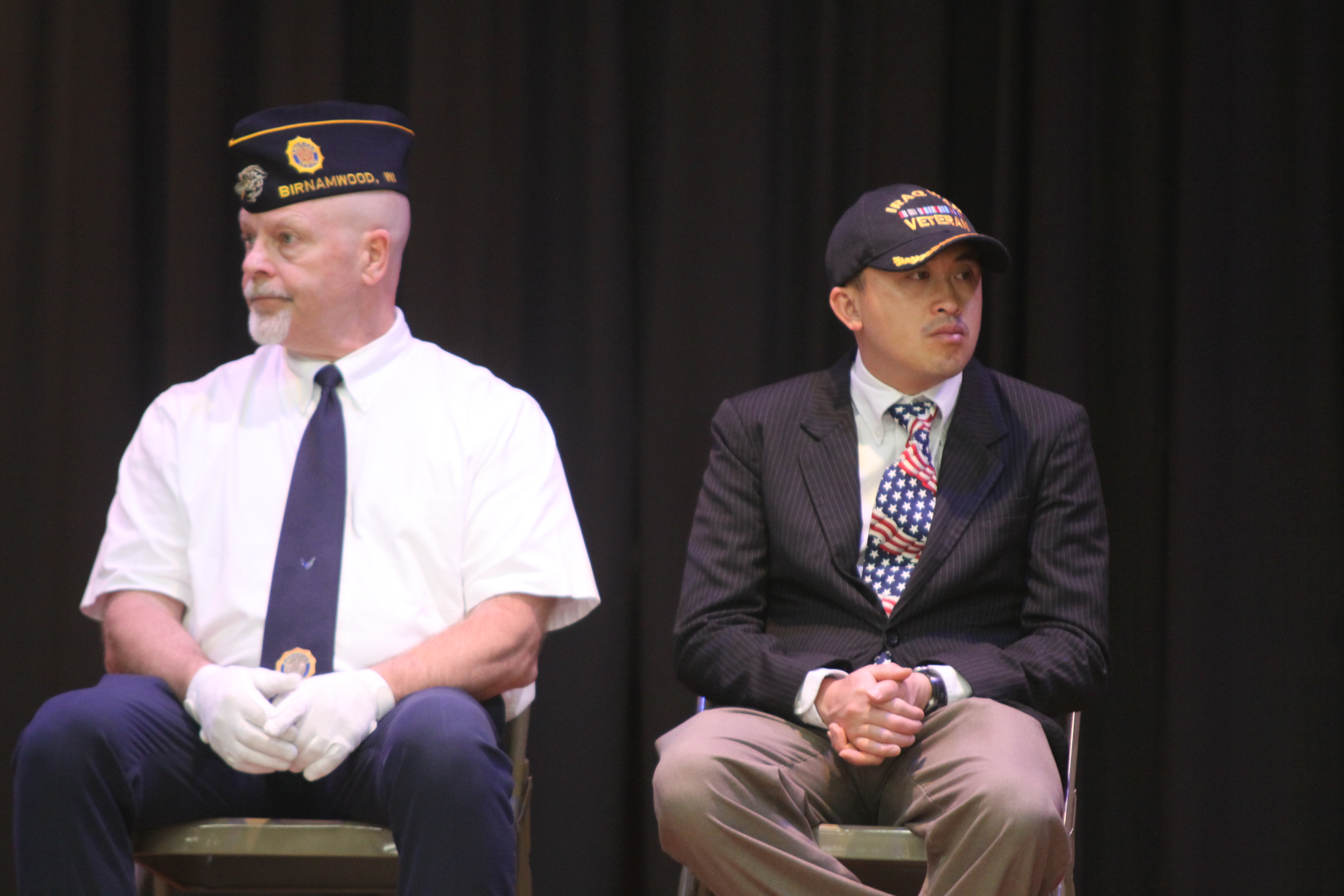
Wausau native and veteran Yauo Yang was the guest speaker during the Birnamwood American Legion Post 341 Memorial Day service on May 30.
After the Sept. 11 terrorist attacks, Yang said he wanted to do his part to keep America safe.
“I thought that the right American thing to do, is to sign up and defend my country,” said Yang. “Against all of the wishes of everyone, in 2002, I signed up for the Wisconsin Army National Guard.”
When he began his training in Neillsville, he met Staff Sgt. Todd Olson. After boot camp in Georgia, Yang said that his unit was deployed to Iraq.
“I was deployed to Iraq immediately after boot camp,” said Yang. “We got shuffled with other communities, but through all of that shuffling, Todd Olsen was still my squad leader.”
Yang explained that IEDs (improvised explosive devices) were planted every night. He and his fellow soldiers would have to walk or drive the streets to prevent planted IEDs.
“On Dec. 26, 2004, we had just been in Iraq for about three weeks,” said Yang. “That night was just another routine patrol. Staff Sgt. Todd Olsen was the number one leading our formation. An hour into our mission, they already had an IED waiting for us. When Staff Sgt. Todd Olsen got close enough, they used a remote control to detonate that IED. Staff Sgt. Todd Olsen got hit by that IED.”
After calling the Quick Reaction Force, Yang said that the unit got news saying that Olsen had succumbed to his injuries.
“It was so strange that just like that, I would never see Staff Sgt. Todd Olsen again,” said Yang.
When they got back to Neillsville, the first person to greet the unit was Olson’s wife, Nancy.
“She tried to cheer us up,” said Yang. “She said that Todd served his community — he was on the school board and a football coach. Nancy told us that if we want the legacy of Todd Olson to continue, then we must serve our community.”
He also talked about his experiences as a Hmong youth growing up in Central Wisconsin, beginning with his people’s support of the United States in the Vietnam War.
“Due to the communist aggression that was happening in Southeast Asia, U.S. forces needed an indigenous group to form an alliance with to fight the war,” said Yang. “We the Hmong people said for you, Americans, we are willing to fight on your behalf.”
He explained that when the United States pulled out of Vietnam, the Hmong were left behind.
“The North Vietnamese people were turning their guns on the Hmong because of their alliance with the United States,” said Yang. “When the communist regime came into my parents’ village, they knew that if they did not escape, they were going to be killed.”
Yang explained that his parents took his three older siblings and ran through the jungles to get to Thailand.
“When they got to the Thailand, my parents ended up having to bury my three older siblings,” said Yang. “It is very difficult to run through the jungles carrying three little children. My mom was pregnant with me at that time, and if she was one of the 30,000 Hmong people that died, I would not be here.”
He explained that he and his family lived in poverty as refugees for seven years before coming to the United States.
“Of all of the communities that we could have went to, it was here — Central Wisconsin,” said Yang.
Yang said that once again, the family lived in poverty. His parents and nine children lived in a two-bedroom duplex.
“That was my upbringing in Central Wisconsin,” said Yang. “I was thankful for no longer having to live in the refugee camp.”
Going to school, Yang talked about how classmates and teachers could tell that he lived in poverty. He said that one teacher formed a relationship with him, inviting Yang’s family over for their first Christmas.
“For the first time in my life, I finally felt what it was like to be an American,” said Yang. “She continued to shower my family with love, including bringing us boating, camping, fishing, you name it.”
He noted that the teacher who showed affection was Caucasian.
“I learned a lesson from her,” said Yang. “I learned that here in America, you love, it does not matter the color of your skin, you just love.”
Yang recalled that in his sophomore year of college, the Sept. 11 attacks happened.
“I thought a lot about that day,” explained Yang. “How dare these Middle-Eastern terrorists come to the United States to destroy who they really think are bad Americans, when in my heart, I know that Americans are kind, loving people.”
He concluded his speech urging the audience to serve the community to honor those who have fallen.
lreimer@newmedia-wi.com
Yang shares story regarding patriotism