Officials from Prevea Health gave an update on COVID-19 in Wisconsin during a Zoom meeting on Jan. 14.
Prevea President and CEO Dr. Ashok Rai covered where Wisconsin is at in regards to COVID-19, expectations for Wisconsin, isolation and quarantine guidelines, and testing.
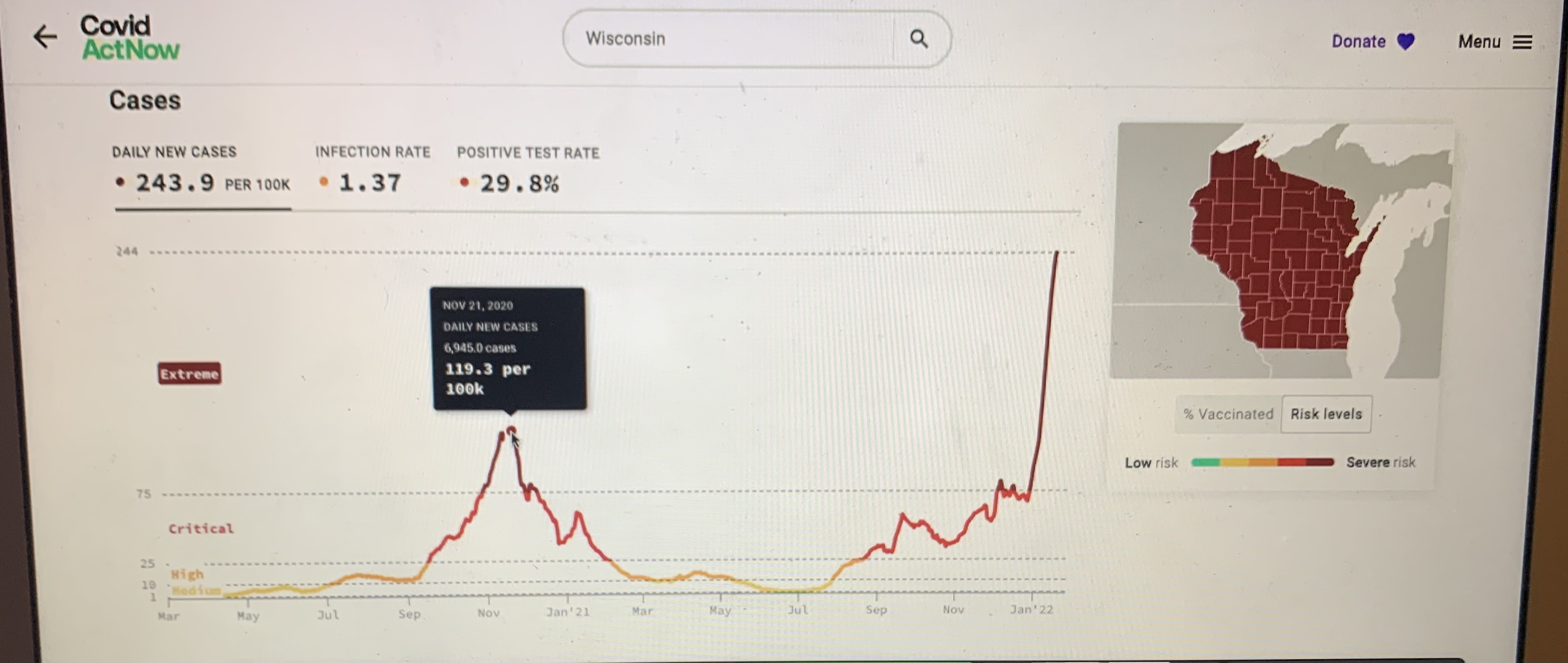
Rai opened the meeting talking about how the omicron variant of COVID-19 has affected Wisconsin. Rai used a graphic showing Wisconsin in a dark red color, signifying a severe risk of being infected.
“There was a time where the state had a lot of green and some yellow, orange and red,” said Rai. “Every single county is now in that extreme range.”
He added that the positivity rate (those who are symptomatic and asymptomatic) is 30%.
“That is almost one in three people,” said Rai. “If we are looking at symptomatic people, it is one in two and one in three for asymptomatic.”
Rai said the omicrom variant is “omnipresent.”
“It doesn’t need a whole lot to infect somebody,” said Rai. “In a vaccinated and boosted individual, the chance of you going into a hospital is mild and very low. In the unvaccinated or unboosted population, the chance of getting sick is higher and higher.”
He said that it may not make people as sick as the delta variant.
“It still is a nasty respiratory virus,” said Rai. “It still puts people on a ventilator.”
Responding to a question, Rai explained when the omicron virus would start to fade away.
“When it runs out of people to infect,” said Rai. “That is how infectious this variant is.”
He said Wisconsin can continue to see infection spread quickly.
“We have a couple of factors that can speed up infection,” said Rai. “We haven’t had the level of mitigation that other states have had. As much as we would like to consider this the end game … we can’t just sit back and say this is going to happen and this is going to be the end game.”
Rai talked about the different forms of testing, as well as gave recommendations for employers.
“We are going to see a lot more home antigen kits through the federal government and state government,” said Rai. “They do work. If they are positive, we ask you to believe them.”
Rai said that due to the way omicron replicates, if an antigen is positive, it should be believed and that person should be isolated for five days or longer.
He also said that Prevea has experienced delays getting testing kits.
“We will still continue to test, we have strategies,” said Rai. “What we are asking, is that if you are symptomatic and you can’t get a test in the next few days, scheduling a test four days from now will do no good. It is isolate for five days.”
He said that the only people that will be tested by Prevea in urgent care and the ER are people he described as an “NIH - pure one patient.”
“Those are going to be people who have had a solid organ transplant, recent chemotherapy or are undergoing chemotherapy, over the age of 75 without a vaccine and over the age of 65 with significant medical issues and not a vaccine,” said Rai. “Otherwise the capacity for testing just isn’t there.”
Rai went on to explain the difference between isolating and quarantining.
“Isolation is when you are positive — if you know the day of your symptoms starting, that is day zero. If you don’t know, the day that you test is day zero,” said Rai. “After five days, if the patient is asymptomatic or their symptoms greatly improved, they would be allowed to come out of isolation with a good fitting mask.”
He said that implementing this will help to get more people back out to work or do whatever they need to do.
In regards to masking, Rai said that with research, they would like to see people wearing a level one mask to start.
“Cloth masks have more of side leak,” said Rai. “In health care, you can’t even visit our facilities with a cloth mask, we will put a level one on you.”
He said that the importance comes from the tight fitting of the mask.
“Filtration is one thing, but fit is the other,” said Rai. “If you have a side leak, then that is completely unfiltered, so it doesn’t matter how good the filter is. What we would recommend is putting the mask with the best filter closest to the mouth, then if you wanted to use a cloth mask, you would put it on the outside.”
lreimer@newmedia-wi.com
Prevea gives COVID-19 update