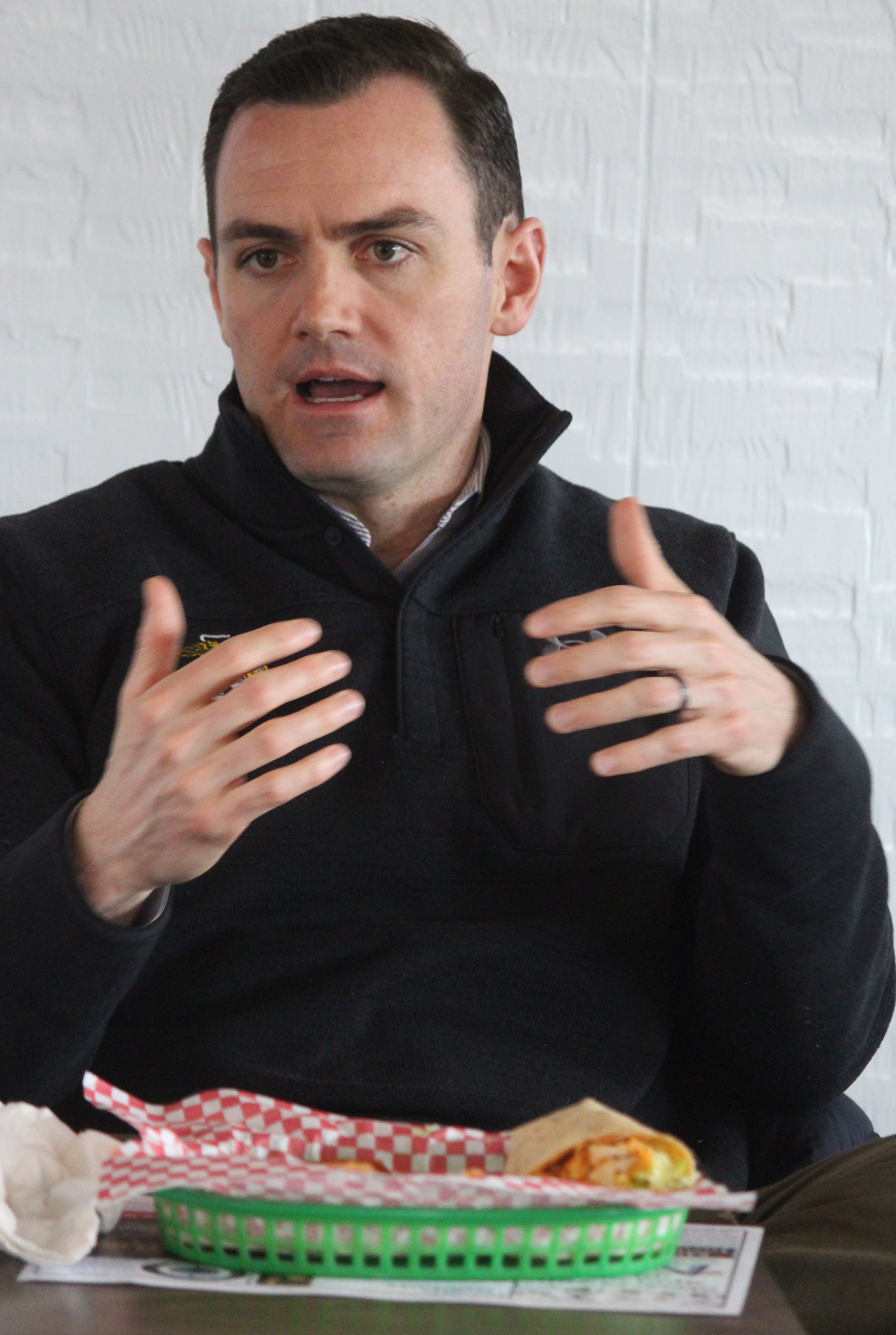
U.S. Rep. Mike Gallagher came to Shawano on Feb. 15 to update constituents on what’s going on in Washington, D.C., but he also got an earful on what dairy farms in Wisconsin are contending with in terms of the immigration issue and environmental matters, among other things.
Gallagher commented during the lunch session at The Lighthouse, facilitated by the Shawano County Republican Party, that if farms could figure out how to monetize manure, farmers would be rich. John Jacobs, owner of Green Valley Dairy, noted that his farm already has done that.
“Renewables are going to be part of our energy portfolio going forward,” Jacobs said. “Unfortunately, we invested in a solar system, and it’s one of the largest solar systems in the state of Wisconsin. That was supposed to be paid for through subsidies. Manure is a valuable resource, and we don’t want an ounce of that phosphorous, nitrogen and potassium go anywhere but on our fields.”
Jacobs noted that fertilizer prices are three times what they were a few years ago, which is why his farm puts the manure through a digester to capture the methane gas and clean it before sending it to California. However, the system is not sustainable, in Jacobs’ view.
“Ultimately, agriculture wants to be a great partner in the state of Wisconsin, the dairy industry in particular,” he said.
Jacobs noted that changing environmental laws and regulations make the system unsustainable, saying that the stroke of a pen can change the way business is done, and farmers can potentially see their investments in green energy wasted.
It takes about 5,000 acres of land for the dairy to do what it needs to, and that generates 150 jobs with $8 million in salaries and wages, according to Jacobs. However, regulations in the state have been “extremely burdensome” with some permits taking between two and five years to get.
“The fact of the matter is that we simply don’t have enough processing capacity,” Jacobs said. “We have a huge bottleneck in our portfolio, and it has to do with processing. There hasn’t been enough done by the state to bring in processing and development industries. We want to expand in Wisconsin now, but we can’t.”
Jacobs noted that “substantial immigration reform” is needed, as many farms rely on workers from other countries to do the work that his farm can’t find in the area. The problem, he noted, is that the immigration debate has zeroed in on Mexico, when businesses are relying on labor from a variety of different countries, including Poland, Germany, the Czech Republic and countries in South America.
“We need everything from ditch diggers to high-level technical professionals and everywhere in between,” Jacobs said. “We need immigration policies to deliver that so we have economic growth. Otherwise, we’re looking at 2030 being somewhere in the neighborhood of 1 million workers short just by attrition from the Boomer generation, and that’s only been accelerated by the pandemic.”
Gallagher noted that any kind of “common-sense reform” on immigration from his colleagues is not likely to come until the Mexican border is more secure.
“Once we secure the border and have a better idea who is coming in and out of the country, then you can argue for a better sense of reform policies geared toward attracting people here legally,” Gallagher said.
Richard Kucksdorf, the county GOP’s vice chairman, encouraged Gallagher to take agriculture issues and concerns seriously when it comes to crafting legislation in Congress.
“The farming industry does partner with everybody else, and we’re all connected here,” Kucksdorf said. “John’s farm operation is top notch.”
Gallagher agreed with the assessment that farms are connected with other industries, noting that before he stopped in Shawano, he visited a business that makes boxes for people to ship foods, including wooden boxes specifically for wheels of cheese.
“It’s supposedly the best thing to ship big blocks of cheese in,” Gallagher said. “They’re making millions of dollars making a reusable box to ship cheese in.”
The irony, according to the Congressman, is that the best wood for those boxes comes from Russia, a type of birch, and because of ongoing tensions between Russia and the United States, the wood is not readily available.
“Wars have unintended consequences,” Gallagher said. “Until you check out some of these businesses, you have no idea how many are downstream of the dairy industry.”
lpulaski@newmedia-wi.com
Gallagher visits Shawano, hears farmer’s plight