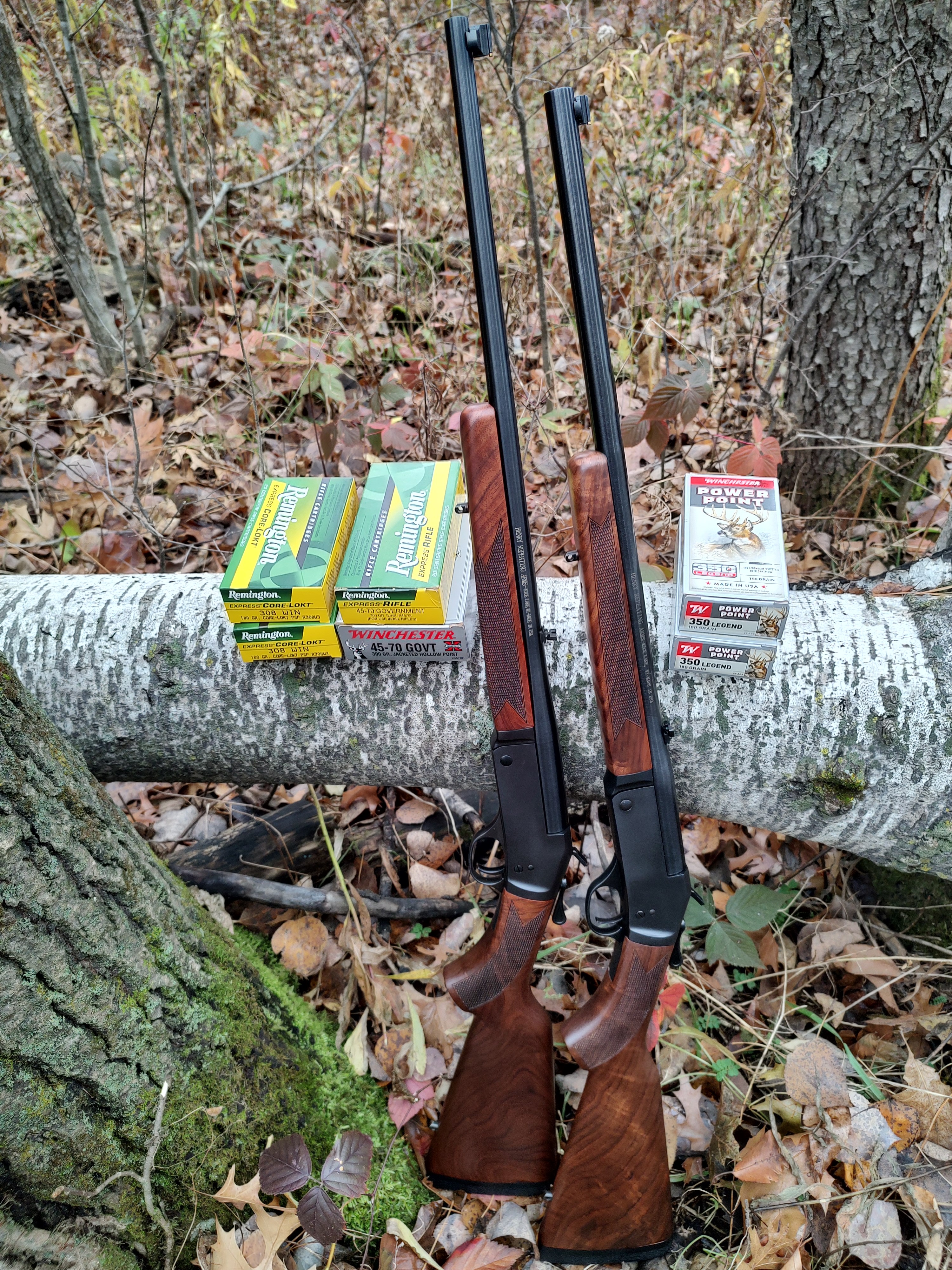
Chances are good that if you grew up in a deer-hunting family, you’ve been given the chance to hunt with Granddad’s beat-up Winchester lever-action .30-30, Uncle Joe’s pump-action .308 with the taped stock or Dad’s Remington bolt-action .30-06.
Classic cartridges like these, the .270, the 7mm Remington Magnum, the .243 and others have been around for decades, but they continue to be the go-to choices for millions of deer hunters nationwide.
Enter ammo shortages, fueled mainly by user stockpiling, and COVID-19, which sent more hunters afield and created an estimated 14 million new gun owners. Suddenly even the old-reliable cartridges became scarce, with some gun shops even buying ammo from customers so they had something to sell.
Online sources like Gun Broker gave some hunters an option, but often at prices that were four to 10 times the original price. Some buyers snapped ammo off store shelves to turn a huge profit at Gun Broker.
The ammo shelves at chain sporting goods stores like Scheel’s, Cabela’s, Fleet Farm and others have finally been filled, and prices have begun to stabilize, although some, like .22 long rifle, remain bewilderingly high. Hunters now have two basic choices: Use the traditional calibers they have always used and search for an extra box or two, if needed, or try a new caliber that may offer a larger supply.
Those who reload their own ammo have faced shortages of components like primers, and those component prices have mimicked the soaring prices of factory ammo.
When I edited Krause Publications’ “Cartridges of the World,” one of the most comprehensive books on global cartridges ever written, I was overwhelmed at the number of oddball options available to hunters. Since my work on that book, many new cartridges have surfaced, including those designed specifically for deer.
Here’s a look at just a few great choices for deer hunting, and their pros and cons.
Before you pick one or more, you need to first look at your overall needs, average shot distance where you hunt, your tolerance for recoil (also called “kick”), your physical size and your willingness to damage valuable meat. Big calibers in general make fast, clean kills, can tackle thick-skinned game such as elk and moose if you also hunt those and can damage meat more than smaller calibers.
They also can make clean kills beyond 300 yards, but if most of your shots are 100 yards or less, do you need a 7mm Remington Magnum or one of the Weatherby calibers? Probably not.
Calibers for young, meek
The last thing you want to do to a young shooter with virgin shoulders is to load up a .30-06, .270 or other long-action rifle and let them shoot targets in a short-sleeve shirt. That youngster will not only leave the range with bruises but also may become gun-shy, develop a flinch and may not want to hunt again.
Although the .243 is still a good option for shooters in their early teens and older, the recoil can spook smaller kids. The .223 and its almost-twin 5.56 in an AR-15 semi-auto platform, with the right bullet, can be a decent deer gun that has very light recoil.
Be sure you get a soft-pointed hunting round (full-metal jacket target rounds in any caliber are prohibited in Wisconsin) that will expand and make a clean kill with proper shot placement.
Another option is to use a pistol caliber in a rifle configuration, such as the Ruger carbine in .44 Magnum or a single-shot or lever-action .44. The longer barrel of a rifle will give the hunter more velocity in a great round that makes big holes and fast kills without much recoil.
The new .350 Legend, a straight-wall cartridge launched by Winchester in 2019, was initially designed to be used in AR-15 platforms but has now been embraced by most firearms makers and is offered in bolt-actions, single shots and lever guns as well. The bullet is .357 and the 160-grain bullet moves at about 2,300 feet per second, making it a 250-yard deer caliber.
Other weights are offered, including 165 and 180 grains. Recoil is minimal.
The classic .30-30 round is a good deer round with light recoil, but lever guns are not recommended for beginners (exposed hammers with half-cocks and tubular magazines create a number of safety issues for newbies).
Newcomers offer new twists
The .450 Bushmaster, developed in 2007, was another cartridge developed for use in AR-15 platforms. It’s designed for efficient one-shot kills because of the .45-caliber, 250- or 260-grain bullet moving at around 2,200 fps. It compares well with the .450 Marlin, invented in 2000, which was designed for lever guns.
The .450 Marlin starts out about 25 fps faster, but because of its larger 325-grain bullet, it retains energy better at distances to 300 yards (1,278 foot-pounds at 300 yards, vs. 874 for the Bushmaster).
The .444 Marlin, created in 1964, is a straight-wall, lever-action round that is essentially an elongated .44 Magnum with power equivalent to the classic .45-70 Government cartridge. This a round built for the biggest of game, including bears, moose, elk and feral hogs. It can push a 240- to 300-grain bullet at 2,400 fps and generate around 3,000 foot-pounds of energy.
For comparison, the .45-70 round fires a 300- or 325-grain bullet at 2,000 to 2,300 fps and a 405-grain bullet at 1,330 fps.
Metric round comes from the target range One hot deer round born out of long-range competitive shooting, the 6.5mm Creedmoor, was developed by Hornady in 2007. The 120- and 143-grain bullets have high ballistic coefficients, meaning they buck the wind efficiently, and travel around 3,000 and 2,700 fps, respectively.
Both bullet weights retain more than 1,600 foot-pounds of energy at 300 yards — far more than needed to drop a whitetail cleanly. By comparison, the .308 Winchester, a legendary deer round, fires a 125- to 185-grain bullet at 3,100 and 2,500 fps, respectively. The round’s twin is the 7.62 x 51mm NATO military round.
So which deer cartridge is the best? It’s the one you feel most comfortable with and the one you can locate ammo for. If you can shoot all your practice rounds into a 4-inch circle at 200 yards, you are good to go. Good luck and shoot straight.
Ross Bielema is a freelance writer from New London and owner of Wolf River Concealed Carry LLC. Contact him at Ross@wolfriverccw.com.
New calibers join old favorites for more options