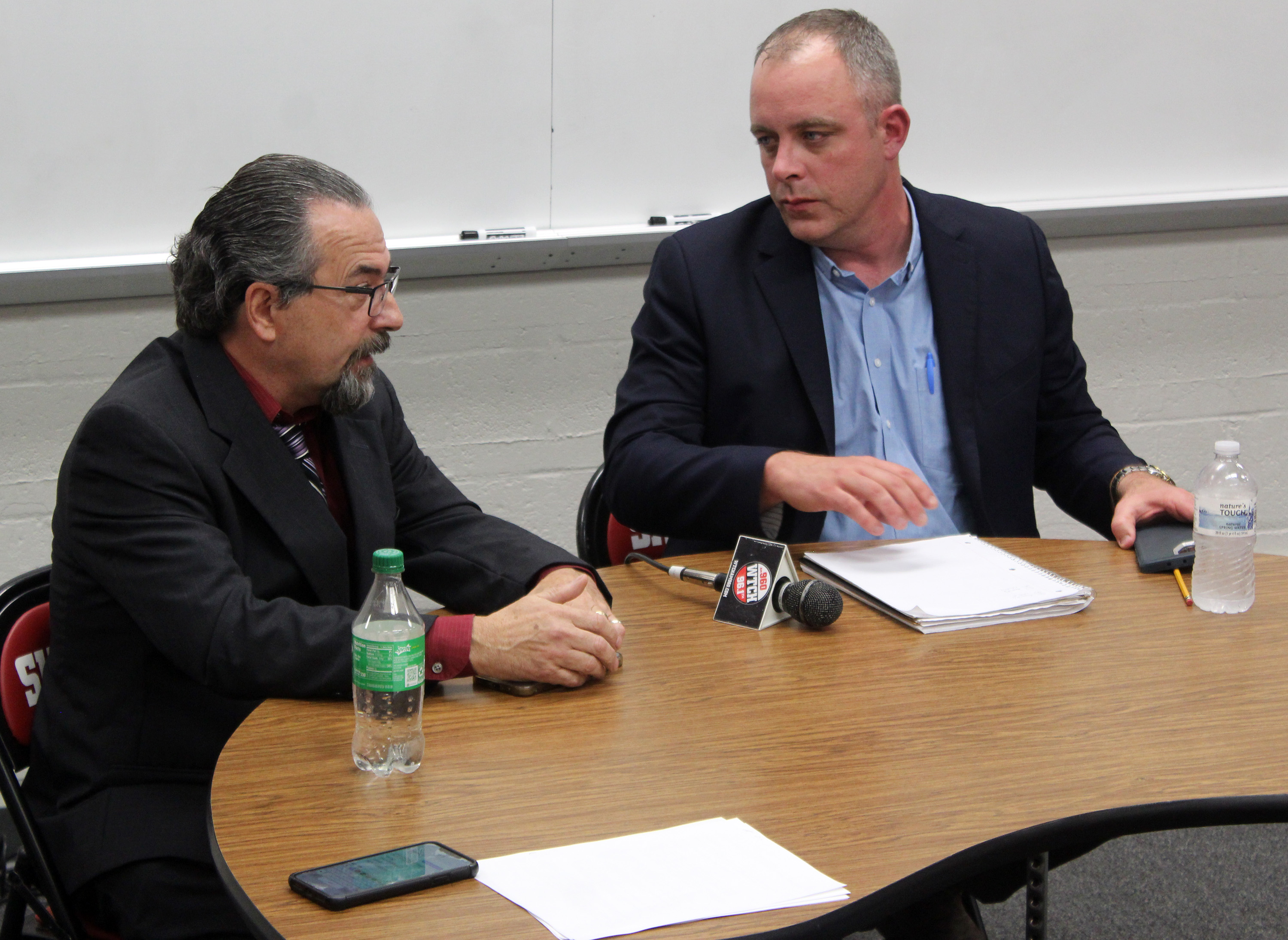
Dean Neubert and William Switalla gave Shawano-area residents different viewpoints on what they’d do as the representative of the Sixth Assembly District during a town hall Oct. 24 at Shawano Community Middle School.
Neubert is running as an official write-in Republican candidate for the seat being vacated by Rep. Gary Tauchen, while Switalla is hoping to turn the seat blue by running as a Democrat. For 90 minutes, the pair talked about education, reproductive rights, agriculture issues and a number of other things that affect rural northeast Wisconsin.
Noticeably absent from the town hall was Peter Schmidt, who barely edged out Neubert in the Republican primary. Neubert, in particular, noted that Schmidt’s reluctance to face competitors in a forum shows what kind of legislator he would be for most of Shawano County and portions of Outagamie, Brown and Waupaca counties.
“Bill actually got out here and talked, not unlike Peter,” Neubert said. “Peter didn’t show up. If he can’t show up for you here to defend himself, how’s he going to defend you down in Madison?”
Switalla, making his third attempt to represent the district at the state capitol, said in his opening statement that his background as a Shawano County supervisor and president of the Wittenberg Village Board will give him firsthand knowledge to represent his constituents at the state level.
“I’ve worked with the community for over a decade now, and I enjoy what I’ve done in lower politics,” Switalla said. “I have a lot of experience working on roads, infrastructure for the village, and I’ve raised over $2 million for roads, parks, our sewer plant and our water department. I have a lot of experience working on funding.”
Neubert touted himself as a political outsider with plenty of community service, which he believes makes him the best choice to replace Tauchen. He noted he’s a business owner who started from scratch after he lost his job in 2009.
“I stand for life,” Neubert said in his opening statement. “I believe in safe neighborhoods. I support parental control of education, and I support the industries — trucking, farming, manufacturing, tourism. I support restoring public confidence in our elections.”
Addressing roads, Switalla noted that the state and federal governments need to give back the money they take for roads so local governments can keep up on maintenance and improvements. He noted that the federal infrastructure bill did not get the job done on improving roads for Wittenberg and would have cost the village more in the long run, so he and the village board had to utilize grants for their pavement.
“A lot of it is getting our state and our federal governments to understand that, even in our rural communities, unlike Milwaukee, people still come up north,” Switalla said. “You see the traffic that comes through up north, they drive our roads, too, so they need to help fund our roads.”
Neubert agreed that small towns need support for their roads just as much as big cities, but he said that the reason for the lack of funds falls at Gov. Tony Evers’ feet.
“Fossil fuels, we let Washington and Tony Evers tell us that fossil fuels are bad, but many of our products are made from fossil fuels,” Neubert said. “Let’s get reasonable cost control so our budgets aren’t getting inflated because of Democratic policy.”
Switalla and Neubert both agreed that farmers don’t start out with the intention to harm animals, but they differed on regulations. Switalla said he doesn’t always agree on regulations, but with larger farms, there’s more of a risk of abuse. Neubert noted that animal abuse claims are inflated by animal rights groups in the hopes of changing the way animals are raised.
Where the two candidates differed the most was on education. Neubert wants to keep school choice in Wisconsin and having it where the state aid follows students and not school districts. Switalla thinks the education funding should go to improve public schools.
Neubert disagreed, feeling that schools are more focused on indoctrination than education.
“When I first started running for office, I would tell people I was running for the Assembly, and they’d say ‘I thought you didn’t like D.C.,’” Neubert said. “We’ve got to be able to tell the difference.”
Switalla noted that he and his descendants have gone through the public school system, and they’ve become decent citizens because of it.
“They took money out of your budget and gave it to the gentleman who wants to go to school in Wausau,” Switalla said.
The candidates also differed when it came to the levy limits that municipalities, counties and school districts must abide by when planning their budgets.
Neubert is opposed to raising the levy limits for fear property owners could be taxed to death and lose their homes.
“If a recession looms, and they raise our taxes, what happens to these people?” Neubert said. “My first solution involves pencil and paper. Let’s eliminate the waste. Our government spends a lot of money on things that are not needed.”
Switalla noted that government is already cutting back on a lot of things, especially at the local level.
“Since 2002, they have been using the pencil and cutting back and cutting back, and it has hurt our communities, especially our police departments,” Switalla said.
lpulaski@newmedia-wi.com
Neubert, Switalla make their cases to voters