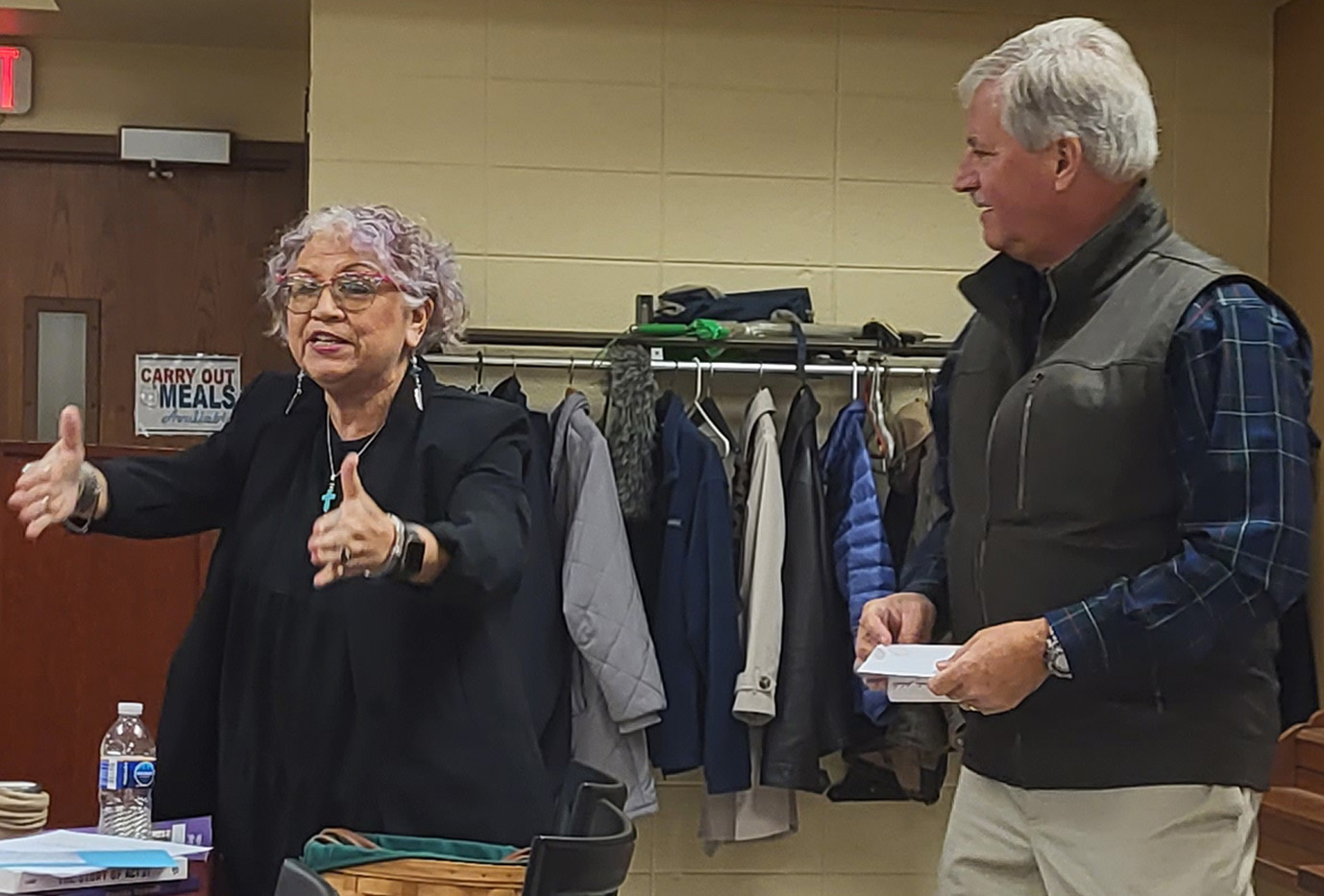
Edi Cornelius-Grosskopf showcased the dark side of the United States’ relations with Native American tribes while speaking at the Shawano County Historical Society annual membership meeting Oct. 17 at the Shawano Civic Center.
Cornelius-Grosskopf’s sad, yet inspirational, presentation focused on her mother’s experience of being forcibly taken from her family to live in an Indian Boarding School in Tomah. Her mother’s experiences prompted Cornelius-Grosskopf to write a book, “Traveling Home Blessed by Spirit-filled Songs: A Journey to Indian Boarding School and Home.”
“Less than 50% of the American population knows about the Indian boarding schools, and that’s just a smidgeon of what this book is about,” Cornelius-Grosskopf said. “It talks about her home life, the culture, the traditions in Oneida that she grew up in before she was sent off to Tomah on a train. My mother was taken from home in about 1918. Birth certificates weren’t kept at the time, but she thought that she had been about 10 or 11 years old.”
The boarding schools were established with an objective of “civilizing” and assimilating Native American children into American culture, Cornelius-Grosskopf said. When Indian children, some as young as 3 years old, were taken from their families, their parents and grandparents didn’t know if they would ever return. Illnesses such as influenza and whopping cough caused many to die in the schools. Children were punished for speaking their native languages. They were stripped of their names, their native clothing and their hair.
“My mother, Alice King Cornelius, got tuberculosis in the boarding school,” Grosskopf said. “She was taken home to die. She was skin and bones, and my grandfather had to carry her. The nuns and the priests from the Episcopal church in Oneida came over every day and brought her medicines and prayers. In about six months, she was completely healed and went on to have 12 children and I was the youngest. My mother lived an amazing life and died when she was 97. This is how I came to write the book.”
While researching the book, Cornelius-Grosskopf visited the Tomah area, which now houses the Veterans Administration office, but the buildings and grounds still remain, she said.
“It is very emotional and personal that my family lived through this,” Cornelius-Grosskopf said.
Her grandmother in Oneida was able to prevent the government agents from finding her children by teaching them how to hide in their home.
“She would crack open her door, just a little bit, and she would say ‘No, I don’t have children to take to your white man’s school.’ She didn’t speak English, only Oneida. Every year, she would buy a little more time to keep the children at home,” Cornelius-Grosskopf said. “Once she did have to send her four oldest children off, they were separated because the agents didn’t want them speaking their language together or running off together.”
Cornelius-Grosskopf said that her grandmother didn’t know if she would ever see the children again.
Grosskopf is a proponent of the book “The Story of Act 31: How Native History Came to Wisconsin Classrooms” written by J.P. Leary. In 1991, it was mandated that two units of Indian history and sovereignty were required in Wisconsin elementary schools and one unit in high schools. She feels that the history of the boarding schools needs to be brought out.
She touched on generational trauma that resulted from multiple issues, including the boarding schools, and encouraged the audience to research that topic. She recommended the Wisconsin Indian Education website to find good information on these subjects.
In addition to her mother’s story, Grosskopf said that there are common, everyday values included in her book. “We need to be teaching these to our kids,” she elaborated.
The book is available on Amazon and at Beans and Books in Shawano.
Grosskopf has a master’s degree in family and consumer sciences education and is currently self-employed as a family wellness coach and consultant.
Speaker tells of mother’s strength, survival