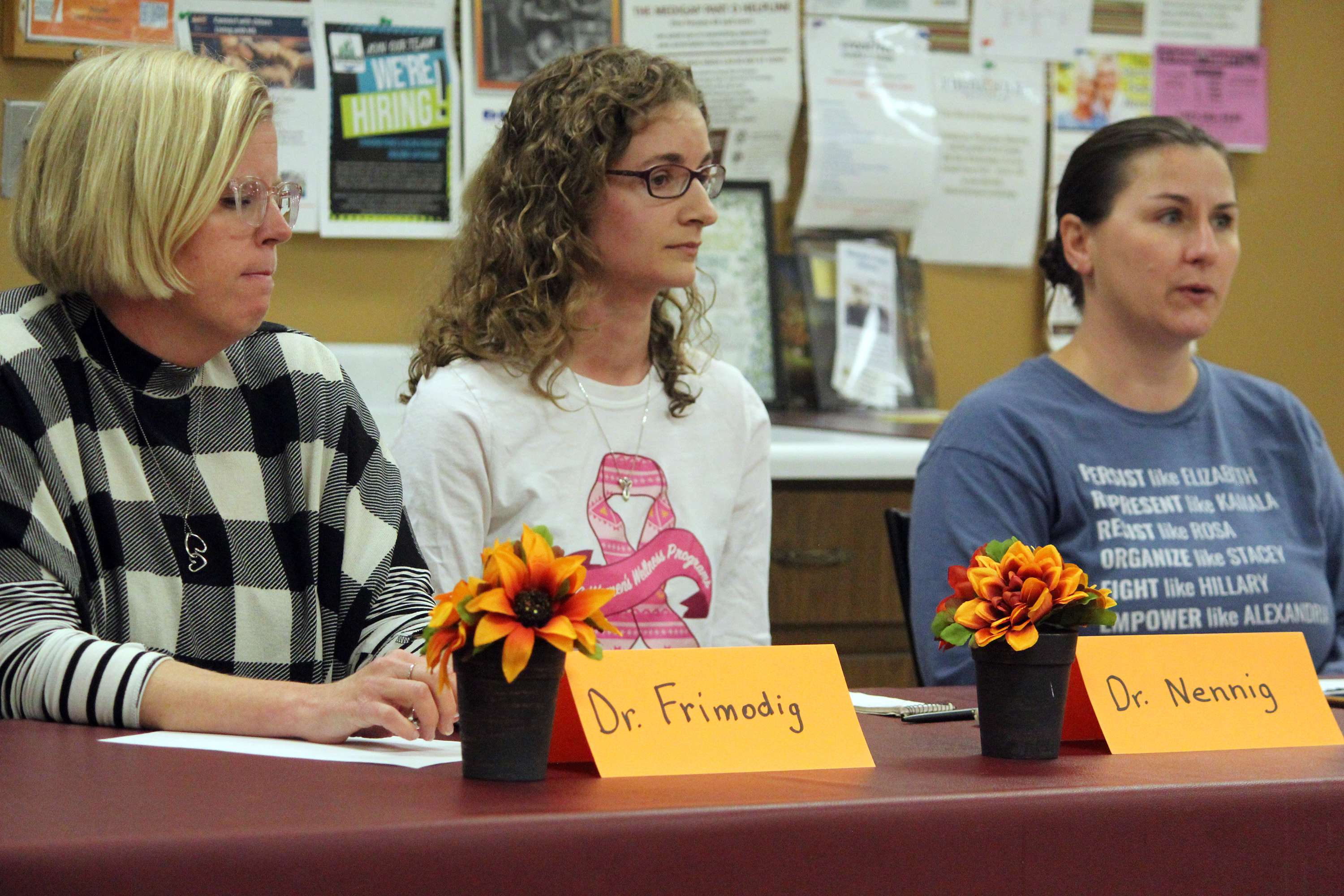
The overturning of Roe v. Wade has generated considerable discussion on abortions and women’s rights, and the Shawano County Democratic Party brought the discussion closer to home.
Three local physicians spoke on the issue Oct. 10 at the Shawano Civic Center, pointing out that the reversion of abortion rights to the states has not only impacted the medical community but could impact the state as a whole as physicians might move to states where laws are not as restrictive, and families might pick other states to live after going to college.
Currently, the law in Wisconsin is a rule from the early days of statehood that does not permit abortions. The 1849 law does not make exceptions for rape or incest, but it does permit abortions when it’s necessary to save the life of the mother.
With abortions pretty much nonexistent in the state, families have to go elsewhere if they wish to halt their pregnancies, according to Dr. Mindy Frimodig, a family physician with ThedaCare. That means traveling to Minnesota or Illinois to make that happen, she said.
Frimodig pointed out that the decision to get an abortion is not usually a spur of the moment thing. She recalled one patient who had to travel out of state after discovering that her baby would not survive the pregnancy or, if it did, would only live a few days.
“They have to go through the stress and trauma of driving to another state,” Frimodig said. “That’s not right.”
Dr. Heather Nennig, who works with the Menominee Tribal Clinic and ThedaCare Medical Center-Shawano, pointed out that there are two ways to abort a pregnancy, surgery or through pills.
“These are all elective abortions,” Nennig said. “The medicine for medical abortions is the same as what we give women when they miscarry, and it’s legal for us to prescribe those if we know that the pregnancy has ended. It is illegal in this state to prescribe those for an elective abortion if the baby is still viable.”
Dr. Amanda Born, a ThedaCare family physician, noted that the travel is less of a hardship in Wisconsin because abortions are still legal in Minnesota and Illinois, but some parts of the United States have a much longer road to travel.
“In some ways, we’re fortunate here in Wisconsin to have neighboring states where women can go, but even still, from here, that’s a substantial drive, and a woman may not have a car or may not have the money for the gas to get there,” Born said. “It poses a lot of challenges and hinders access to health care.”
Nennig noted that abortions weren’t covered by insurance even before Roe v. Wade was overturned, with the average cost for one hovering around $500.
“Even before this law, they had to pay for the procedure or for the pills,” Nennig said. “We have a population that does not have that kind of money just laying around.”
She added that her patients did not consult with her regarding abortions prior to the U.S. Supreme Court decision because procedures were handled elsewhere, but now that significant travel and expense is factored in, patients are asking her what their options are.
Frimodig noted medical care is being impacted by outlawing abortions. The one exception to save the mother’s life still requires two physicians to independently examine her and determine the risk. In rural areas where doctors are few and far between, that’s risky, she said.
“If you’re in a really rural area — a one doc shop, so to speak — and a woman comes into your ER with an ectopic pregnancy and there are no other doctors in sight, you’re put into a position where you do what you know is right to save her life and put your license at risk,” Frimodig said. “That’s a horrible position to be in.”
Nennig noted the 1849 law was before a lot of modern things like pregnancy tests and ultrasounds were in place, before there were even female doctors.
“A lot of the physicians were barbers and they were surgeons and dentists,” she said. “There weren’t specialties. There weren’t ER doctors. They did everything.”
Born took aim at Sen. Ron Johnson, who is running for a third term in the U.S. Senate and is against abortions, saying that he shouldn’t determine what a woman does with her body.
“This is not at all relevant to his life or his worldview, making decisions for a population he knows nothing about,” Born said. “It also illustrates how much he does not embrace diversity in any way, shape or form.”
Born fears that the strict stance on abortion in Wisconsin will send medical professionals and others elsewhere.
“No one, regardless of their profession, likes to feel they can’t go their job,” Born said. “If that is taken away, no one is going to want to practice here. Physicians will leave, which will put hospitals overall at risk. It all crumbles.”
Nennig said the exodus of qualified medical staff could mean that other professionals leave Wisconsin for better health care in other states, and even those who wish to go into medicine might receive training elsewhere.
“People might not apply to our colleges from out of state because they don’t want to be put into a situation,” Nennig said. “People might not take jobs here and might go work for a company out of state that covers those kinds of services.”
lpulaski@newmedia-wi.com
Abortion law could be costly to Wisconsin