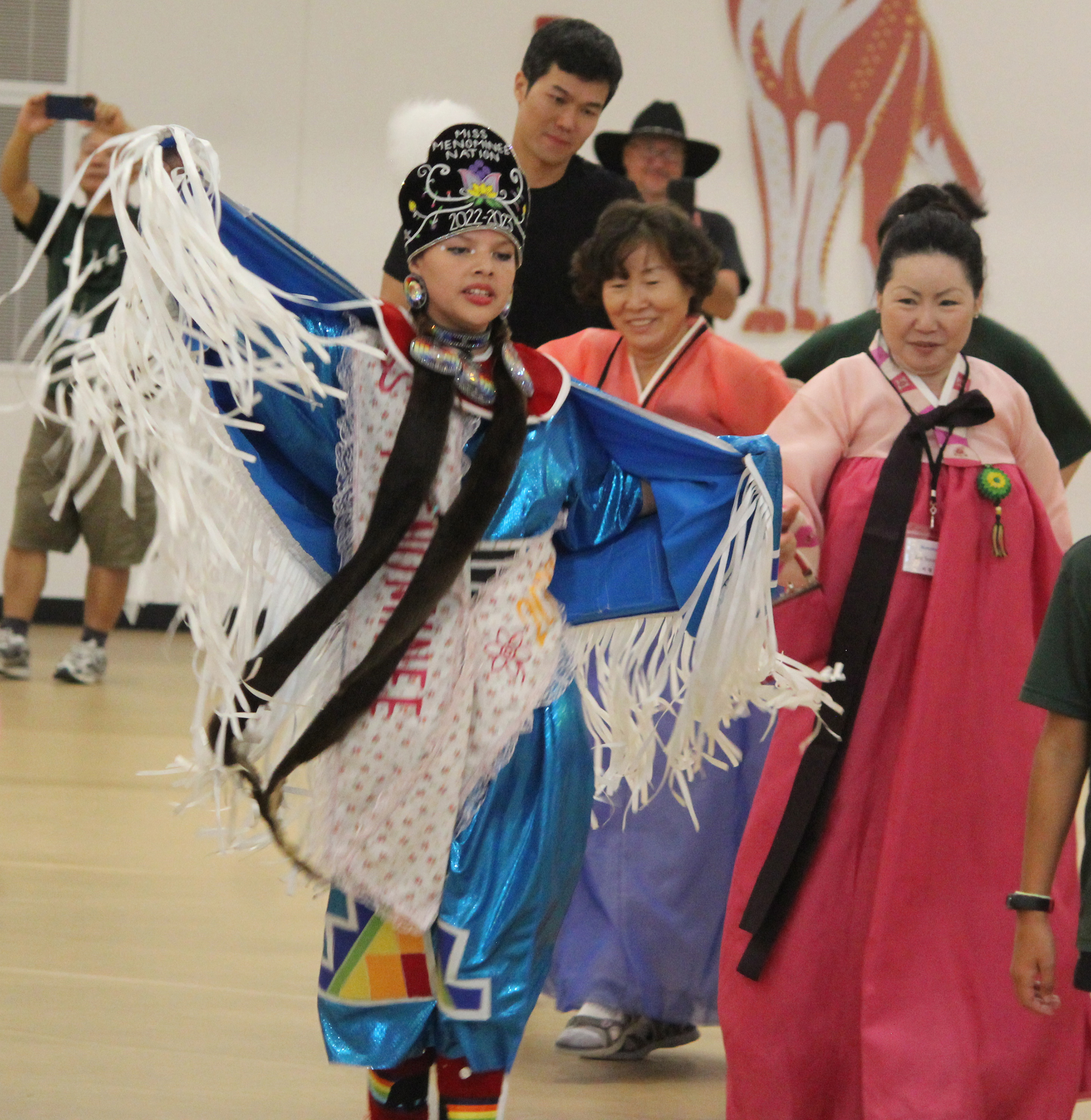
The Menominee tribe has many proud traditions in its history, but members got to see the similarities and differences with Korean traditions as Korean-Americans visited the reservation for four days in a cultural exchange showed what makes them unique and special.
The visit culminated in a public event of food and fun held Aug. 11 at the Omaeqnomenewak Wetohkatikamek Center in Keshena. Everything started with a buffet table with traditional Korean dishes like marinated beef, kimchee, spicy rice cakes and fried rice on one end, while wild rice, frybread and other things Menominee enjoy eating sat on the other side. Korean women donned their traditional cultural attire as they eagerly scooped out their food for their hosts and members of the public to enjoy, and Menominee and Korean people dined together at the tables outside the center.
After the meal, everyone gathered in the center’s gymnasium for examples of Menominee and Korean culture. The Menominee showcased their pow wow dances and the drum circles that keep the beat going at the event. The Korean visitors eagerly showed off three of their cultural activities — traditional swordfighting, traditional drums and the more modern K-Pop dance phenomenon.
The Korean visitors, who have become known to some Menominee tribal members as their “relatives,” also visited the Stockbridge-Munsee and Potawatomi tribes for the week they were in Wisconsin, according to Bryant Doud with the Woodland Boys and Girls Club, which coordinates the cultural exchange. This exchange has been going on for decades, and there is always something new to learn.
“They took a break during the pandemic, but they’re coming back now,” Doud said. “We have a group of 35 who were here all week doing different stations. They did face painting, hair, haircuts, games, arts and crafts, and they had their food all week.”
The Korean relatives reach out to Boys and Girls Clubs and other reservations regularly to travel around the country giving people a taste of what makes their culture interesting and thriving, according to Doud. While they showcase Korean culture, the visitors currently live in Michigan, Maryland and Massachusetts, he said, but they find it’s very important to keep their traditions front and center while living in America.
“They’re just trying to bring awareness to their culture and their traditions, and in exchange, we show them ours,” Doud said. “It’s the same thing we try to do in showing our culture and our traditions.”
Doud said the Koreans got to learn about the Menominee clan system and a variety of foods. Out of the food offered by the Koreans, Doud particularly enjoyed the shrimp fried rice and the dumplings.
“I think we’re taking it back to a long, long time ago when two ethnicities meet together, and they don’t know each other, so they do that cultural exchange,” he said. “Personally, it’s very eye-opening to see what their traditions and their beliefs and their traits are. They align similarly to the Menominee traits, too, their morals and stuff like that, how they carry themselves. I didn’t expect to learn so much in a couple of days being with them.”
Doud believes the cultural exchange is good for the young people he sees through the Boys and Girls Club, showing them that while they should be proud of their traditions, there are other ways of life and other cultures that are just as rich and fulfilling.
“We’re trying to broaden their horizons and show it’s not just here, not the Menominee rez, but there’s a whole bigger world out there,” Doud said.
Lambert Ham, one of the Korean visitors, said he was very interested to learn more about Menominee history and culture.
“I like to learn first, and then we introduce our culture, too,” he said. “We like to make friendships first and then introduce each other to build up those friendships. That’s a very important thing, and that’s why we came.”
Ham and others traveled by bus for 20 hours to arrive in Wisconsin, but it was worth it to make the journey to learn more. It’s Ham’s fifth time participating in the exchange program.
“Every year, we come here, and we make friends,” Ham said. “We were so excited to meet friends and the children, enjoy your culture and friends.”
Frybread, while not an ancient delicacy, was one of the favorite foods Ham enjoyed that were offered by the Menominee. He said he also enjoyed meeting Gary Besaw, a member of the Menominee Tribal Legislature.
Ham also raved about the Omaeqnomenewak Wetohkatikamek Center, which was built during the pandemic. During his previous four visits, the cultural exchanges happened at the Boys and Girls Club’s main facility in Neopit.
One of the similarities that Ham sees between the Korean and Menominee cultures is their shared struggle to maintain their heritage. Indigenous tribes have been displaced from their ancestral lands and forced to shed their traditions in favor of that of their conquerors, he said, and the Koreans have dealt with that, too, when Japan occupied their country from 1910 to 1945.
“We lost a lot a long time ago,” Ham said. “For more than 30 years, the Japanese occupied our country. They got rid of my language. They got rid of my culture. The Menominee and we have a similar cultural background, but we survived. We got back our language, our culture, everything. That’s why we pray for the Menominee people, too, as they get back their language and their culture.”
Because the Korean culture has been resurrected, it’s more important than ever to share it with people and show the heritage of another group, in Ham’s view. He plans to continue coming back and learning more about the Menominee as long as the tribal members are eager to absorb more about Koreans.
“Just one year? No,” Ham said. “This is a long-term friendship. I’m 65 years old, and I’m the grandfather, but as long as I’m healthy, I plan to come here another 10 years. Every year, this is my vacation. Next year, I want to come, but not only be in this building. I want to go outside and meet more Menominee, see the scenery and introduce myself to more friends.”
lpulaski@newmedia-wi.com
Menominee get visit from Korean ‘relatives’