Shawano had a discussion on race Feb. 24 that had nothing to do with roaring engines and a dirt track.
Instead, the presentation held at the Shawano Public Library focused on how racism is still prevalent in American society today — from full-blown hatred and discrimination toward people of a different colored skin to making assumptions of foreigners, like their intelligence or their ability to speak a certain way.
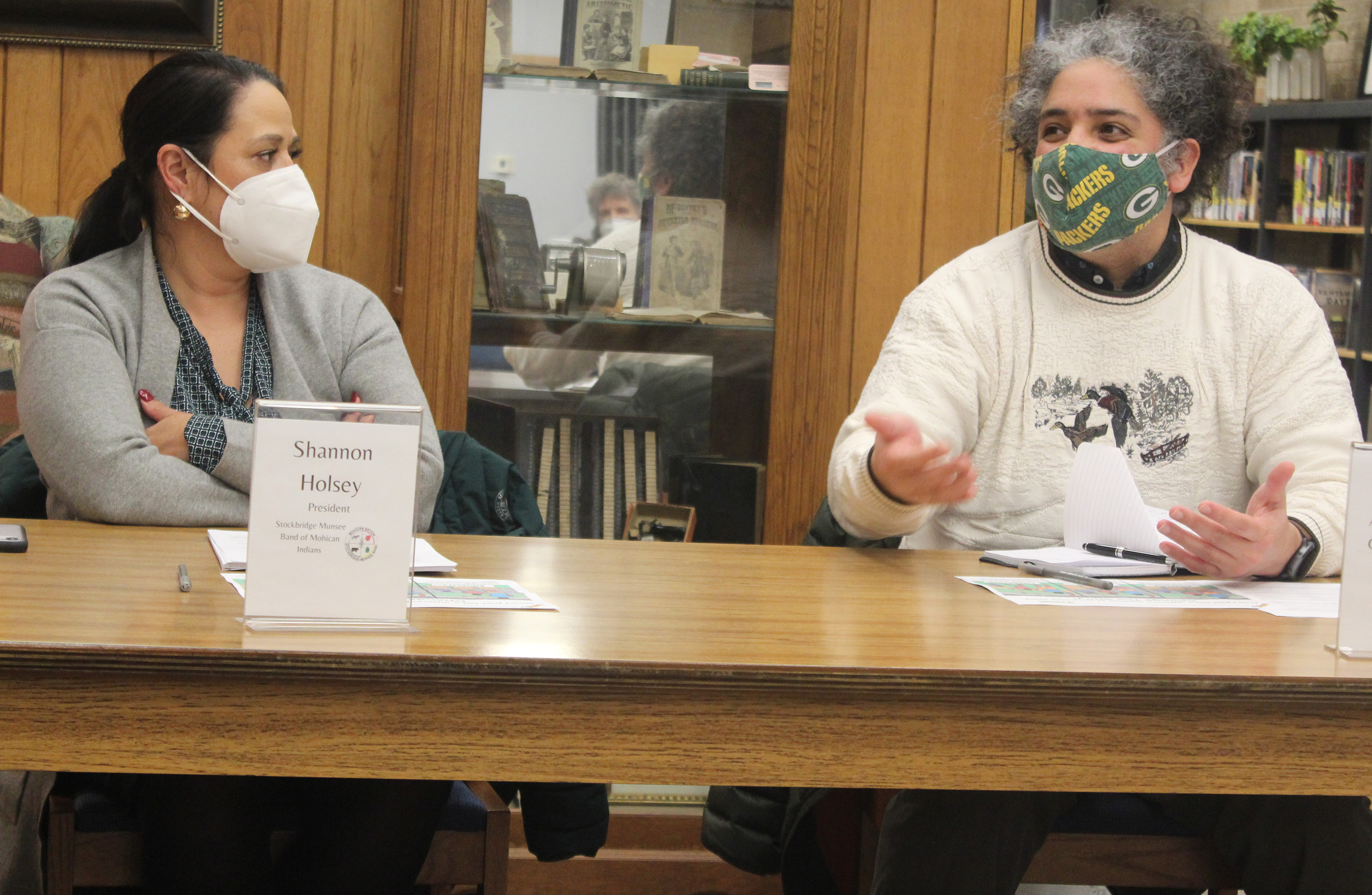
The library hosted the event as part of a month-long dive into a discussion about race. The library held a winter reading challenge to encourage the community to read “Stamped From the Beginning” by Ibram X. Kendi, which examines the history of racist ideas in America, and followed that up with a Facebook discussion group discussing what is addressed in the book. The program concluded with the evening presentation featuring Shannon Holsey, president of the Stockbridge-Munsee Band of Mohican Indians, and professor Angel Saavedra Cisneros, who teaches political science at St. Norbert College.
Holsey noted that her tribe is not originally from Wisconsin but from upstate New York, but forced relocations from the government brought her people to Wisconsin to settle on land that originally belonged to the Menominee. Even when the U.S. Constitution was crafted, she said, it was geared toward white men and not considered for other races — especially not Native Americans, who were not granted U.S. citizenship until 1924.
“We didn’t even receive our freedom of religion until 1978,” Holsey said, noting that the early Europeans had deemed the various tribes living here centuries ago to be uncivilized. “We were always civilized, and some people think that, when people came to the Americas, they somehow evolved Native Americans through assimilation.”
For Holsey, having discussions on the different ways various cultures live their lives and conduct themselves today is important to realize there’s more than one way of doing things.
“Unity does not have to mean necessarily uniformity, but there has to be a level of diplomacy and decorum because it’s really significantly important to understand our history,” Holsey said. “We don’t want them to repeat themselves because there’s an underbelly and ugliness of it.”
Holsey noted that many K-12 history textbooks today don’t speak of Indigenous people beyond 1900.
“There’s an invisibility about who we are,” Holsey said.
Cisneros noted his job requires him to teach about things that are “impolite to talk about at the dinner table,” which includes race and politics. He immigrated to the United States from Mexico and became a citizen last fall, and he said that he’d been pretty naive about this country and imagined it was a multicultural melting pot.
“I thought race was something that we read about in textbooks and that racism had been eradicated,” Cisneros said. “I want to remind us all that we’re human, and we have lots of flaws. We can fight these flaws if we remember that we’re human. If we listen to humans and sit next to humans, then we can change the way we view our identities and use them for good.”
Healing is a key factor in mending race relations, according to Cisneros, but that only works when the perpetrator apologizes. He noted that people should think before they speak.
“What do you lose from being able to do right by someone?” Cisneros said. “You don’t lose anything by saying, ‘You know what? That might hurt you, and I don’t have to do that anymore.’ Micro-aggressions are really interesting. If you wouldn’t use that compliment for somebody like you, then maybe you shouldn’t use it.”
The issue of white privilege also came up during the panel discussion, and Cisneros pointed out that the concept of privilege is not necessarily limited to races with white skin, and that it should be acknowledged but not in a shameful way.
“Privilege is something you have, whether you want it or not,” Cisneros said. “You can’t give it up. You can elevate people. You can use it for good, but you can’t give it up.”
Holsey related her experience from two days earlier, when she addressed the Wisconsin Assembly. She noted that like-minded people or people who looked the same were congregated in different parts of the chamber.
“I am in the legislative hall, and I’m not even kidding — the Republicans are on one side of the hall, the Democrats are on one side, and the Natives are just over in a corner somewhere,” Holsey said.
Holsey suggested that people should try to regularly put themselves in situations where they’re not with like-minded individuals, and that it might help people to understand that differences are OK.
“Every day I learn from somebody, and everybody has their own story to tell,” Holsey said.
lpulaski@newmedia-wi.com
Panel addresses racial issues in America