The Green Bay Packers survived a 12-game gauntlet of games and injuries with a 9-3 record. They’re just a half-game behind the Arizona Cardinals for the No. 1 seed in the NFC. What’s gone right? What’s gone wrong? And what are the keys for a drive to the Super Bowl? Here’s a unit-by-unit look at the Packers.
Quarterbacks
What went right: Rather quietly, Aaron Rodgers is second in the NFL in passer rating. He’s thrown 23 touchdowns vs. four interceptions – and that’s after tossing two picks in a 38-3 loss in the opener. He returned to his MVP form of last season during the second-half comeback at Minnesota and the victory over Los Angeles.
What went wrong: Rodgers tested positive for COVID-19, which kept him out of a winnable game at Kansas City. Adding injury to insult, he suffered a broken pinkie toe at some point during his 10-day isolation. He practiced only on Friday before facing the Vikings and didn’t practice at all before beating the Rams. The hope is the bye-week rest will get him on the road to recovery.
Key to rest of season: Rodgers has to be great. This is a diverse team, with its ability to run the football on offense and keep teams out of the end zone on defense, but it’s also a team with a lot of injuries. As always, as Rodgers goes, so go the Packers. His last six quarters before the bye were encouraging. He picked apart the Rams with patience and precision.
Defense and Special Teams Outlook
Running backs
What went right: AJ Dillon showed he could catch the football. Dillon wasn’t asked to do that during his collegiate career at Boston College, and he was thrown the ball only twice during his rookie season.
The coaches swore Dillon had good hands, and they were right. He’s caught 27-of-29 passes for 261 yards and two touchdowns. His 93.1% catch rate is third in the NFL. In the last four games, he caught all 17 passes for 171 yards and one score.
What went wrong: The Packers, having navigated their salary-cap problems, surprisingly re-signed Aaron Jones in free agency. He entered the season with a career average of 5.16 yards per carry. That was fifth-best in NFL history among running backs. This year, he’s averaging only 4.24 yards per carry.
Key to rest of season: Jones has averaged less than 4 yards per carry in four of his last five games. Moreover, his 5.1 yards per touch lags well behind last year’s 5.9. As one of the team’s few game-breaking threats, the Packers have to get him going — whether it’s runs, screens or true receiver routes.
Receivers
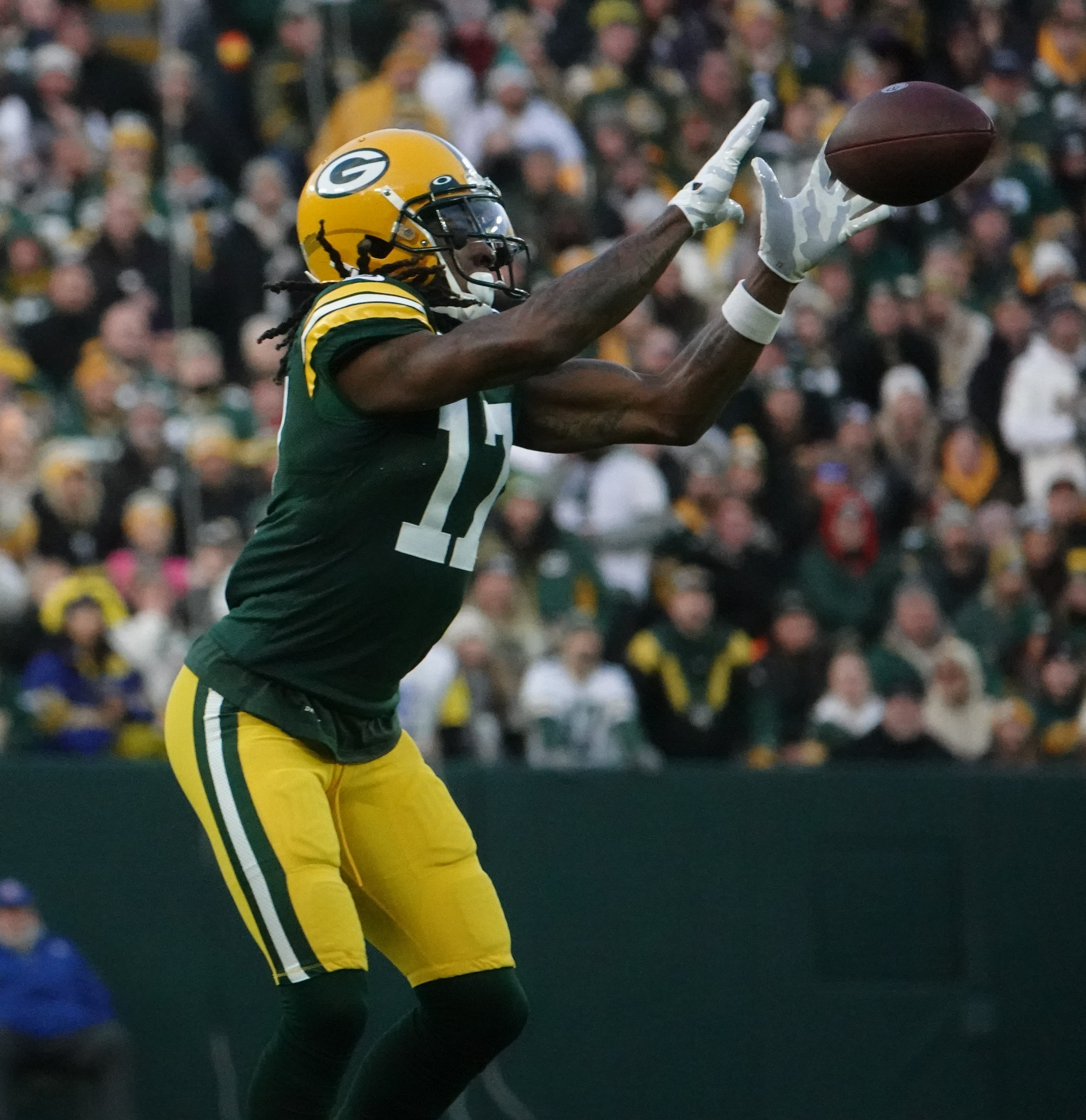
What went right: Davante Adams is doing typical Davante Adams things. He’s caught 80 passes for 1,083 yards and five touchdowns. He’s caught at least six passes in five consecutive games and entered the bye by catching 15-of-17 targets for 219 yards and two touchdowns vs. the Vikings and Rams.
Rodgers was right to convince general manager Brian Gutekunst to acquire Randall Cobb at the start of training camp. He’s been a reliable complementary piece, and 20 of his 28 receptions have been for first downs.
Back from a hamstring injury, Marquez Valdes-Scantling had a 41-yard catch vs. Seattle, four catches for 123 yards and one touchdown vs. Minnesota and four catches for 50 yards vs. the Rams.
What went wrong: After a strong training camps, Valdes-Scantling and Allen Lazard appeared ready to be reliable options alongside Adams. That hasn’t happened, though.
The injury kept Valdes-Scantling out for five games. Lazard has handled the dirty work with his usual aplomb but has as many incomplete targets this year (19 catches out of 32 targets) as last year (33 catches out of 46 targets). That includes 3-of-10 the past two games with two drops.
Key to rest of season: Defenses are going to continue to gang up on Adams. Somebody must step to the forefront. It doesn’t have to be one player being that reliable No. 2 option. It could be Valdes-Scantling one game, Lazard the next and Cobb after that. As offensive coordinator Nathaniel Hackett said on Monday, “When your number’s called, you’ve got to do the right thing.”
Tight ends
What went right: Marcedes Lewis continues to block at a high level at the point of attack, Josiah Deguara caught a touchdown pass on a scramble drill at Minnesota and Dominique Dafney has blocked well and stripped the ball on punt coverage vs. the Rams. Otherwise, not much has gone right.
What went wrong: Robert Tonyan was one of the NFL’s breakout standouts last season, when he led all NFL tight ends in touchdowns, catch percentage and drop percentage. Asked to contribute more as a blocker to start this season due to injuries on the offensive line, he wasn’t nearly as impactful as a receiver. But he caught four passes for 63 yards vs. Washington in week seven and had a 33-yard catch at Arizona in week eight.
Right when it looked like Tonyan was ready to reprise his role as big-play receiver, he suffered a torn ACL at the end of that play. The injury was a huge blow to the offense. Moreover, Tonyan will be an unrestricted free agent at the end of the season. He might be ready at some point in training camp, but there’s no doubt the injury will impact his next contract.
Key to rest of season: Tonyan was irreplaceable. No tight end on the roster could match his combination of height, athleticism, catching ability and connection with the quarterback. At 6-foot-2, Deguara is more a jack-of-all-trades player than a true tight end. Still, he’s the one player with some dynamic receiving ability. He’s not going to catch 25 passes and score five touchdowns during the final five games of the regular season but anything he could produce would be a bonus.
Offensive line
What went right: With David Bakhtiari returning from last year’s torn ACL, Elgton Jenkins showed he was much more than one of the best guards in the NFL. By moving to left tackle, he showed he was one of the best linemen in the NFL, period. With Jenkins sidelined by injuries, Yosh Nijman showed he could play winning football at left tackle, too. A lot of teams don’t have one left tackle. The Packers have three.
What went wrong: Injuries, injuries and more injuries. Just when it looked like Bakhtiari was ready to return to starting the lineup, his comeback hit a snag and he had clean-up procedure on his reconstructed left knee. Maybe he’ll return to practice after the bye. Jenkins missed three early-season games with a sprained ankle, then suffered a torn ACL.
Rookie center Josh Myers also is out with a knee injury that required surgery, though he might return for the stretch run. So, instead of a starting wall of Bakhtiari at left tackle, Jenkins at left guard, Myers at center, rookie Royce Newman at right guard and veteran Billy Turner at right tackle, the Packers lined up vs. the Rams with Nijman at left tackle, Jon Runyan at left guard, Lucas Patrick at center, Newman at right guard and Turner at right tackle.
Key to rest of season: Bakhtiari’s return might be the biggest key for any team at any position. With a healthy Bakhtiari, the Packers probably would have gone to last year’s Super Bowl. After all, with Bakhtiari at left tackle and Turner at right tackle instead of Turner at left tackle and Rick Wagner at right tackle, it’s almost impossible to believe the Buccaneers would have recorded five sacks.
If Bakhtiari can return to his All-Pro form for the playoffs, it would allow coach Matt LaFleur to open up the offense.
Packers Outlook: Offense