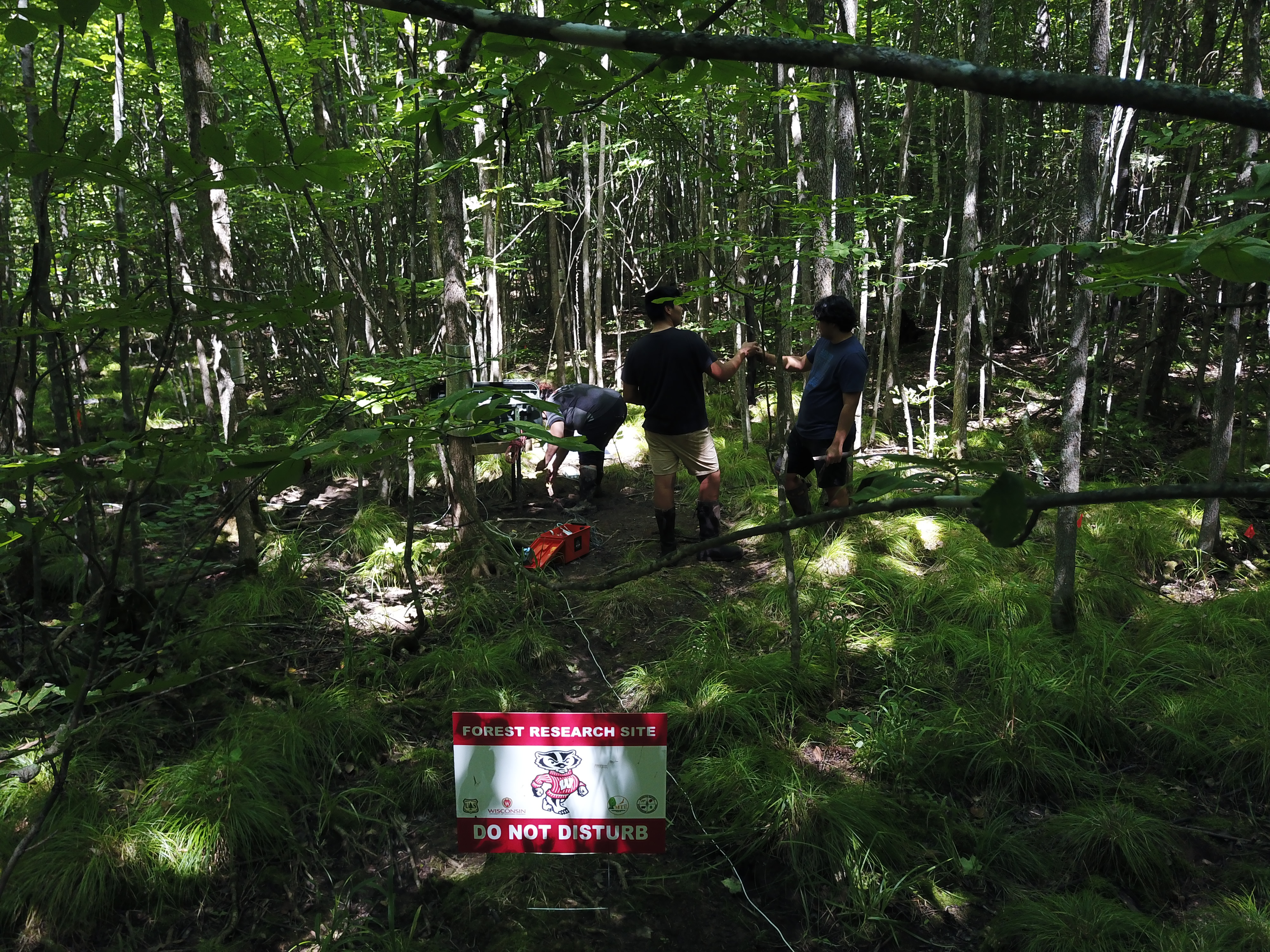
Angela Waupochick is dedicated to helping the forests that sit on the Menominee and Stockbridge-Munsee reservations, but in addition to that, she wants to make sure future generations are engaged and willing to carry on the work in the future.
Black ash trees on the reservations are threatened in particular by the emerald ash borer, a jewel beetle that’s native to northeastern Asia that feeds on ash species of trees. The insect was first discovered in the United States in 2002 around Detroit and has since destroyed 40 million trees in that state and tens of millions more in other parts of the country and Canada.
For Waupochick, the demise of the black ash trees in the area could result in damaging the ecosystem overall in Wisconsin. She had previously worked as a natural resources manager for the Stockbridge-Munsee, but she is now doing graduate work at the University of Wisconsin-Madison that will look at how to mitigate the damage the invasive species is expected to do.
“Like most tribes, we want to find mitigation strategies and respond to the impacts that we expect from the emerald ash borer,” Waupochick said. “I didn’t have the expertise for that. I was a hydrologist, but I didn’t know how to do that.”
Waupochick said she brought in some experts to do a sap flux study, which measures whole-tree water use. She wanted to see what the black ash trees’ role was in the forests and wetlands that make up much of northern Wisconsin.
“If we can determine what their role is in these systems, then we’d know what the impact would be once the ash is gone,” Waupochick said. “What will the water levels be? What can we expect to grow there? What will be the impact on the species that live there? By measuring water, that’s going to open a door to study a bunch of things that will be impacted by the emerald ash borer.”
Because of the massiveness of the project, Waupochick knew she couldn’t do the work in her role with the tribe, so she made the decision to go back to school to get a doctorate in forest and wildlife ecology and utilize the university’s resources to grab hold of the problem and perhaps find some solutions.
“I contacted some folks at UW, and they were willing to take me on as a graduate student,” Waupochick said. “So, here I am.”
Two years into her research and study, one thing has been made clear, according to Waupochick. Wetlands do not have a common mapping or classification, which makes it hard to determine impacts from invasive species in general and the emerald ash borer in particular.
“We don’t know the status to begin with,” Waupochick said. “We have ideas, but I can’t make comparisons between wetlands because there are so many differences.”
The reason there’s little data on wetlands, according to Waupochick, is that many have assumed those ecosystems were “wastelands” that weren’t important to people. The emerald ash borer has caused almost 100% mortality with the black ash trees it comes in contact with, she said, and she hopes to come up with better ways to manage the forests so that the mortality rate can go down.
“It’s a good hope,” Waupochick said. “Right now, the only thing we can anticipate is complete loss.”
She believes the black ash trees suck up more water than any other and release it into the atmosphere, so the loss of the trees would have an impact on water management. The loss of that tree species would also impact birds, mammals and reptiles who use them for shade, breeding and nesting, impacting the biodiversity of the region.”
“What does that mean? Are we going to lose diversity on the landscape?” Waupochick said. “Are we not going to have that support for other trees that need drainage? Losing a tree species is major. That’s something we don’t want.”
To help her with her research, Waupochick has been enlisting the aid of students at Menominee Indian High School. She said that, with increasing forest issues, it was important to be vigilant with the management of the land, and it only made sense to bring future generations in to focus on the care.
“Let’s show them the importance of modern forest health,” Waupochick said. “Let’s encourage them to go into the field. They’re already primed because they’ve lived in the forest their whole life. This is the most reasonable action we can do now.”
The reaction has been mixed, according to Waupochick. At first, it was overwhelming for the students, many of whom asked if they were the best research assistants for something this big. However, Waupochick showed the students that the forests where they’ve lived are a friendly space and prime for learning.
“It’s just like learning to ride a bike. You get used to it,” Waupochick said. “I think after they realized — hey, we’re contributing — hopefully that alone will spark some interest. They are totally capable with this. Anyone is if you have the right atmosphere, the right space.”
lpulaski@newmedia-wi.com
Waupochick mapping future of forests, wetlands