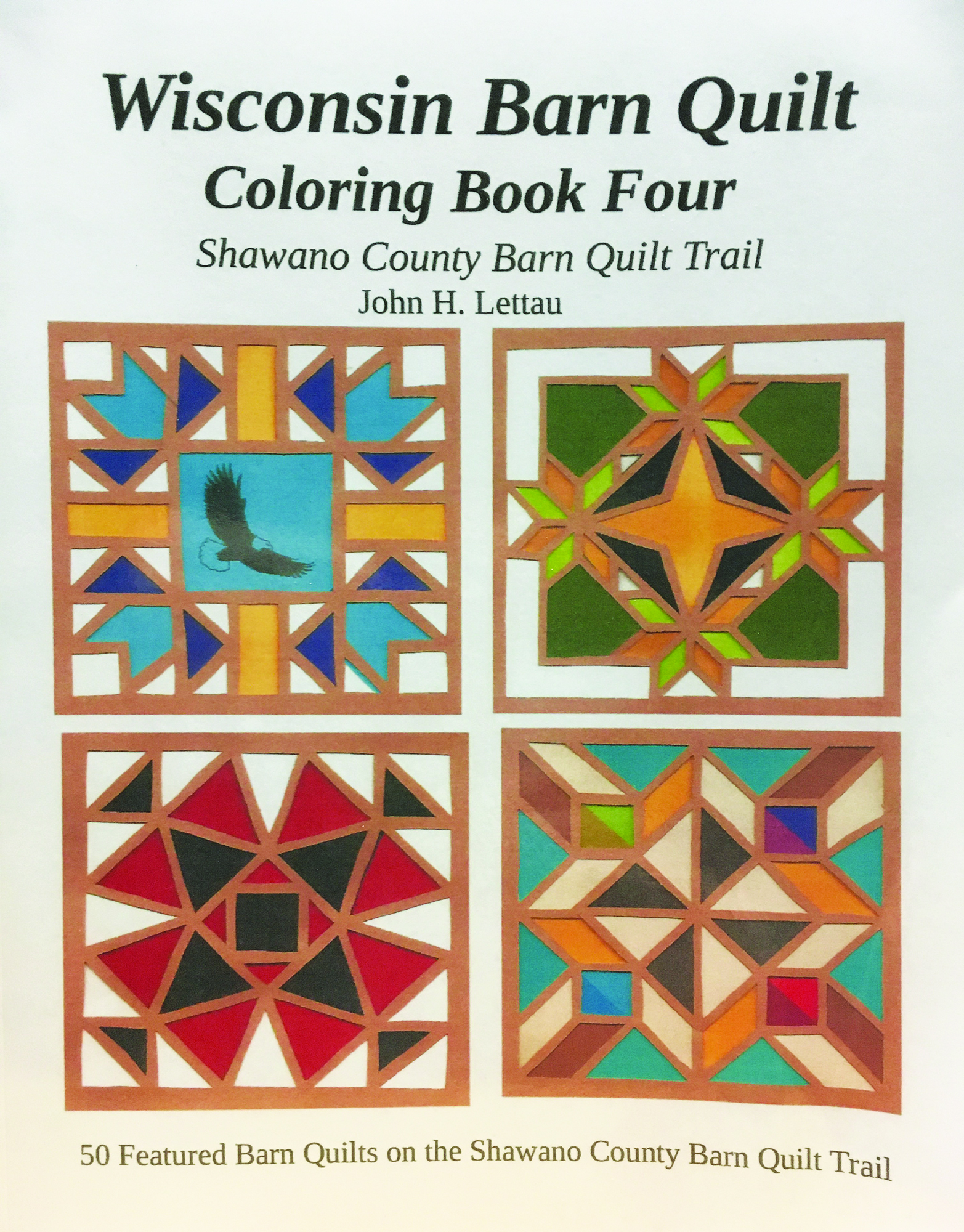
John Lettau’s love of geometric design and skill with graph paper is bringing him home to Wisconsin — while happily remaining a California resident.
Lettau, 93, of Santa Maria, California, has published his fourth coloring book of the barn quilts of Shawano County. Each of the 50 quilts in the book has information about its location, a large quilt block and a dozen smaller blocks, printed in black and white and ready to color.
“I have been into geometric design creations since the early 1960s. I actually put together a book called, ‘Graph Paper Design,’ where I used graph paper just to recreate and create my own designs,” Lettau said. “While teaching school, I taught first through sixth grade. One of the first things I did — even with first graders — how to do a basic design with graph paper.”
Lettau’s brother, who lives in Larsen, Wisconsin, had a barn quilt put on his barn called “Sara’s Star,” and asked Lettau for a smaller version of it. Lettau found a book, “The Barn Quilts of Shawano County, Wisconsin,” by Jim Leuenberger, who initially brought the barn quilt project to Shawano, and found the pattern on the Shawano Chamber of Commerce website (https://www.shawanocountry.com).
“At that point, Jim had roughly 300 quilts in his book, so I did my brother’s and I thought, with all these other designs on the website, I can do a book. I met Jim Leuenberger about three years when I came back for a football game,” Lettau said.
He pitched the idea of a barn quilt coloring book and Leuenberger said he was on board with it.
One book led to two, two to three, and now the fourth edition, “Wisconsin Barn Quilt Coloring Book Four” is in print and for sale at Amazon.com. The newest Shawano County version joins barn quilt coloring books Kansas, Tennessee, and other states with the colorful boards attached to the top of barns.
“I’ve been very happy doing this. I do it as a hobby, not as a business. I get a very small royalty. Its not the money part, its promoting the hobby and these barn quilt projects. The royalty is used for paint, and cut pictures, layers of construction paper that create the barn quilt pattern.”
In addition to the coloring books, Lettau also makes small painted versions of the quilts and layered, cut-paper versions.
To adapt patterns for quilt, he makes one large version — using graph paper — for the first of the books two pages per quilt. The first page is a big page of design.
“Second page, with 12 smaller versions — some are pretty intricate. It’s an interesting process with graph paper — I can duplicate any pattern I see,” he said.
Although Lettau is a fan and promoted of barn quilts throughout the country, one has special meaning for him.
“Number 315 is one I sponsored for $200 in memory of my Lettau grandparents who came from West Prussia in 1892 and when they got to the United States they settled in the little town of Herman in Shawano for about a year, then they got 400 acres in (the Town of) Norrie,” he said. “That’s where I bought the quilt, to honor where they came to the country.”
Lettau spends a lot of his time making the small wooden quilt plaques and cut paper quilt squares. He gives them away or offers them to barn quilt sponsors as fundraisers.
“The 19th of February is the date my wife died, nine years ago,” Lettau said. “I took care of her for four or five years, 24 hours a day. When she passed away I had to keep going. So I was spending six, seven, maybe even eight hours a day working on coloring books and cutting these pictures. That kept me going all the while.”
As he did so much work with quilt patterns, Lettau considered joining a quilt guild near his home in Santa Maria, California.
“I thought, ‘I’ve been thinking about this for 50, 60 years, I’m going to do it.’ I joined their group and when I went … I looked in the window. I was expecting maybe 25, 30 gals. I looked in there and there had to be at least 95 women. I though ‘What in the hell did I get myself into?’ but I couldn’t back out. I had to go in, and obviously you introduce yourself as a new member,” he said.
When asked what kind of quilting he did, Lettau said, “I do exactly the same thing you do, but not with machines and material and threads. I do mine with paint and brushes.”
Lettau offered to show the needle-and thread quilters how he makes his construction paper and painted versions, and eventually held workshops for the cloth-based crafters.
Although he prefers to work in construction paper or wood, Lettau said he does enjoy coloring the patterns as well.
Book brings barn quilts home