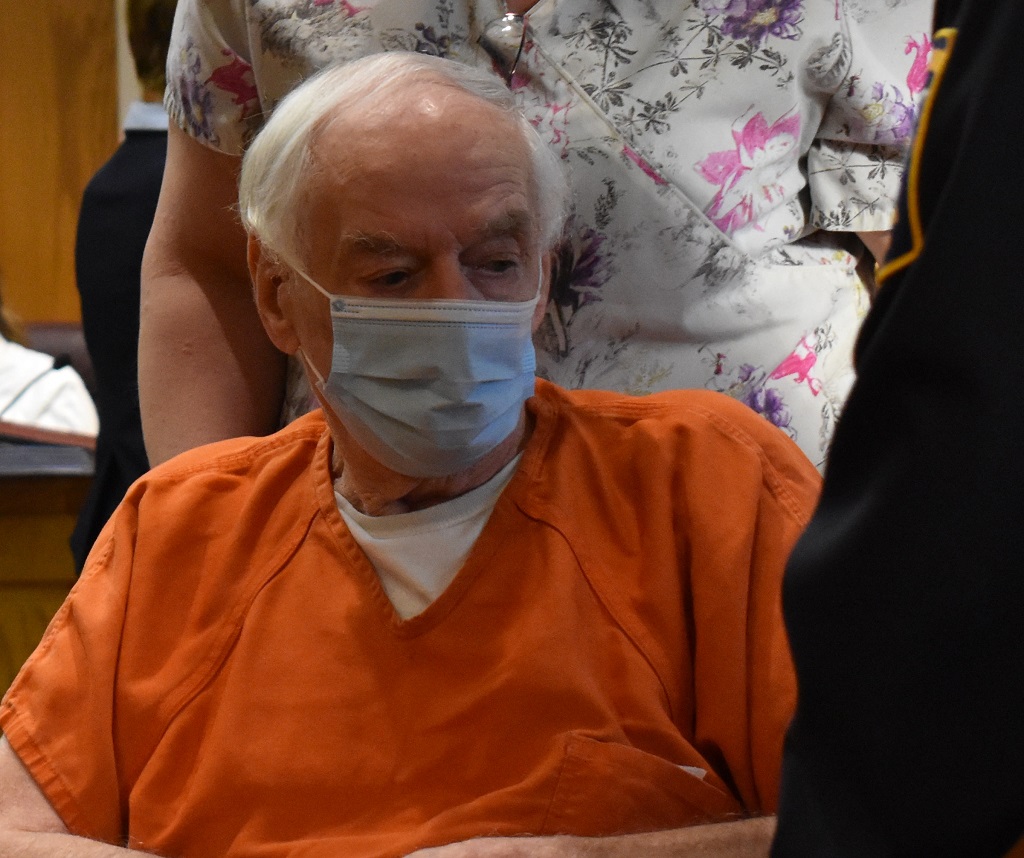
An elderly Lakewood man accused of murdering a Green Bay couple in 1976 will stay in the Marinette County Jail, probably until his scheduled trial in July.
Raymand L. Vannieuwenhoven, 83, has been incarcerated since he was arrested in March 2019 and charged with the shooting deaths of David Schuldes, 25, and Ellen Matheys, 24, at the McClintock Park campground in the Town of Silver Cliff in July 1976. Matheys had also been sexually assaulted.
The case went unsolved for more than 40 years until, investigators say, DNA found with Matheys’ body was positively matched to Vannieuwenhoven in early 2019.
The trial, which is expected to take up to two weeks starting July 19, has been delayed both by COVID-19 concerns and several months when the defendant suffered a mental setback that left him temporarily not competent to assist in his own defense.
At a motions hearing Jan. 29, defense attorney Travis Crowell asked Marinette County Judge James A. Morrison to reduce the $1 million bond to allow his release to his family or at least to a nursing home, although Vannieuwenhoven objected to the latter option.
“My dad died in the nursing home,” he said, interrupting his attorney’s argument. “I don’t want to go there.”
The defendant is in a category of vulnerability to COVID and has various other medical issues that make the jail a dangerous place for him, Crowell argued.
“The main considerations when you look at somebody who’s presumed innocent are they a flight risk, and I think Mr. Vannieuwenhoven’s been in northeastern Wisconsin his entire life,” he said, “and is he dangerous, and Mr. Vannieuwenhoven can barely walk.”
“How do you suggest I protect him?” Morrison responded. “One of the risks is … with a suspect in a case like this is the potential to harm himself. How do I protect him from that?”
District Attorney DeShea Morrow argued that where he’s being kept in the county jail — away from the general population and with 24/7 nursing care — is already the safest place.
Morrison asked Sheriff Jerry Sauve, who attended the hearing, if officials had investigated alternative sites for his care.
“We’ve looked at the potential for other options, and I’ve come up empty,” Sauve said. “I’ve researched this, I’ve talked to my colleagues across the states, and they scratch their heads and say, ‘Sheriff, you’ve got a new one on us.’ So we continue to do our best. I don’t know, your honor, how I answer your question.”
“I think you just did,” Morrison said.
The judge said he’s not persuaded that COVID is an issue in the jail, and in any case the defendant is safer there than in a nursing home or with a family member.
“If you can come up with a plan that would be as secure for Mr. Vannieuwenhoven, I would be happy to look at this motion again,” Morrison said in denying the defense motion. “If you can come up with a plan that (he) would not harm himself and be compliant with medication, I would be very happy to look at that.”
Earlier, Morrison heard testimony from two officers about the effort to reportedly trick Vannieuwenhoven into providing a sample of his DNA. A defense motion asks Morrison to suppress the DNA evidence on the basis it was a warrantless search and therefore violates the Fourth Amendment prohibition on unreasonable search and seizure.
Marinette County Detective Todd Baldwin testified how Parabon NanoLabs, a Virginia firm that uses DNA and genealogical research to identify crime suspects, was able to trace the sample in Matheys’ body to the Vannieuwenhoven family, specifically Raymand and his two living brothers. A fourth brother is now deceased, Baldwin said.
After detectives surreptitiously gathered DNA samples and eliminated the other two brothers, Baldwin said they were unable to get a sample from Raymand through usual means, such as searching his garbage — Lakewood doesn’t have a garbage collection system.
Because Lakewood is in the next county, Baldwin enlisted Oconto County Chief Deputy Darren Laskowski to come into the Lakewood home and ask the defendant if he would fill out a short survey about policing in the area, further asking him to seal the completed survey in an envelope.
Crowell asked why they didn’t just ask Vannieuwenhoven for a DNA sample.
“There’s other potential suspects, and I don’t want to get anyone tipped off down the line,” Baldwin said.
Morrow argued that a number of higher-court decisions have ruled it’s OK for police to use deception to obtain evidence. The two sides have submitted written briefs to argue the point.
Morrison said he would like to write the decision regarding the visit.
“I’m sure that regardless of the decision I make, the losing party will appropriately want somebody at the Third Circuit Court of Appeals or higher to look at it,” Morrison said. “So I don’t want to do that orally, I’m going to write an opinion.”
No bail reduction for 1976 murder suspect