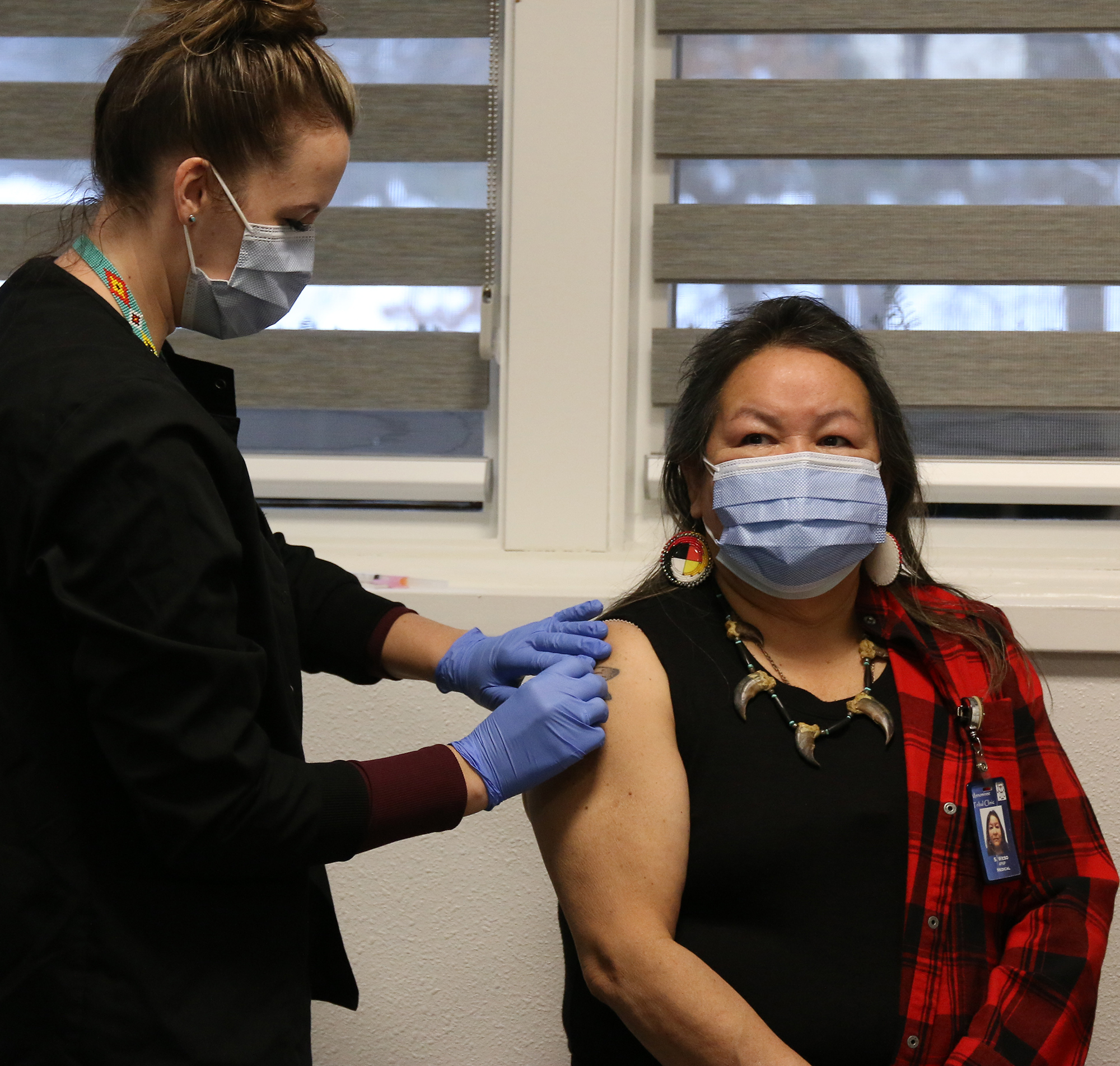
With a small amount of fanfare and a lot of hope, the first COVID-19 vaccines were given to health care professionals and elderly residents of the Menominee Indian Tribe on Dec. 29-30.
The Menominee Tribal Clinic received 100 doses of the new Moderna vaccine, said Amy Slagle, MTC clinical director. The first 21 shots were given to clinic providers and staff on Dec. 29, and another batch was given on Dec. 30.
Three doses were publicly given to medical staff at the clinic, after a short prayer by David Nahwahquaw Grignon, Tribal historic preservation officer.
Sarah Harkey, advanced practice nurse prescriber at the clinic, said she found it “very exciting—I’m honored to be one of the first” to get the vaccine,” she said.
Sue Weso, also an advanced practice nurse prescriber, said she hoped that by getting a vaccine right away, she would be setting an example for other tribal members.
“This is the culmination of a lot of prayers,” Weso said, noting that in the past, “millions of native were dying from what are now vaccine-preventable diseases.” She said she understands that there may be hesitation by Tribal members to accept the vaccine. But as someone who has seen the toll thatCOVID-19 has been on tribal members, she sees it as the way out of the current health care crisis.
“By my actions, I’m demonstrating that I believe in the vaccine,” she said.
The process to get and distribute the vaccines has been months in the making, Slagle said. A team at the clinic has set up the process to give the vaccines and determine the order in which individuals are eligible.
“We are following the CDC and state Department of Health Services guidelines. Phase 1A are staff who deal with known COVID cases and people now on the COVID testing team,” she said. The first group will also include doctors who work with COVID-19 patients, at the hospital, and clinic lab techs and housekeepers who work directly with patients who have COVID-19.
Also on a list to receive vaccines early are some elders in group homes.
“We follow CDC guidelines but as a sovereign nation we have the ability to make decisions that work for our community, so the CDC said 75 and older and we are lowering it to age 65,” Slagle said. She said the clinic’s experience with Native Americans often experiencing additional risk factors at age 65 helped to form that decision.
Slagle was one of the three to receive the vaccine in the public ceremony on Dec. 30. She said she did not have any personal concerns about its safety.
“My only fear is how long it will last,” she said, noting that because the vaccine is so new, there are no others to compare it to. Some vaccines last a lifetime, she said, while others have a more limited effective range.
Despite receiving the vaccine, she noted that she will not be making any change to behaviors, including wearing a mask and practicing social distancing.
“For that to happen you have to have herd immunity, which means somewhere between 70 and 80 percent immunized,” she said.
The vaccine arrives frozen and has to be refrigerated once it thaws. It remains good for a week, and no one working with the program thought there would be a chance that there would be vaccines waiting that long.
Vaccines are available to adults over age 18.
Faye Dodge, a registered nuse who coordinates the vaccination program at the clinic, said she works with the Wisconsin Immunization Registry. Any time someone receives a COVID-19 vaccination, a message is sent to the WIR. This allows the state to ship replacement vaccines as they are needed, she said.
Dodge, who received one of the first doses, said she did not feel any ill effects from the shot.
“I woke up feeling good. My arm didn’t even hurt,” she said, though she counseled that a small reaction to the vaccine is normal and is an indication that it is working.
Slagle said the vaccine team is working on ways to contact various groups within the Tribe to let them know when the vaccine will be available for them. She said some folks are calling already because they are considered “essential workers.” They are essential and will be in group “1B,” she said.
She added that their team expects to get regular deliveries of the vaccine once a week well into the new year. Plans to distribute the vaccines to the public include a system for patients to wait 15 minutes after receiving the shot to make sure there are no ill effects.
The vaccines are free to the clinic and patients.
“There are no barriers to gettine one,” Dodge said.
First COVID-19 vaccines given at Menominee clinic