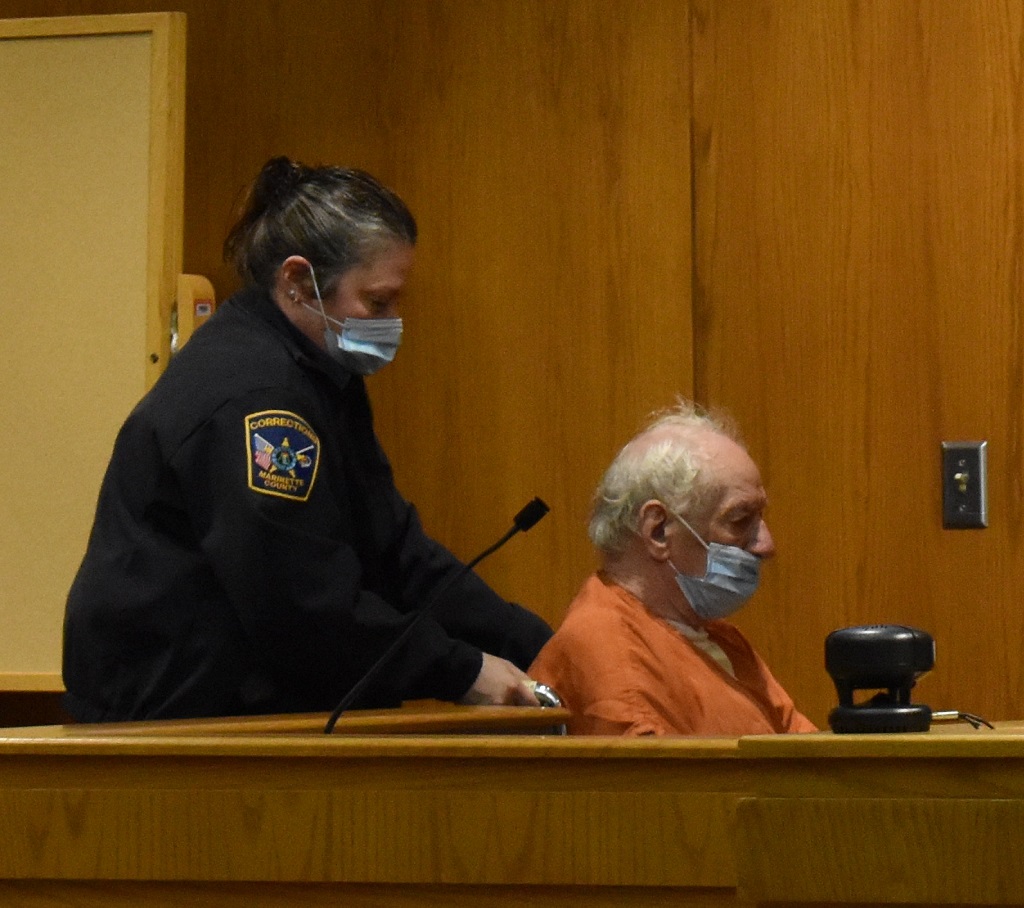
A psychologist hired by the defense was scheduled to meet with an elderly murder suspect Wednesday in Marinette to get a second opinion as to whether the Lakewood man is competent to stand trial for two 1976 murders.
Raymand L. Vanniuewenhoven, 83, is charged in the deaths of David Schuldes, 25, and Ellen Matheys, 24, who were shot and killed July 9, 1976, at the McClintock Park campground in the Marinette County Town of Silver Cliff.
The case went unsolved for decades until modern DNA testing matched evidence found with Matheys’ body to Vannieuwenhoven in 2018, investigators said.
He has been held since the spring at Mendota Mental Health Institution near Madison, where psychologist Anna Garcia determined in June that he was not able to assist in his own defense but had the potential to become competent with treatment.
Garcia more recently found Vannieuwenhoven has recovered to a point where the trial could proceed, prompting the defense to bring in psychologist Kevin Miller of Green Bay.
COVID-19 protocols at Mendota have so far prevented Miller from having a face-to-face meeting with the defendant, who was brought to the Marinette County Jail for a court hearing Monday before Circuit Judge James A. Morrison.
During his testimony, Miller offered to do the examination at the jail, which he said would also give him an opportunity to see the suspect in the environment where the trial would be held.
Miller and the defense team expressed concern because Vannieuwenhoven apparently suffered some kind of serious medical event about a month ago that remains undiagnosed, despite a stay at University of Wisconsin Hospitals.
“First they said he had a stroke, then an MRI showed that he had not had a stroke,” defense attorney Lee Schuchart said. “There’s something going on, but they don’t know what it is.”
Miller said the medical incident is cause for concern and could definitely affect his competency to stand trial.
“I can assess his behavior on any given day, but without knowing the underlying pathology, I can’t fully understand what’s going on,” he said.
From reports he’s read, Miller noted the defendant has diabetes, trouble hearing, some signs of dementia and difficulty controlling his emotions (”He’s a pain in the neck”), all of which could affect his ability to stand trial.
“Could this guy sit in a trial for a week? I couldn’t say,” Miller said, initially saying it could take him five or six months to make a determination.
Mark Williams, a special prosecutor with the state Department of Justice who is helping District Attorney DeShea Morrow prosecute the case, said it’s not Miller’s job to predict how Vannieuwenhoven would fare during a lengthy trial, simply to determine whether he’s competent to assist his own defense.
“I don’t know why this can’t be done in 30 days,” Williams said.
Given his condition and especially the recent medical event, Miller said he is “truly shocked” that Vannieuwenhoven has not been examined by a neurologist since his arrival at Mendota.
“That’s just a basic health care necessity,” he said.
Garcia, who like Miller appeared in court via Zoom video conferencing technology, said the defendant’s diabetes is under control and his hearing is adequate enough that he answers questions when he wants to.
“If it was considered medically necessary for him to see a neurologist, he would have been seen,” Garcia said.
After hearing that Miller was willing to clear his calendar and come to Marinette on Wednesday for the examination, Morrison ordered that Vannieuwenhoven remain in the county jail until that time, to be returned to Mendota after his session with Miller. He also ordered that the defendant’s medical records be released to Miller for his review.
Miller said if all goes well, he can have his report to the court by Oct. 23. Morrison scheduled a competency hearing for 12:30 p.m. Nov. 4 to take testimony whether the suspect can proceed to trial or will need continued institutionalization.
Medical event delays ruling on suspect’s competency