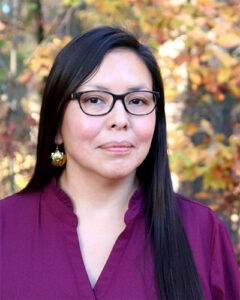
A lesson taught by her grandparents, to give help whenever needed, has been a driving force in the professional life of Jennifer Gauthier, of Shawano, one of six women chosen to receive the University of Wisconsin-Madison 2021-2022 Outstanding Women of Color Award.
The awards were presented at a reception held at the Pyle Center in Madison on March 3.
“It was very emotional for me,” Gauthier said. “I was able to see lots of family and friends after two years (pandemic-related social distancing). Receiving the award was overwhelming in a really good way.”
She learned she was nominated for the award from a colleague, who shared nomination letters with her, which commended her work with UW-Extension.
The honor is presented to women of color among UW-Madison’s faculty, staff, students and greater-Madison community members who have made outstanding contributions in social justice, community service, scholarly research and community building. The areas are all focused on advocacy on behalf of disadvantaged and marginalized populations, teaching on race, ethnicity and indigeneity in U.S. society and/or creating an inclusive and respectful environment for all.
Gauthier, UW-Extension community development educator in Menominee County and the Menominee Indian Tribe of Wisconsin, meets most of those criteria through her job performance. Her office is based at the College of Menominee Nation, and her work focuses on the health needs of the county and tribal residents, adapting Extension programming guidelines to fit the needs of the community.
She noted that her job title is the same in other Wisconsin counties, but the job duties may be different based on each community’s special needs. Backed by UW research, community development educators work with local governments, civic organizations, businesses and community leaders to help people identify critical local concerns, set goals and work on solutions.
Gauthier worked for the tribe for almost 15 years before her Extension position. Her experience with the tribe gave her an in-depth understanding of community and cultural teachings, as well as tribal, state and federal political systems that help her to do the work she currently does through the Extension.
She was brought up on the Menominee Reservation and considers it home. Gauthier has been an integral member of the CMN/University of Michigan/University of New Mexico’s Indigenous Summer Planning Institute, where long-term strategies address sustainable environments.
Gauthier assists the community in seeking wellness through fostering healthy relationships, connection to the land, language preservation and respect for their ancestors.
“When people ask for help, if I can help, I will get involved,” following her grandparents’ examples, Gauthier said.
In her case, this important work ethic has led to her involvement in many areas, topics and efforts on behalf of tribal and county health initiatives.
Her deep connection to the tribal lands is one of the reasons that she has a vision for improving the community’s health. Getting people walking, helping people to eat healthier, building a community of safety by biking in established bike lanes and increasing healthy snack options for after-school events, and improving community gardens, are some of the issues Gauthier is working on.
The involvement of some community partners has helped to increase participation at events, where participants can count on getting healthy foods. She also noted that it is important to include cultural/Indigenous foods at special events.
To help answer the volumes of community questions and improve communications during COVID-19, Gauthier was instrumental in creating and distributing a weekly digital newsletter to county and tribe members. She highlighted information about gardening and cooking and access to resources in the newsletters.
She also included culturally-appropriate information about maintaining social distancing to the members, whose culture places great value on community and large family gatherings. She partnered with the Wisconsin Farm Bureau to provide supplemental meals and dairy products to families, adapting no-contact distribution to community members.
In addition, she has shared the knowledge she’s gained by working through the Extension with Indigenous organizations in Montana, Hawaii, and took two trips to visit the Maori in New Zealand. She links what has been done on the reservation, for example how to create community food gardens, with what the needs are in those remote locations. She said that she also learns from those visits and incorporates their practices into what she does in her Extension work.
Gauthier chuckled about a dream that she has of being able to walk into an area restaurant and “order a hummus and veggie plate.” Working toward this dream to improve the health of the community, she encourages community partners to put healthy food options, and cultural foods, into vending machines. Gauthier’s involvement with the Wisconsin Obesity Prevention Initiative focused on local food policy research, food sovereignty and Indigenous approaches to health and wellness.
“We’re going to get healthy again by power and strength in knowledge and sharing with others listening and learning,” Gauthier stated.
Speaking of the partnerships she’s developed within the tribe and county, Gauthier added: “So many of us are committed to preserving what was passed on, to make sure it’s there for future generations. Our language and our culture all connects to what we do in various ways.”
Giving help where needed has its rewards