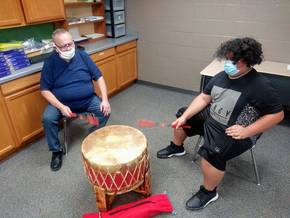
Paying tribute to the rich history of Native Americans, Bowler Elementary School students got immersed into this rich culture during the month of November.
Sixth grade teacher Harold Katchenago, an enrolled Menominee tribal member, often infuses the Native American culture into his lessons, helping pique the curiosity of his students.
Katchenago reflects with great pride his deep roots in the Native American culture and what this month means to him.
“It is a time to remember my elders, veterans and people,” said Katchenago. “A time to remember my people’s way of life, traditions, stories, language, dances and songs. A time to be proud.”
Bowler School District’s student enrollment is nearly half Native Americans, with the majority coming from the Stockbridge-Munsee tribe. Nearly 20 years ago, the Native Americans in attendance at Bowler were about one-third.
“With increased attendance at our school from our Native American community, it is important that we recognize and infuse their culture into our teaching,” said Wade Turner, elementary principal. “Not just for the month of November, but for the entire school year. Our teachers are always looking for resources to reach our students with engaging lessons that teach our students about the rich Native American culture. We can always do a better at recognizing this important culture.”
Although Katchenago infuses Native American history and traditions throughout the school year in his teaching, he pays particular attention during November.
“I try to look at different traditions of my tribe to share with my students and other tribes who call Wisconsin their home,” he said.
Katchenago can also speak from experience. He has performed at pow wows and community feasts, such as the annual sturgeon feast in the spring. He has also attended ceremonies like the sweat lodge.
That personal experience really resonates with his students — both Native and non-Native — as they frequently ask probing questions to learn more about the Native American way of life.
This information is a critical piece of Act 31, a state statute that requires all public schools in Wisconsin and pre-service teaching programs to provide instruction on the history, culture of the state’s federally recognized Indian nations and tribal communities. Staff are encouraged to attend trainings on Act 31 to provide in-depth information and facilitate discussion with their students on American Indian Studies in Wisconsin.
On the school’s morning announcements, students learned about Native American history. This includes Electa Quinney, a member of the Stockbridge-Munsee who became Wisconsin’s first woman public school teacher in the early 1800s, as well as Ada Deer, a member of the Menominee who was the first person to head the U.S. Bureau of Indian Affairs and the first Native American woman to run for the United States Congress.
Deer was also influential in the start-up of the College of Menominee Nation in Keshena, where many Bowler graduates have gone, and where Bowler schools have hired some teaching graduates.
Third grade teacher Lori Mueller has compiled a Native American resource library, including more than 130 items that she shares with her colleagues.
“I hope they enjoy the resources and learn from them as much as I have,” said Mueller.
The school also recognized Rock Your Mocs Day on Nov. 16, an annual event which encourages the wearing of moccasins or turquoise as a way to honor indigenous people worldwide.
Katchenago hopes the information he shares with his students can transcend into a lifetime of understanding among all cultures.
“I hope we can celebrate the unique differences and similarities between native culture and our neighbors around us,” he said. “Hopefully, by sharing, we close gaps of misunderstanding and create bridges of friendship and diversity of peoples.”
Bowler school celebrates Native American Heritage Month