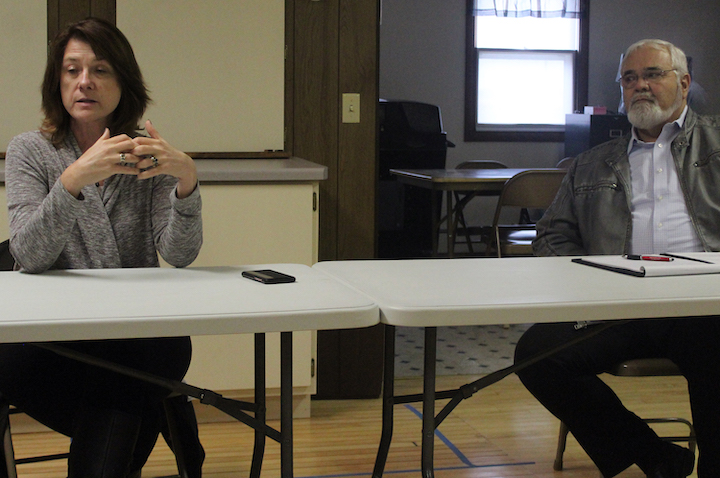
A state budget listening session held by Sen. Mary Felzkowski, R-Tomahawk, and Rep. Jeff Mursau, R-Crivitz, saw sparse attendance March 27 at the Oconto Falls Town Hall, but those who attended had plenty of concerns for the state legislators.
Felzkowski, who sits on the Senate Joint Committee on Finance, noted that certain powers the Wisconsin Legislature had years ago have since been abdicated to the governor. With the potential of an 11% tax hike, according to Felzkowski, being proposed by Gov. Tony Evers, the Legislature is looking at taking some of those powers back.
“It’s basically been decided we’re not going to work off the governor’s budget, but we’re going to work off a base budget,” Felzkowski said. “This means we take the last session’s budget and work off of that.”
Mursau noted that was why the Legislature is also trying to take control of the stimulus money expected to come into the state. Wisconsin is expected to get about $5.2 billion, with $2 billion going to municipalities, counties and school districts. That leaves more than $3 billion that the state has to figure where to spend.
“The governor has a lot of discretion on where he puts it, and he’s the last person to say, that’s where it goes,” Mursau said. “We’re saying that the Senate and the Assembly should have some say in that.”
Felzkowski noted that, when the Great Recession took place in 2009 and federal funds were funneled to states then to help out, then-Gov. Jim Doyle and lawmakers worked out language that allowed for legislative oversight on where the money goes. Back then, the Democrats dominated the Legislature, while Republicans are the majority party now. Because of the party difference, Democrat Evers is not recommending that same level of oversight, she said.
“There is a precedent that was set in 2009,” Felzkowski said. “When huge amounts of federal money came in, the Legislature had a say in where it was assigned. The governor puts out a spending plan, we review it, and we might say, governor, maybe you should do some things over here, or it just goes through. It’s not an active review; it’s a passive review.”
There are also some portions of Evers’ budget where money is being spent before it’s even collected, in Mursau’s view. One example he cited is the governor’s plan to legalize recreational and medical marijuana, which has not been decided by the Legislature.
“We don’t even know what kind of revenue that would bring in,” Mursau said. “There are a number of situations where he does that.”
The legislators also talked about broadband internet access, an issue affecting rural areas across the state. Evers is proposing earmarking $200 million to expand broadband across the state, much more than has been spent in recent years, but the Legislature is looking at spending more than double that, about $500 million.
“This is one-time money that would get our rural areas caught up on broadband, especially those who don’t have it at all,” Mursau said.
“That could be a one-time thing where we’re not growing government and having ongoing costs associated with our spending,” Felzkowski added.
Felzkowski and Mursau also discussed issues involving fire departments and emergency services. Felzkowski noted that ambulance and emergency services were the No. 1 topic she heard at the Oconto Falls listening session and the other three she held on March 27.
“We’re hitting crisis mode around this,” Felzkowski said, noting that some people with ambulance companies she talked to were unable to get contracts with municipalities.
Mursau has a bill circulating in the current legislative session that would put about $25 million into fire and rescue services earmarked for receiving emergency calls. Mursau noted there’s a tax that already exists on phone bills that would pay for this.
Felzkowski said there’s also an issue with unions and volunteer agencies providing fire and emergency medical services. She noted the unions don’t want there to be volunteer fire departments anymore.
“What the big union guys want is for fire and EMS to become essential services,” she said. “If that happens, the state is obligated to provide hundreds of millions of dollars to have full-time fire departments around the state.”
Another topic Felzkowski touched on is term limits in Congress. The state Legislature is examining the possibility of calling an Article V convention to bring that up. So far, 15 states have passed resolutions calling for such a convention, and 12 more states are taking it up. At least 34 states must pass such resolutions to call such a convention, and then 38 states must approve any proposals brought to it.
“It won’t happen overnight,” Felzkowski said. “This is a long haul, but I firmly believe that if we’re going to rein in the federal government, this is the only way we’re going to do it.”
The joint finance committee is expected to discuss the state budget on April 12.
Tax hikes, federal funds discussed by legislators