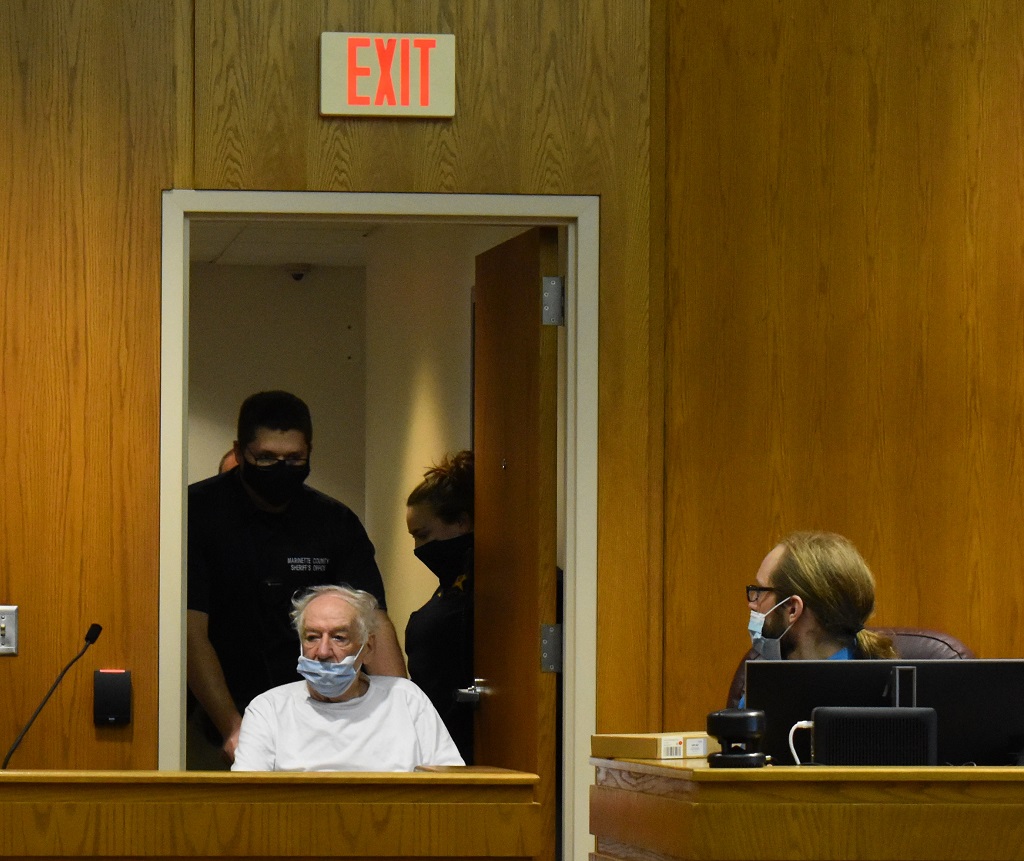
A Lakewood man is back on course to stand trial for a 1976 double murder in Marinette County after being ruled competent to assist in his own defense.
Raymand L. Vannieuwenhoven, 83, is charged with two counts of first-degree murder in connection with the shooting deaths of David Schuldes, 25, and Ellen Matheys, 24, at the McClintock Park campground in the Marinette County Town of Silver Cliff in July 1976.
The case went unsolved for more than 40 years until, investigators say, DNA found with Matheys’ body was positively matched to Vannieuwenhoven in early 2019.
He had been held since spring at Mendota Mental Health Institution near Madison, where psychologist Anna Garcia determined in June that he was not able to assist in his own defense but had the potential to become competent again with treatment.
Garcia more recently found Vannieuwenhoven has recovered to a point where the trial could proceed, prompting the defense to bring in psychologist Kevin Miller of Green Bay for a second opinion.
Miller’s report also found the defendant competent to continue, and during a Nov. 4 hearing in Marinette County Circuit Court, attorney Travis Crowell told Judge James A. Morrison that the defense would not contest Miller’s conclusions.
Morrison asked Vannieuwenhoven directly if he thinks he’s competent to stand trial, and the response was, “Yeah.”
“All right,” the judge said, “So it seems to me that you think you are, your doctors both think you are, the state thinks you are, and your lawyers, so who am I to say they’re all wrong? I’m going to find that you are competent to proceed in this case going forward.”
Morrison said the defendant will now remain at the Marinette County Jail, having been released from Mendota, and he reinstated bail at $1 million cash. Crowell said the defense does intend to file a bail modification motion. Motions must be filed by Dec. 2, with replies due Dec. 16 and a motion hearing Jan. 29.
A two-week jury trial has been scheduled beginning July 19 and a final pre-trial conference June 22.
Crowell’s co-counsel, Lee Schuchart, told Morrison he has done some case-law research regarding potential challenges to investigators’ searches but would like to file a more complete brief after the evidentiary hearing in January.
“I would still like to file a motion ahead of time to have the hearing, so I’d put everybody on notice as to what the issues are, but then I would like to have the evidentiary hearing and then a briefing schedule after that,” Schuchart said.
Special prosecutor Mark Williams, who is working on the case with District Attorney DeShea Morrow, said he agreed that it would be helpful to be able to file written briefs after the motion hearing.
“I have no problem giving both of you the opportunity to write briefs to basically argue how the facts fit into the law as the facts have been shown at the hearing,” Morrison said,” but I don’t want to come in here on the 29th and have either side get ambushed by the position of the other … so you’ve got to tell us what the challenge is by Dec. 2.”
At Schuchart’s request Morrison also asked prosecutors to submit a preliminary witness list by Dec. 2, including any experts who would be interpreting the autopsy report, which was conducted in 1976 by a pathologist who has since passed away.
Both sides said they planned to introduce motions. While the defense may challenge aspects of the search, prosecutors are preparing a motion to allow testimony regarding past actions by the defendant that might show a proclivity to commit the murders.
As the hearing drew to a close, Morrison addressed about a half-dozen members of the victims’ families who attended the session, especially with regard to the length of time the case is taking, with a trial scheduled more than two years after the original arrest.
“This is a very complicated case,” Morrison said. “It requires state-of-the-art scientific evidence and actions that are claimed to have occurred decades ago … There’s a lot of work on the part of the attorneys to try to get their arms around all those facts.”
COVID-19 concerns have limited the amount of resources available, he added.
“We have one courtroom in this courthouse that the county has built for us specifically to be able to try cases in a large enough courtroom so that we can socially distance,” Morrison said. “I’ve no idea how long COVID’s going on, but we have to assume that it’s going on for a while yet.”
The judge said no one is trying to slow down the process.
“I know it’s burdensome to everybody involved — the victim’s families, and the defendant and his family, and certainly the court system,” he said. “Nobody here is doing anything to slow-walk this case, I assure you.”
1976 double-murder trial scheduled next July